 Uyiyiphi idayinaso? Ikwizi
 Idabi leedayinaso
 Ugqatso lweedayinaso
 Imidlalo emincinci yeedayinaso
 I-albhamu yezitikha
 Iilisti ze-TOP zeedayinaso
 Ndothuse!
Magnamanus
Magnamanus was a big, plant-eating dinosaur that lived in what is now Spain about 130 million years ago. It had huge hands with a thumb spike and a fifth finger, which helped it grab plants. This dinosaur was as long as a bus and weighed as much as a small car.1
Yaphila nini?
Yayinkulu kangakanani?
Yayinde kangakanani?
Yayiphakame kangakanani?
uqikelelo
Yayinzima kangakanani?
 inde njengeemoto ezingama-2 zipakwe zilandelelana🍌inde njengeebhanana ezingama-56 zilandelelana
 inzima njengezinja ezingama-150🍉inzima njengamavatala angama-600🎒inzima njengamagumbi okufundela apheleleyo abantwana angama-4🐻❄️inzima njengeebhere ezimhlophe ezingama-7🏃ibinokubaleka iimitha ezili-100 ngemizuzwana engama-15 (oyena mntu ukhawulezayo udinga i-9,6)
Magnamanus wayemkhulu kangakanani xa ethelekiswa NAWE?
Yimathematika nje kwibhrawuza yakho. Akukho nto igcinwayo okanye ithunyelwe naphi na.
Yayikhawuleza kangakanani?


Iinyani ezimnandi
Magnamanus had a hand that was very wide, with the wrist making up 70% of the hand's length.1
Its thumb had a sharp spike, similar to the famous Iguanodon, which might have been used for defense or digging.1
The name Magnamanus means 'large hand' in Latin, because its hands were big compared to its body.1
This dinosaur lived during the Early Cretaceous period, about 130 million years ago, in a warm, wet environment with rivers and lakes.1
The skeleton of Magnamanus was found scattered over an area of eight square meters, but all bones belonged to one old adult.1
Magnamanus is a styracosternan, a group of plant-eating dinosaurs that includes Iguanodon and its close relatives.1
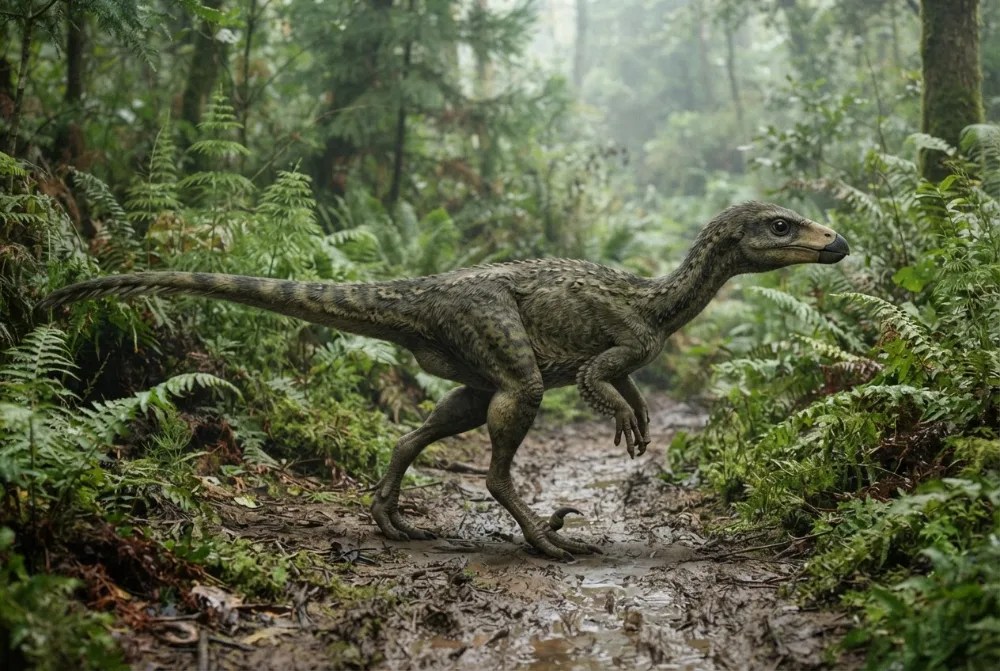
Eyona mibuzo ibuzwa kakhulu: Magnamanus
?How big was Magnamanus?
Magnamanus was about 9 to 10 metres long and weighed around 3 tonnes, about the size of a bus and as heavy as a large elephant.1
?What did Magnamanus eat?
Magnamanus was a herbivore, meaning it ate plants. It used its big hands and thumb spike to grab and pull plants.1
?Why is it called Magnamanus?
The name Magnamanus means 'large hand' in Latin, because its hands were big compared to its body.1
?Where was Magnamanus found?
Magnamanus was found in the Golmayo Formation near Soria, Spain. Its skeleton was discovered in a marsh area called Zorralbo I.1
Kwiingcali zeedayinaso
- Igama lenzululwazi
- Magnamanus
- Inikwe igama ngu:
- Fuentes Vidarte et al. 20162
- Iqela
- Izitya-zityalo ezinemilomo
- Usapho / iclade
- Styracosterna2
- Ukuhlelwa
- Ornithischia > Ornithopoda > Iguanodontia2
- Ubudala bamatye
- 133 ukuya ku-121 izigidi zeminyaka (Hauterivian / Barremian)2
- Izakhiwo zamatye
- Golmayo2
- Amazwe
- iSpeyin2
- Iirekhodi zeefosili
- 1 kwi-Paleobiology Database2
- Ukufunyanwa
- Magnamanus was discovered between 2000 and 2004 by Carolina Fuentes and Manuel Meijide, along with their children, at the Zorralbo I site near Soria, Spain. It was named and described in 2016 by Fuentes Vidarte and colleagues.1
- Kusaxoxwa ngayo
- Scientists are still debating exactly where Magnamanus fits on the family tree of iguanodontian dinosaurs, as it has some unique features in its hands and wrists.1
Apho iinyani zivela khona
- Magnamanus (en.wikipedia.org)
- Magnamanus in The Paleobiology Database (CC BY 4.0): ubudala, iindawo, izakhiwo zamatye, ukuhlelwa.
Yonke inyani ekweli phepha inenombolo ebonisa umthombo wayo. Ukuba siphosisile, uxolo, sithanda iidayinaso, asiyojenali yenzululwazi. Sixelele apha: [email protected], siya kuyilungisa.
 URex ulambile! I-Dino Wiki yiprojekthi katata ukwenzela unyana wakhe othanda iidayinaso, isimahla, ayinazintengiso, ayinazilandeli. Abantu abadala banokuphakela uRex isidlwana ukuze incede ihlale kwi-intanethi.Phakela uRex
 Iguanodon
 Tenontosaurus
 Thescelosaurus
 Zalmoxes
 Camptosaurus
 Rhabdodon
 Stegosaurus
 Archaeopteryx
 Giganotosaurus
 Microraptor
 Deinonychus
 Baryonyx