 Uyiyiphi idayinaso? Ikwizi
 Idabi leedayinaso
 Ugqatso lweedayinaso
 Imidlalo emincinci yeedayinaso
 I-albhamu yezitikha
 Iilisti ze-TOP zeedayinaso
 Ndothuse!
Malawania
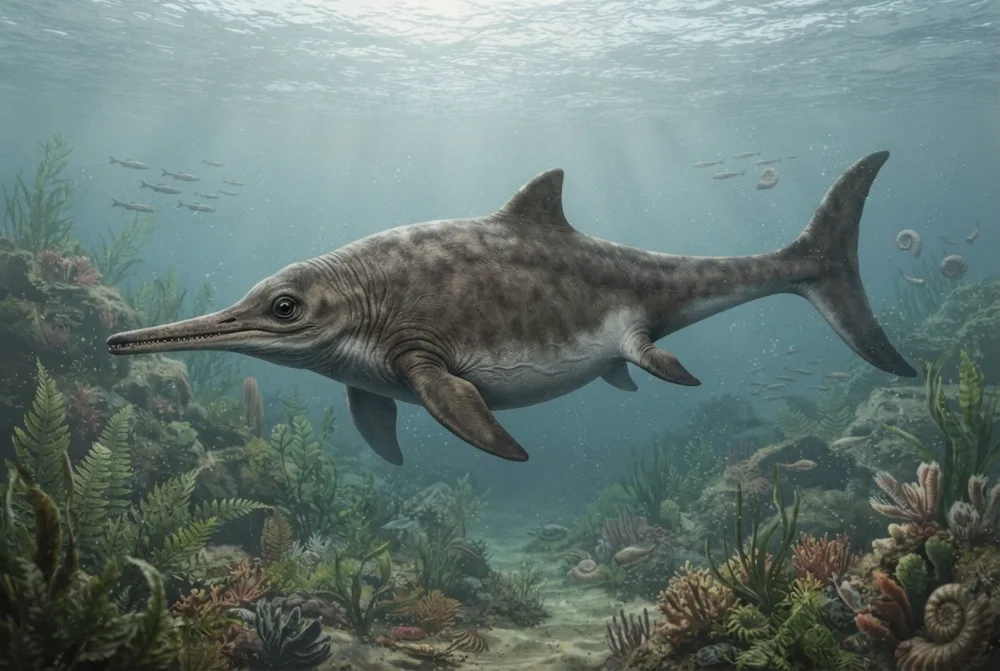
Malawania was a small ichthyosaur that lived in the Early Cretaceous seas. It looked a bit like a dolphin, with flippers instead of legs and a long snout. It is special because it was one of the last ichthyosaurs that did not belong to the ophthalmosaurid group.12
Yaphila nini?
Yayinkulu kangakanani?
Yayinde kangakanani?
 inde njengezinja ezingama-3, impumlo ukuya emsileni🍌inde njengeebhanana ezingama-17 zilandelelana🏊ibinokuqubha ubude bechibi elikhulu lokuqubha (50 m) ngemizuzwana engama-3.8
Malawania wayemkhulu kangakanani xa ethelekiswa NAWE?
Yimathematika nje kwibhrawuza yakho. Akukho nto igcinwayo okanye ithunyelwe naphi na.
Yayikhawuleza kangakanani?


Iinyani ezimnandi
Malawania is the first non-ophthalmosaurid ichthyosaur known from after the Jurassic,Cretaceous boundary, meaning it survived a time when most of its relatives had died out.1
Its scientific name means 'out-of-time swimmer' because it seemed to belong to an earlier time period.1
The only fossil of Malawania was found in 1952, but scientists did not know its age until 2013 when they studied tiny fossils called palynomorphs in the rock.2
Malawania had a short, trapezoid-shaped humerus (upper arm bone) and an intermedium bone in its flipper that was almost as big as the radius.2
Its forefin had four main fingers and no extra digits, unlike many later ichthyosaurs.2
The fossil was found in Iraq, which is the first post-Triassic ichthyosaur ever reported from the Middle East.2
Eyona mibuzo ibuzwa kakhulu: Malawania
?How big was Malawania?
About 3 metres (9.8 feet) long. That is roughly as long as a small car.1
?What did Malawania eat?
Scientists are not sure exactly, but like other ichthyosaurs it probably ate fish and squid. Its long snout and sharp teeth were good for catching slippery prey.1
?When did Malawania live?
It lived during the Early Cretaceous period, about 130 to 125 million years ago. That is after most of its relatives had already died out.12
?Where was Malawania found?
The only fossil was discovered in 1952 in Iraqi Kurdistan, near the town of Amadia. It is the first post-Triassic ichthyosaur ever found in the Middle East.1
Kwiingcali zeedayinaso
- Igama lenzululwazi
- Malawania
- Inikwe igama ngu:
- Fischer et al. 20133
- Iqela
- Ii-ichthyosauri
- Usapho / iclade
- Thunnosauria3
- Ukuhlelwa
- Ichthyosauria > Ichthyosauromorpha3
- Ubudala bamatye
- 133 ukuya ku-121 izigidi zeminyaka (Hauterivian / Barremian)3
- Amazwe
- i-Iraq3
- Iirekhodi zeefosili
- 1 kwi-Paleobiology Database3
- Ukufunyanwa
- The only known fossil of Malawania was discovered in 1952 near Amadia in Iraq. It was named Malawania anachronus by Fischer and colleagues in 2013.12
- Kusaxoxwa ngayo
- Scientists are still debating exactly how Malawania is related to other ichthyosaurs, because it has a mix of ancient and modern features.2
Apho iinyani zivela khona
- Malawania (en.wikipedia.org)
- biblio.naturalsciences.be (biblio.naturalsciences.be)
- Malawania in The Paleobiology Database (CC BY 4.0): ubudala, iindawo, izakhiwo zamatye, ukuhlelwa.
Yonke inyani ekweli phepha inenombolo ebonisa umthombo wayo. Ukuba siphosisile, uxolo, sithanda iidayinaso, asiyojenali yenzululwazi. Sixelele apha: [email protected], siya kuyilungisa.
 URex ulambile! I-Dino Wiki yiprojekthi katata ukwenzela unyana wakhe othanda iidayinaso, isimahla, ayinazintengiso, ayinazilandeli. Abantu abadala banokuphakela uRex isidlwana ukuze incede ihlale kwi-intanethi.Phakela uRex
 Ichthyosaurus
 Platypterygius
 Stenopterygius
 Khudiakovia
 Ophthalmosaurus
 Chonespondylus
 Stegosaurus
 Iguanodon
 Archaeopteryx
 Giganotosaurus
 Microraptor
 Deinonychus