 Uyiyiphi idayinaso? Ikwizi
 Idabi leedayinaso
 Ugqatso lweedayinaso
 Imidlalo emincinci yeedayinaso
 I-albhamu yezitikha
 Iilisti ze-TOP zeedayinaso
 Ndothuse!
Yaphila nini?

Yayinkulu kangakanani?
Yayiphakame kangakanani?
Yayinzima kangakanani?
Mirarce wayemkhulu kangakanani xa ethelekiswa NAWE?
Yimathematika nje kwibhrawuza yakho. Akukho nto igcinwayo okanye ithunyelwe naphi na.
Yayikhawuleza kangakanani?


Iinyani ezimnandi
Its fossil was discovered in 1992 but was not officially named until 2018.1
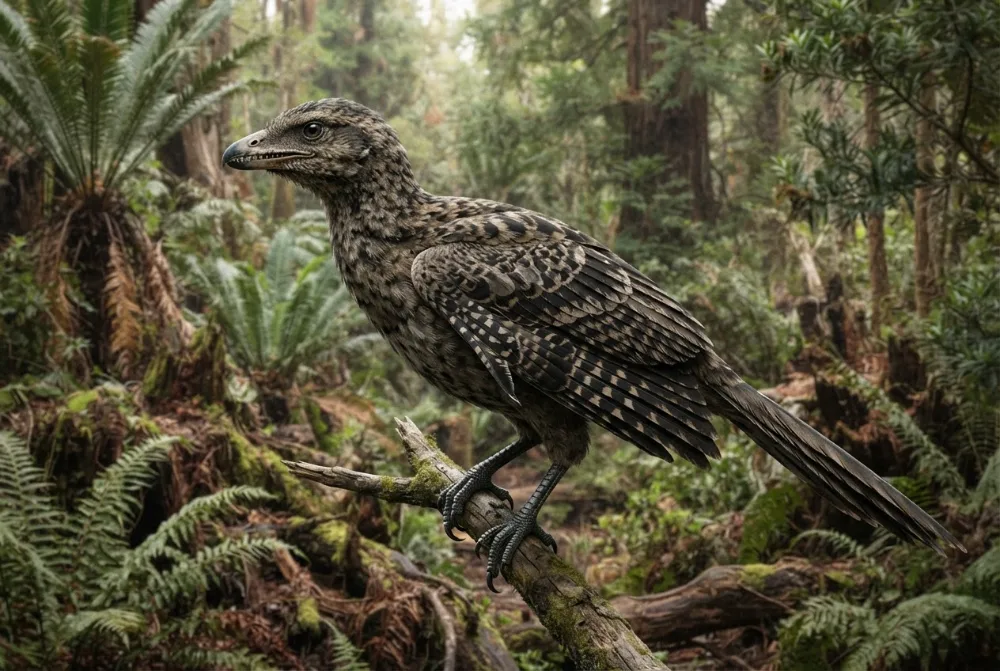
Mirarce had quill knobs on its ulna bone, which are bumps that help anchor flight feathers. This is the first time such knobs have been found in enantiornithine birds.21
It had a deeply keeled sternum (breastbone) and a narrow furcula (wishbone), features that improved its flight abilities.2
Mirarce lived during the Campanian age of the Late Cretaceous, about 76 to 74 million years ago.1
Its name combines Latin 'mirus' (wonderful) and the Greek messenger Arke, referring to its well-preserved flight-related features.1
Eyona mibuzo ibuzwa kakhulu: Mirarce
?Was Mirarce a dinosaur?
Yes, Mirarce was a bird, and birds are a type of dinosaur called avialan theropods. So it was a dinosaur, but not a non-avian dinosaur like T. rex.1
?How big was Mirarce?
Mirarce was about the size of a turkey vulture, growing to around 60 cm tall. It weighed about 0.45 kg.13
?What did Mirarce eat?
Mirarce was a raptorial predator, meaning it hunted and ate other animals. It had powerful talons and leg tendons, similar to modern birds of prey.1
?When did Mirarce live?
Mirarce lived during the Campanian age of the Late Cretaceous, about 76 to 74 million years ago.1
Kwiingcali zeedayinaso
- Igama lenzululwazi
- Mirarce
- Inikwe igama ngu:
- Atterholt et al. 20184
- Iqela
- Iintaka zokuqala
- Usapho / iclade
- Avisauridae4
- Ukuhlelwa
- Theropoda > Avialae4
- Ubudala bamatye
- 84 ukuya ku-72 izigidi zeminyaka (Campanian)4
- Izakhiwo zamatye
- Kaiparowits4
- Amazwe
- iUSA4
- Iirekhodi zeefosili
- 1 kwi-Paleobiology Database4
- Ukufunyanwa
- The fossil was collected in 1992 by Howard Hutchison in Utah. It was studied and named by Jesse Atterholt and colleagues in 2018, who called it Mirarce eatoni in honor of paleontologist Jeffrey Eaton.1
- Kusaxoxwa ngayo
- Scientists are still debating how enantiornithine birds like Mirarce compare to modern birds in terms of flight abilities and evolutionary relationships.2
Apho iinyani zivela khona
- Mirarce (en.wikipedia.org)
- The most complete enantiornithine from North America and a phylogenetic analysis of the Avisauridae (pmc.ncbi.nlm.nih.gov)
- Rare fossil bird deepens mystery of avian extinctions (vcresearch.berkeley.edu)
- Mirarce in The Paleobiology Database (CC BY 4.0): ubudala, iindawo, izakhiwo zamatye, ukuhlelwa.
Yonke inyani ekweli phepha inenombolo ebonisa umthombo wayo. Ukuba siphosisile, uxolo, sithanda iidayinaso, asiyojenali yenzululwazi. Sixelele apha: [email protected], siya kuyilungisa.
 URex ulambile! I-Dino Wiki yiprojekthi katata ukwenzela unyana wakhe othanda iidayinaso, isimahla, ayinazintengiso, ayinazilandeli. Abantu abadala banokuphakela uRex isidlwana ukuze incede ihlale kwi-intanethi.Phakela uRex
 Archaeopteryx
 Hesperornis
 Ichthyornis
 Baptornis
 Jurapteryx
 Gobipteryx
 Tyrannosaurus
 Triceratops
 Velociraptor
 Spinosaurus
 Ankylosaurus
 Parasaurolophus