 Uyiyiphi idayinaso? Ikwizi
 Idabi leedayinaso
 Ugqatso lweedayinaso
 Imidlalo emincinci yeedayinaso
 I-albhamu yezitikha
 Iilisti ze-TOP zeedayinaso
 Ndothuse!
Navaornis
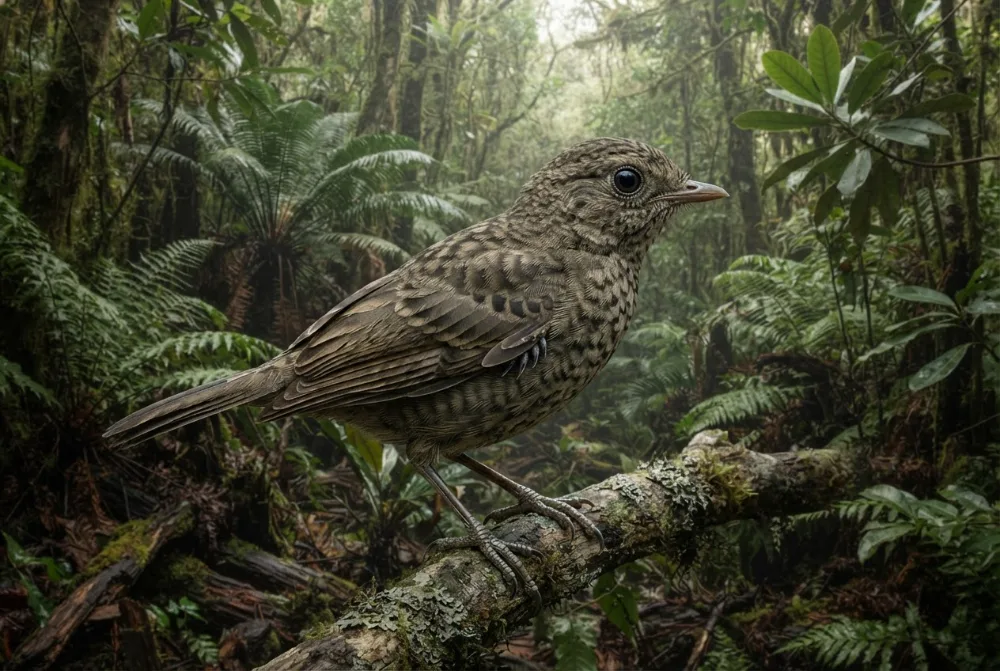
Navaornis was a starling-sized bird that lived about 80 million years ago in what is now Brazil. It had a toothless, large-eyed skull that looked almost like a modern bird, but it belonged to an ancient group called enantiornithines. Its beautifully preserved skull let scientists see inside its brain for the first time in such an old bird.12
Yaphila nini?
Yayikhawuleza kangakanani?


Iinyani ezimnandi
Navaornis had a toothless skull with large eyes, just like many birds today, but its brain still had some ancient features like a small cerebellum and a weakly expanded telencephalon.1
Its skull is the best-preserved Mesozoic bird skull ever found, preserved in three dimensions without being flattened.1
The fossil site where Navaornis was found is very small, only about 6 square meters, but it has yielded hundreds of enantiornithine bird bones.1
Navaornis belongs to a group called Enantiornithes, which were the most diverse birds of the Mesozoic and lived on every continent except Antarctica.12
Its inner ear (bony labyrinth) was shaped like that of many modern birds but was much larger.1
Kwiingcali zeedayinaso
- Igama lenzululwazi
- Navaornis
- Inikwe igama ngu:
- Chiappe et al. 20243
- Iqela
- Iintaka zokuqala
- Usapho / iclade
- Enantiornithes3
- Ukuhlelwa
- Theropoda > Avialae3
- Ubudala bamatye
- 84 ukuya ku-66 izigidi zeminyaka (Campanian / Maastrichtian)3
- Izakhiwo zamatye
- Adamantina3
- Amazwe
- iBrazil3
- Iirekhodi zeefosili
- 1 kwi-Paleobiology Database3
- Ukufunyanwa
- The fossil site was discovered in 2004 by William Nava, and the holotype skull was found in 2016. The species was named Navaornis hestiae by Chiappe and colleagues in 2024.13
- Kusaxoxwa ngayo
- Scientists are still debating exactly how Navaornis is related to other enantiornithines, because its toothless skull and modern-looking head make it hard to place in the family tree.1
Apho iinyani zivela khona
- Cretaceous bird from Brazil informs the evolution of the avian skull and brain | Nature (nature.com)
- Cretaceous bird from Brazil informs the evolution of the avian skull and brain (pmc.ncbi.nlm.nih.gov)
- Navaornis in The Paleobiology Database (CC BY 4.0): ubudala, iindawo, izakhiwo zamatye, ukuhlelwa.
Yonke inyani ekweli phepha inenombolo ebonisa umthombo wayo. Ukuba siphosisile, uxolo, sithanda iidayinaso, asiyojenali yenzululwazi. Sixelele apha: [email protected], siya kuyilungisa.
 URex ulambile! I-Dino Wiki yiprojekthi katata ukwenzela unyana wakhe othanda iidayinaso, isimahla, ayinazintengiso, ayinazilandeli. Abantu abadala banokuphakela uRex isidlwana ukuze incede ihlale kwi-intanethi.Phakela uRex
 Archaeopteryx
 Hesperornis
 Ichthyornis
 Baptornis
 Jurapteryx
 Gobipteryx
 Tyrannosaurus
 Triceratops
 Velociraptor
 Spinosaurus
 Ankylosaurus
 Parasaurolophus