 Uyiyiphi idayinaso? Ikwizi
 Idabi leedayinaso
 Ugqatso lweedayinaso
 Imidlalo emincinci yeedayinaso
 I-albhamu yezitikha
 Iilisti ze-TOP zeedayinaso
 Ndothuse!
Nichollssaura
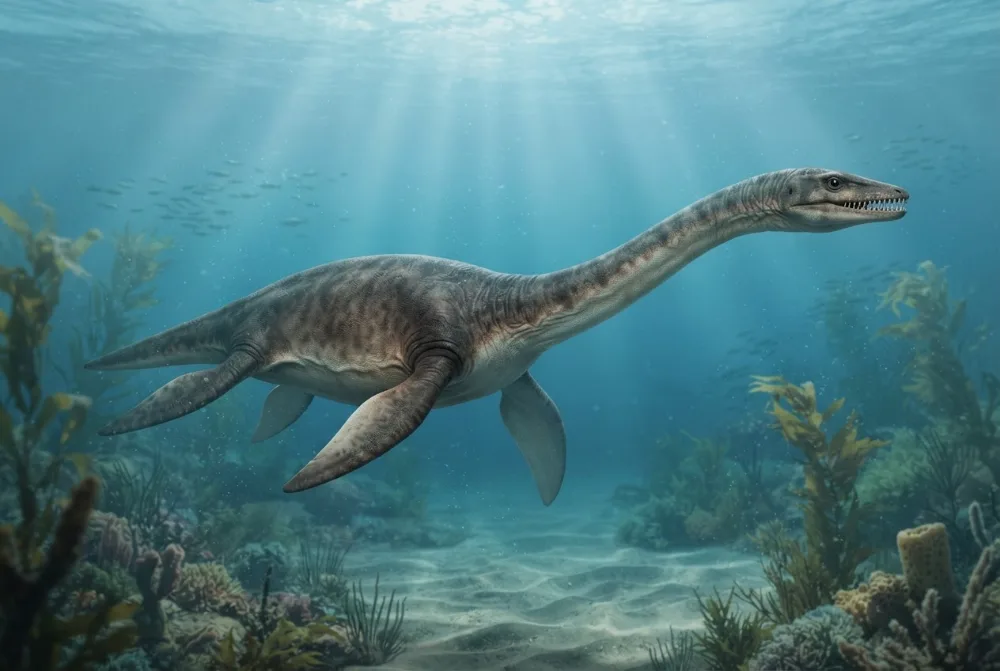
Nichollssaura was a small, fast-swimming marine reptile that lived in the ancient seas of North America. It had a long neck, four flippers, and a mouth full of sharp teeth for catching fish.1
Yaphila nini?
Yayinkulu kangakanani?
Yayinde kangakanani?
Yayinzima kangakanani?
 inde njengezinja ezingama-3, impumlo ukuya emsileni🍌inde njengeebhanana ezingama-16 zilandelelana🍉inzima njengamavatala angama-27🧸inzima njengabantwana basenkulisa abangama-7🎒inzima njengabantwana besikolo abangama-4🏊ibinokuqubha ubude bechibi elikhulu lokuqubha (50 m) ngemizuzwana engama-6.4
Nichollssaura wayemkhulu kangakanani xa ethelekiswa NAWE?
Yimathematika nje kwibhrawuza yakho. Akukho nto igcinwayo okanye ithunyelwe naphi na.
Yayikhawuleza kangakanani?


Iinyani ezimnandi
Nichollssaura fills a 40-million-year gap in the fossil record of North American plesiosaurs, meaning no plesiosaur fossils from that time were known before its discovery.1
The only known skeleton was accidentally discovered by a 100-ton electric shovel operator in an oilsand mine near Fort McMurray, Alberta, in 1994.1
The fossil is almost complete, missing only a few bones like the left forelimb and some ribs, which were lost when the shovel hit the skeleton.1
Inside the stomach of the Nichollssaura fossil, scientists found 165 gastroliths (stomach stones) made of chert and quartzite, which may have helped it digest food.1
The gastroliths in Nichollssaura are similar to those found in another plesiosaur from the same area, Wapuskanectes, suggesting both animals collected stones from the same ancient beaches.1
Kwiingcali zeedayinaso
- Igama lenzululwazi
- Nichollssaura
- Inikwe igama ngu:
- Druckenmiller and Russell 20092
- Iqela
- Iiplesiosauri
- Usapho / iclade
- Leptocleididae2
- Ukuhlelwa
- Plesiosauria > Sauropterygia2
- Ubudala bamatye
- 113 ukuya ku-100 izigidi zeminyaka (Albian)2
- Izakhiwo zamatye
- Clearwater2
- Amazwe
- iKhanada2
- Iirekhodi zeefosili
- 1 kwi-Paleobiology Database2
- Ukufunyanwa
- The fossil was discovered in 1994 by shovel operators Greg Fisher and Lorne Cundal in an oilsand mine near Fort McMurray, Alberta. It was named Nichollsia borealis in 2008 by Druckenmiller and Russell, but renamed Nichollssaura borealis in 2009 because the original name was already taken.12
- Kusaxoxwa ngayo
- Scientists are not sure exactly where Nichollssaura collected its stomach stones, but they think it may have swum westward to gather rocks from the Cadomin Formation, which is 8 to 10 million years older than the plesiosaur itself.1
Apho iinyani zivela khona
- Nichollssaura (en.wikipedia.org)
- Nichollssaura in The Paleobiology Database (CC BY 4.0): ubudala, iindawo, izakhiwo zamatye, ukuhlelwa.
Yonke inyani ekweli phepha inenombolo ebonisa umthombo wayo. Ukuba siphosisile, uxolo, sithanda iidayinaso, asiyojenali yenzululwazi. Sixelele apha: [email protected], siya kuyilungisa.
 URex ulambile! I-Dino Wiki yiprojekthi katata ukwenzela unyana wakhe othanda iidayinaso, isimahla, ayinazintengiso, ayinazilandeli. Abantu abadala banokuphakela uRex isidlwana ukuze incede ihlale kwi-intanethi.Phakela uRex
 Elasmosaurus
 Pliosaurus
 Plesiosaurus
 Cimoliasaurus
 Colymbosaurus
 Trinacromerum
 Stegosaurus
 Iguanodon
 Archaeopteryx
 Giganotosaurus
 Microraptor
 Deinonychus