 Uyiyiphi idayinaso? Ikwizi
 Idabi leedayinaso
 Ugqatso lweedayinaso
 Imidlalo emincinci yeedayinaso
 I-albhamu yezitikha
 Iilisti ze-TOP zeedayinaso
 Ndothuse!
Yaphila nini?

Yayinkulu kangakanani?
Yayinde kangakanani?
Yayiphakame kangakanani?
uqikelelo
Yayinzima kangakanani?
 inde njengezinja ezingama-5, impumlo ukuya emsileni🍌inde njengeebhanana ezingama-28 zilandelelana🍉inzima njengamavatala angama-100🧸inzima njengabantwana basenkulisa abangama-26🎒inzima njengabantwana besikolo abangama-16🏃ibinokubaleka iimitha ezili-100 ngemizuzwana engama-9.5 (oyena mntu ukhawulezayo udinga i-9,6)
Owenodon wayemkhulu kangakanani xa ethelekiswa NAWE?
Yimathematika nje kwibhrawuza yakho. Akukho nto igcinwayo okanye ithunyelwe naphi na.
Yayikhawuleza kangakanani?


Iinyani ezimnandi
Owenodon is known mostly from a partial lower jaw with ten teeth, found in a limestone block.1
It was first named Iguanodon hoggii by Richard Owen in 1874, honoring naturalist A.J. Hogg who collected the fossil.1
The jaw was damaged while stored in a museum collection, breaking one tooth crown and part of the bone.1
Owenodon lived in a warm, Mediterranean-like climate with lakes, lagoons, and salty marshes.1
Scientists think Owenodon was an intermediate ornithopod, between Camptosaurus and Iguanodon in evolution.1
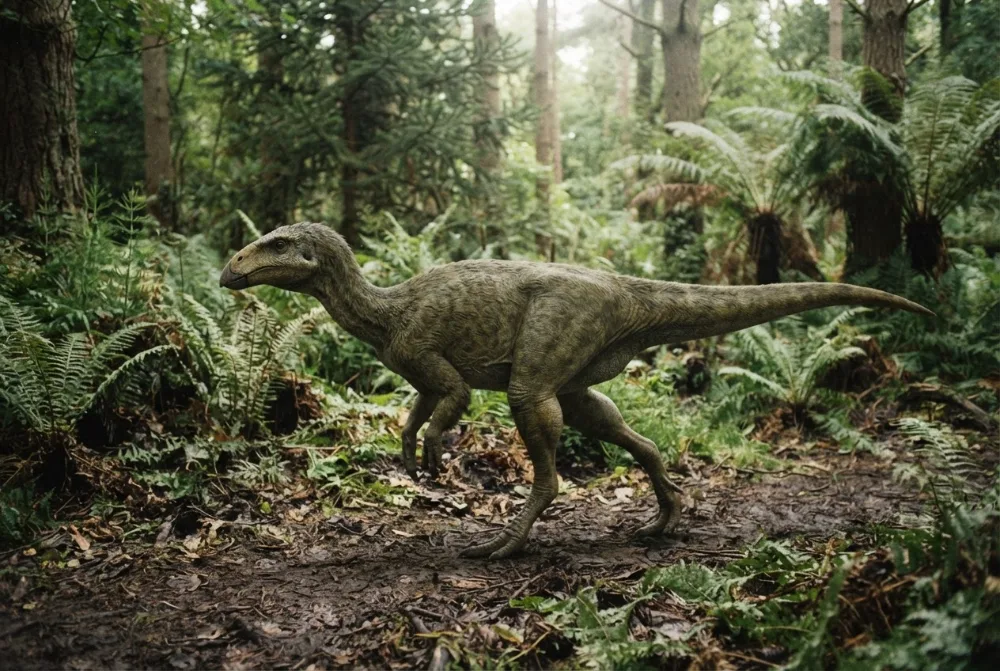
Eyona mibuzo ibuzwa kakhulu: Owenodon
?How big was Owenodon?
Scientists do not know for sure, because only a partial lower jaw has been found. It was probably a small ornithopod, but no exact size is known.1
?When did Owenodon live?
Owenodon lived during the Early Cretaceous, about 140 million years ago, in the Berriasian stage.1
?Where was Owenodon found?
The only definite Owenodon fossil was found in Dorset, United Kingdom, in the Lulworth Formation. Some teeth from Romania and Spain may also belong to it.1
Kwiingcali zeedayinaso
- Igama lenzululwazi
- Owenodon
- Inikwe igama ngu:
- Galton 20093
- Iqela
- Izitya-zityalo ezinemilomo
- Usapho / iclade
- Dryomorpha3
- Ukuhlelwa
- Ornithischia > Ornithopoda > Iguanodontia3
- Ubudala bamatye
- 149 ukuya ku-137 izigidi zeminyaka (Tithonian / Berriasian)3
- Izakhiwo zamatye
- Lower Bauxite, Lulworth3
- Amazwe
- iRomania, iUnited Kingdom3
- Iirekhodi zeefosili
- 6 kwi-Paleobiology Database3
- Ukufunyanwa
- The fossil was discovered by A.J. Hogg in the Purbeck Limestone of Dorset, England, and described by Richard Owen in 1874 as Iguanodon hoggii. It was given its own genus Owenodon by Peter Galton in 2009.1
- Kusaxoxwa ngayo
- Scientists are not sure exactly where Owenodon fits in the ornithopod family tree, because the fossils are so few and incomplete.1
Apho iinyani zivela khona
- Owenodon (en.wikipedia.org)
- Owenodon hoggii | Dinosaur Database by DinoAnimals.com (dinoanimals.com)
- Owenodon in The Paleobiology Database (CC BY 4.0): ubudala, iindawo, izakhiwo zamatye, ukuhlelwa.
Yonke inyani ekweli phepha inenombolo ebonisa umthombo wayo. Ukuba siphosisile, uxolo, sithanda iidayinaso, asiyojenali yenzululwazi. Sixelele apha: [email protected], siya kuyilungisa.
 URex ulambile! I-Dino Wiki yiprojekthi katata ukwenzela unyana wakhe othanda iidayinaso, isimahla, ayinazintengiso, ayinazilandeli. Abantu abadala banokuphakela uRex isidlwana ukuze incede ihlale kwi-intanethi.Phakela uRex
 Iguanodon
 Tenontosaurus
 Thescelosaurus
 Zalmoxes
 Camptosaurus
 Rhabdodon
 Stegosaurus
 Archaeopteryx
 Giganotosaurus
 Microraptor
 Deinonychus
 Baryonyx