 Uyiyiphi idayinaso? Ikwizi
 Idabi leedayinaso
 Ugqatso lweedayinaso
 Imidlalo emincinci yeedayinaso
 I-albhamu yezitikha
 Iilisti ze-TOP zeedayinaso
 Ndothuse!
Palatodonta
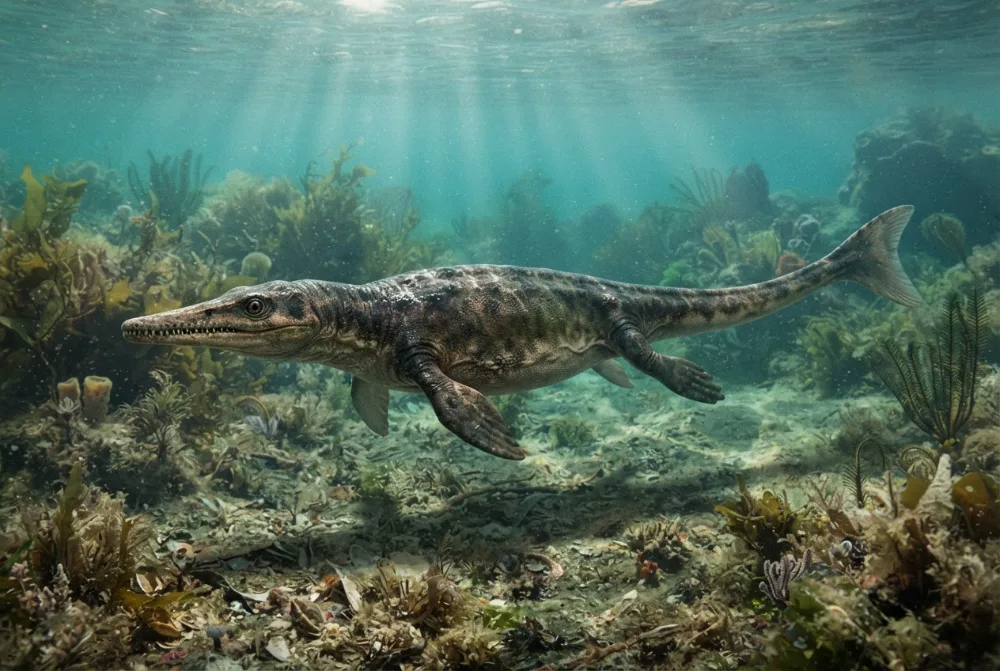
Palatodonta was a small marine reptile that lived in the sea about 245 million years ago. It had a row of pointed teeth on the roof of its mouth, which it probably used to sift through soft mud for tiny prey. It was an early cousin of the placodonts, reptiles with flat crushing teeth for eating shellfish.12
Yaphila nini?
Yayikhawuleza kangakanani?


Iinyani ezimnandi
Palatodonta had a single row of at least 10 narrow, pointed teeth on its palate, which is different from the broad, flat crushing teeth of later placodonts.1
Its front teeth were blunt, peg-like, and slightly forward-pointing, similar to those of the placodont Placodus, which used them to pick up hard-shelled prey.1
The only known fossil is a juvenile skull, so scientists think it was a young animal when it died.1
Palatodonta lived in the early Middle Triassic, about 247 to 241 million years ago, in a shallow sea that covered part of Europe.31
Its skull had an L-shaped cheek bone, a feature that links it to early placodonts.1
Palatodonta is the most basal known placodontiform, meaning it branched off before true placodonts evolved their specialized crushing teeth.1
Eyona mibuzo ibuzwa kakhulu: Palatodonta
?How big was Palatodonta?
The only known fossil is a juvenile skull about 2 centimetres (0.8 inches) long. Adults might have been slightly larger, but no adult fossils have been found.1
?What did Palatodonta eat?
It used its blunt, peg-like front teeth to sift through soft mud on the seafloor for small, soft prey like worms or tiny crustaceans.1
Kwiingcali zeedayinaso
- Igama lenzululwazi
- Palatodonta
- Inikwe igama ngu:
- Neenan et al. 20134
- Iqela
- Izirhubuluzi zaselwandle
- Usapho / iclade
- Placodontiformes4
- Ukuhlelwa
- Sauropterygia4
- Ubudala bamatye
- 247 ukuya ku-241 izigidi zeminyaka ()4
- Izakhiwo zamatye
- Vossenveld4
- Amazwe
- iNetherlands4
- Iirekhodi zeefosili
- 1 kwi-Paleobiology Database4
- Ukufunyanwa
- Palatodonta was named in 2013 by Neenan and colleagues, based on a fossil skull found by Remco Bleeker in Winterswijk, the Netherlands. The species name bleekeri honors its discoverer.13
- Kusaxoxwa ngayo
- Scientists are still debating exactly how Palatodonta is related to other marine reptiles, and whether it truly represents the European origin of placodonts or if they originated elsewhere.1
Apho iinyani zivela khona
- European origin of placodont marine reptiles and the evolution of crushing dentition in Placodontia | Nature Communications (nature.com)
- Palatodonta (en.wikipedia.org)
- PBDB Taxon (paleobiodb.org)
- Palatodonta in The Paleobiology Database (CC BY 4.0): ubudala, iindawo, izakhiwo zamatye, ukuhlelwa.
Yonke inyani ekweli phepha inenombolo ebonisa umthombo wayo. Ukuba siphosisile, uxolo, sithanda iidayinaso, asiyojenali yenzululwazi. Sixelele apha: [email protected], siya kuyilungisa.
 URex ulambile! I-Dino Wiki yiprojekthi katata ukwenzela unyana wakhe othanda iidayinaso, isimahla, ayinazintengiso, ayinazilandeli. Abantu abadala banokuphakela uRex isidlwana ukuze incede ihlale kwi-intanethi.Phakela uRex
 Nothosaurus
 Placodus
 Lariosaurus
 Cyamodus
 Cymatosaurus
 Proneusticosaurus
 Chonespondylus
 Cymbospondylus
 Phalarodon
 Mixosaurus
 Chaohusaurus
 Chensaurus