 Uyiyiphi idayinaso? Ikwizi
 Idabi leedayinaso
 Ugqatso lweedayinaso
 Imidlalo emincinci yeedayinaso
 I-albhamu yezitikha
 Iilisti ze-TOP zeedayinaso
 Ndothuse!
Parahenodus
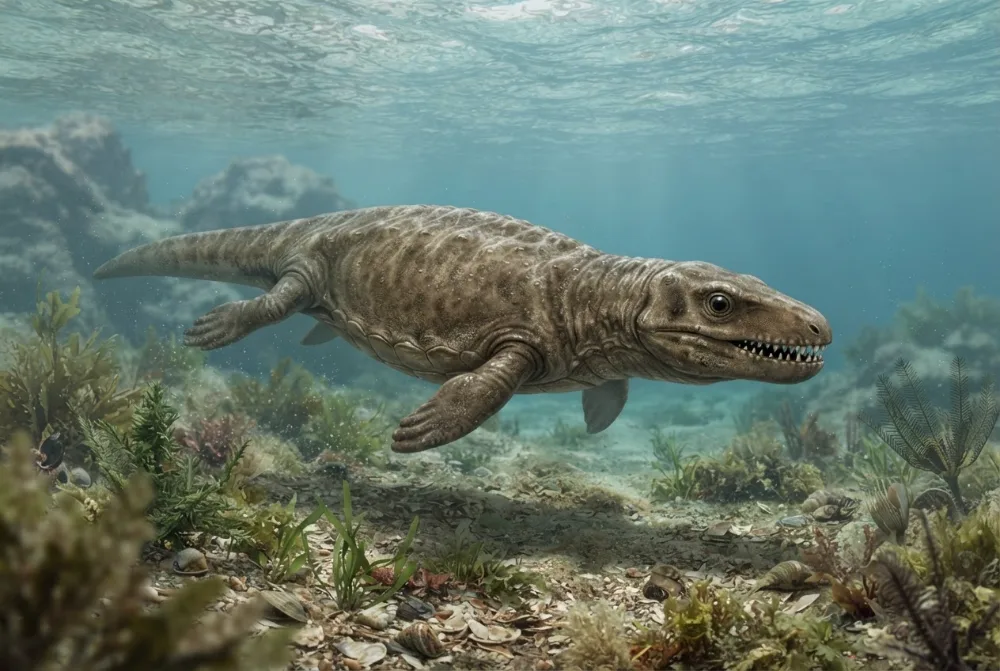
Parahenodus was a strange, shell-crushing marine reptile that lived in the Late Triassic. It looked a bit like a turtle but was actually a placodont, a group of reptiles that ate hard-shelled animals. Only its skull has been found so far!12
Yaphila nini?
Yayikhawuleza kangakanani?


Iinyani ezimnandi
Parahenodus is known from just one partial skull, discovered between 2008 and 2015 in Spain.1
It was a close relative of Henodus, another placodont from Germany, and together they form the family Henodontidae.12
Parahenodus lived during the Late Triassic, about 237 to 205 million years ago, in the Carnian and Norian ages.31
Its name means 'near Henodus', because it looks very similar to Henodus but has some more primitive features.1
The discovery of Parahenodus helped scientists understand how the unusual skull of Henodontidae evolved over time.2
Kwiingcali zeedayinaso
- Igama lenzululwazi
- Parahenodus
- Inikwe igama ngu:
- Miguel Chaves et al. 20183
- Iqela
- Izirhubuluzi zaselwandle
- Usapho / iclade
- Henodontidae3
- Ukuhlelwa
- Placodontia > Sauropterygia3
- Ubudala bamatye
- 237 ukuya ku-206 izigidi zeminyaka (Carnian / Norian)3
- Izakhiwo zamatye
- Keuper3
- Amazwe
- iSpeyin3
- Iirekhodi zeefosili
- 1 kwi-Paleobiology Database3
- Ukufunyanwa
- Parahenodus was named and described in 2018 by Carlos de Miguel Chaves, Francisco Ortega, and Adán Pérez-García based on a partial skull found in the Keuper Facies of El Atance, Spain.13
Apho iinyani zivela khona
- Parahenodus (en.wikipedia.org)
- A new placodont from the Upper Triassic of Spain provides new insights on the acquisition of the specialized skull of Henodontidae (onlinelibrary.wiley.com)
- Parahenodus in The Paleobiology Database (CC BY 4.0): ubudala, iindawo, izakhiwo zamatye, ukuhlelwa.
Yonke inyani ekweli phepha inenombolo ebonisa umthombo wayo. Ukuba siphosisile, uxolo, sithanda iidayinaso, asiyojenali yenzululwazi. Sixelele apha: [email protected], siya kuyilungisa.
 URex ulambile! I-Dino Wiki yiprojekthi katata ukwenzela unyana wakhe othanda iidayinaso, isimahla, ayinazintengiso, ayinazilandeli. Abantu abadala banokuphakela uRex isidlwana ukuze incede ihlale kwi-intanethi.Phakela uRex
 Nothosaurus
 Placodus
 Lariosaurus
 Cyamodus
 Cymatosaurus
 Proneusticosaurus
 Massospondylus
 Plateosaurus
 Coelophysis
 Podokesaurus
 Thecodontosaurus
 Eudimorphodon