 Uyiyiphi idayinaso? Ikwizi
 Idabi leedayinaso
 Ugqatso lweedayinaso
 Imidlalo emincinci yeedayinaso
 I-albhamu yezitikha
 Iilisti ze-TOP zeedayinaso
 Ndothuse!
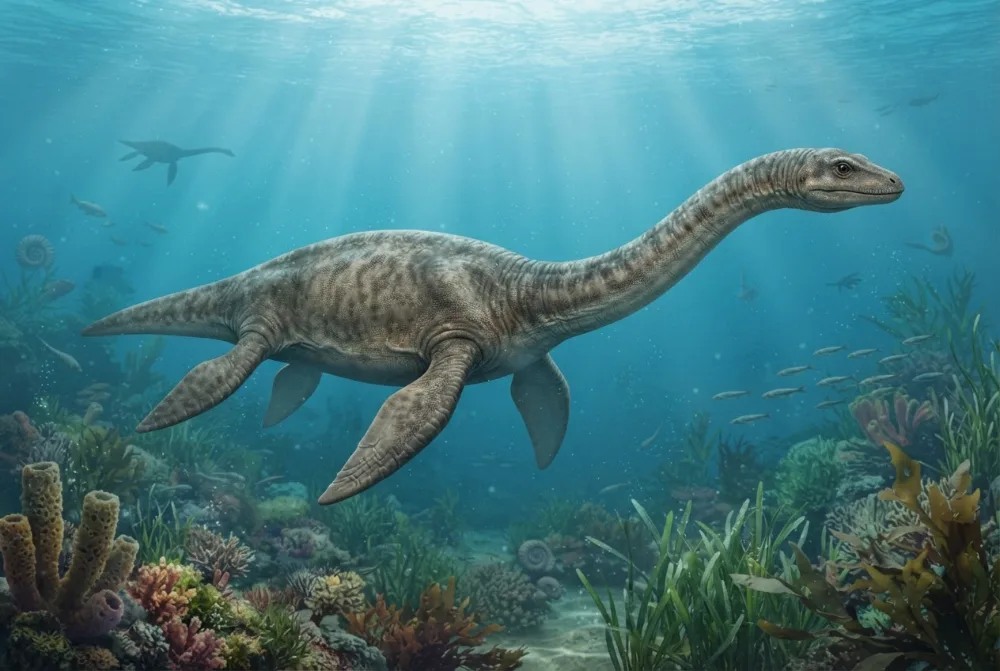
Cryptoclidus
Cryptoclidus was a medium-sized plesiosaur that swam in warm seas during the Middle and Late Jurassic. It had a small head, a long neck, and four flippers. It probably ate soft animals like squid and small fish.1
Yaphila nini?
Yayinkulu kangakanani?
Yayinde kangakanani?
Yayinzima kangakanani?
 inde njengezinja ezingama-4, impumlo ukuya emsileni🍌inde njengeebhanana ezingama-22 zilandelelana🍉inzima njengamavatala angama-150🧸inzima njengabantwana basenkulisa abangama-40🎒inzima njengabantwana besikolo abangama-24🏊ibinokuqubha ubude bechibi elikhulu lokuqubha (50 m) ngemizuzwana engama-6.4
Cryptoclidus wayemkhulu kangakanani xa ethelekiswa NAWE?
Yimathematika nje kwibhrawuza yakho. Akukho nto igcinwayo okanye ithunyelwe naphi na.
Yayikhawuleza kangakanani?


Iinyani ezimnandi
The name Cryptoclidus means 'hidden collarbone' because its collarbones are tiny and hidden in the shoulder area.1
Fossils of Cryptoclidus have been found in the Oxford Clay of Cambridgeshire, England, and in the Kimmeridge Clay of France.1
The type species was first called Plesiosaurus eurymerus, which means 'wide thigh bone', because scientists mistook a front flipper bone for a back leg bone.1
Cryptoclidus had a small, fragile skull and teeth that could not handle tough prey, so it ate only soft animals.1
Scientists think Cryptoclidus used its long, intermeshing teeth to strain small animals from the water or sift through mud.1
The size and shape of its nostrils suggest Cryptoclidus could smell chemicals in seawater, helping it find food.1
Complete skeletons of Cryptoclidus have been found, including some that are nearly entirely preserved, showing both adults and juveniles.1
Eyona mibuzo ibuzwa kakhulu: Cryptoclidus
?How big was Cryptoclidus?
About 4 metres long and weighed around 737 to 756 kilograms. That is about as long as a small car.1
?What did Cryptoclidus eat?
It ate small, soft animals like squid and small fish. Its fragile teeth could not handle tough prey.1
?Was Cryptoclidus a dinosaur?
No, it was a plesiosaur, which is a marine reptile that lived in the sea. It is not a dinosaur.1
?When did Cryptoclidus live?
It lived during the Middle and Late Jurassic Period, about 166 to 160 million years ago.1
?Where were Cryptoclidus fossils found?
Fossils have been found in England, France, Cuba, and Russia. Many come from the Oxford Clay in Cambridgeshire, England.12
?Could Cryptoclidus swim?
Yes, it was a good swimmer. It used its four flippers to move through warm Jurassic seas.1
Inyaniso ngeentsomi
Intsomi: Some people think Cryptoclidus was a dinosaur.
Inyaniso: Cryptoclidus was a plesiosaur, a marine reptile that lived in the sea, not a dinosaur.1
Kwiingcali zeedayinaso
- Igama lenzululwazi
- Cryptoclidus
- Inikwe igama ngu:
- (Seeley 1892)2
- Iqela
- Iiplesiosauri
- Usapho / iclade
- Cryptoclididae2
- Ukuhlelwa
- Plesiosauria > Sauropterygia2
- Ubudala bamatye
- 165 ukuya ku-143 izigidi zeminyaka (Callovian / Tithonian)2
- Izakhiwo zamatye
- Oxford Clay, Jagua, Kimmeridge Clay2
- Amazwe
- iUnited Kingdom, iCuba, i-Argentina, iFransi2
- Iirekhodi zeefosili
- 17 kwi-Paleobiology Database2
- Ikwaziwa ngokuba
- Apractocleidus (amagama amadala ngoku abalwa njengesilwanyana esinye)2
- Ukufunyanwa
- The first fossils were described in 1871 by John Phillips as Plesiosaurus eurymerus. Harry Govier Seeley renamed it Cryptoclidus in 1892.12
- Kusaxoxwa ngayo
- Scientists are not sure whether Cryptoclidus caught prey by swimming fast or by ambushing it, because its skeleton was not built for speed.1
Apho iinyani zivela khona
- Cryptoclidus (en.wikipedia.org)
- Cryptoclidus in The Paleobiology Database (CC BY 4.0): ubudala, iindawo, izakhiwo zamatye, ukuhlelwa.
Yonke inyani ekweli phepha inenombolo ebonisa umthombo wayo. Ukuba siphosisile, uxolo, sithanda iidayinaso, asiyojenali yenzululwazi. Sixelele apha: [email protected], siya kuyilungisa.
 URex ulambile! I-Dino Wiki yiprojekthi katata ukwenzela unyana wakhe othanda iidayinaso, isimahla, ayinazintengiso, ayinazilandeli. Abantu abadala banokuphakela uRex isidlwana ukuze incede ihlale kwi-intanethi.Phakela uRex
 Elasmosaurus
 Pliosaurus
 Plesiosaurus
 Cimoliasaurus
 Colymbosaurus
 Trinacromerum
 Brachiosaurus
 Diplodocus
 Allosaurus
 Brontosaurus
 Compsognathus
 Camarasaurus