 Uyiyiphi idayinaso? Ikwizi
 Idabi leedayinaso
 Ugqatso lweedayinaso
 Imidlalo emincinci yeedayinaso
 I-albhamu yezitikha
 Iilisti ze-TOP zeedayinaso
 Ndothuse!
Prosantosaurus
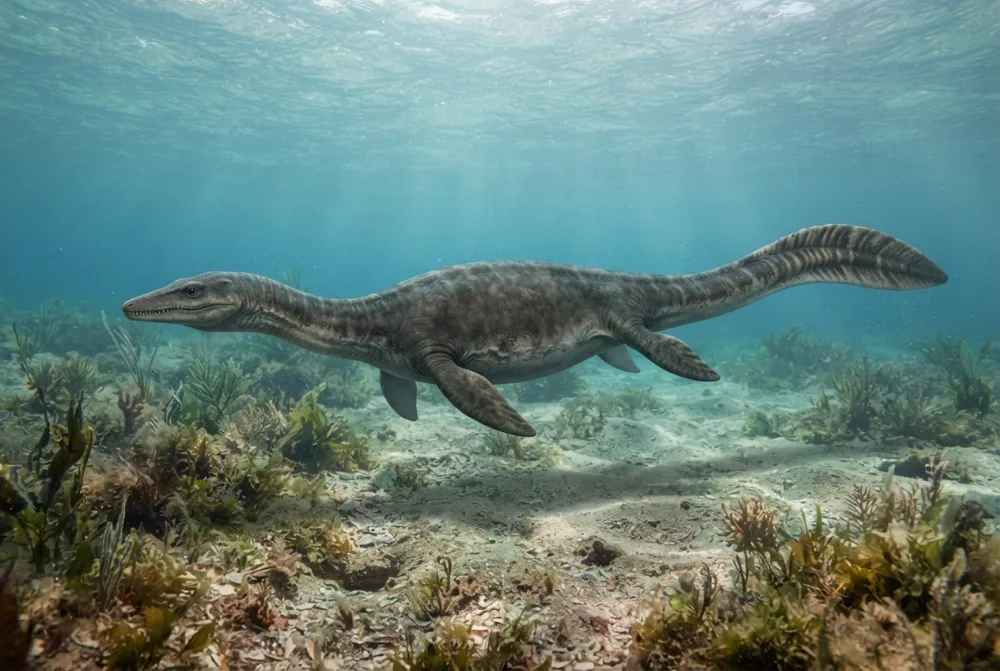
Prosantosaurus was a small, lizard-like marine reptile that swam in the warm seas of the Middle Triassic, about 241 million years ago. It had a long body and tail, and probably hunted small fish and crustaceans. It was not a dinosaur, but a relative of plesiosaurs.13
Yaphila nini?
Yayinkulu kangakanani?
Yayinde kangakanani?
Prosantosaurus wayemkhulu kangakanani xa ethelekiswa NAWE?
Yimathematika nje kwibhrawuza yakho. Akukho nto igcinwayo okanye ithunyelwe naphi na.
Yayikhawuleza kangakanani?


Iinyani ezimnandi
Prosantosaurus could regrow its teeth if they broke off. This was seen for the first time in a European pachypleurosaur.1
Its teeth were less pointed and broader at the base compared to other pachypleurosaurs.1
The fossils were found at about 2700 metres above sea level in the Swiss Alps, but back then this area was covered by the Tethys Ocean.1
Six nearly complete skeletons and an isolated skull were discovered, which is a lot for such an ancient marine reptile.2
Prosantosaurus lived about 241 million years ago, during the early Ladinian stage of the Middle Triassic.12
It is the sister taxon to a group that includes Serpianosaurus, Proneusticosaurus, and Neusticosaurus species.2
Inyaniso ngeentsomi
Intsomi: Some people might think Prosantosaurus was a dinosaur because it lived in the Triassic and looked like a small reptile.
Inyaniso: Prosantosaurus was a marine reptile called a pachypleurosaur, part of the group Sauropterygia, which is not dinosaurs. Dinosaurs were land reptiles with a different hip structure.13
Kwiingcali zeedayinaso
- Igama lenzululwazi
- Prosantosaurus
- Inikwe igama ngu:
- Klein et al. 20223
- Iqela
- Izirhubuluzi zaselwandle
- Usapho / iclade
- Pachypleurosauria3
- Ukuhlelwa
- Sauropterygia3
- Ubudala bamatye
- 241 ukuya ku-239 izigidi zeminyaka (Ladinian)3
- Izakhiwo zamatye
- Prosanto3
- Amazwe
- iSwitzerland3
- Iirekhodi zeefosili
- 1 kwi-Paleobiology Database3
- Ukufunyanwa
- Prosantosaurus was named in 2022 by Nicole Klein and colleagues from skeletons found in the Prosanto Formation in Switzerland. The species name scheffoldi honours Beat Scheffold, a scientific illustrator who helped with the research.13
- Kusaxoxwa ngayo
- Scientists are still debating how pachypleurosaurs migrated across the Tethys Ocean, and whether Prosantosaurus's tooth replacement pattern is unique among European pachypleurosaurs.2
Apho iinyani zivela khona
- Prosantosaurus (en.wikipedia.org)
- A new pachypleurosaur from the Early Ladinian Prosanto Formation in the Eastern Alps of Switzerland (zora.uzh.ch)
- Prosantosaurus in The Paleobiology Database (CC BY 4.0): ubudala, iindawo, izakhiwo zamatye, ukuhlelwa.
Yonke inyani ekweli phepha inenombolo ebonisa umthombo wayo. Ukuba siphosisile, uxolo, sithanda iidayinaso, asiyojenali yenzululwazi. Sixelele apha: [email protected], siya kuyilungisa.
 URex ulambile! I-Dino Wiki yiprojekthi katata ukwenzela unyana wakhe othanda iidayinaso, isimahla, ayinazintengiso, ayinazilandeli. Abantu abadala banokuphakela uRex isidlwana ukuze incede ihlale kwi-intanethi.Phakela uRex
 Nothosaurus
 Placodus
 Lariosaurus
 Cyamodus
 Cymatosaurus
 Proneusticosaurus
 Chonespondylus
 Cymbospondylus
 Phalarodon
 Mixosaurus
 Chaohusaurus
 Chensaurus