 Uyiyiphi idayinaso? Ikwizi
 Idabi leedayinaso
 Ugqatso lweedayinaso
 Imidlalo emincinci yeedayinaso
 I-albhamu yezitikha
 Iilisti ze-TOP zeedayinaso
 Ndothuse!
Qantassaurus
Qantassaurus was a small, fast plant-eater that lived in Australia during the Early Cretaceous. It had a very short, deep lower jaw with only ten cheek teeth, which made it different from other small ornithopods. It probably ate ferns and horsetails that grew close to the ground.1
Yaphila nini?
Yayinkulu kangakanani?
Yayinde kangakanani?
Yayiphakame kangakanani?
Yayinzima kangakanani?
 inde njengeekati zasekhaya ezingama-4, impumlo ukuya emsileni🍌inde njengeebhanana ezingama-11 zilandelelana🍉inzima njengamavatala angama-6🏃ibinokubaleka iimitha ezili-100 ngemizuzwana engama-8.8 (oyena mntu ukhawulezayo udinga i-9,6)
Qantassaurus wayemkhulu kangakanani xa ethelekiswa NAWE?
Yimathematika nje kwibhrawuza yakho. Akukho nto igcinwayo okanye ithunyelwe naphi na.
Yayikhawuleza kangakanani?


Iinyani ezimnandi
Qantassaurus is known only from its lower jaw bones, and scientists have found three of them.1
Its lower jaw was unusually short and deep, with the top and bottom edges slanting toward the front.1
It had only ten cheek teeth on each side of its lower jaw, fewer than most other small ornithopods.1
Qantassaurus lived in a rift valley between Australia and Antarctica as the two continents were slowly pulling apart.1
The fossils were found in rocks that are about 125 to 127 million years old, from the late Barremian age.2
Its teeth are very similar to those of another Australian dinosaur, Atlascopcosaurus, but the jaws are different shapes.1
Qantassaurus was named after the airline Qantas, which helped transport the fossils.1
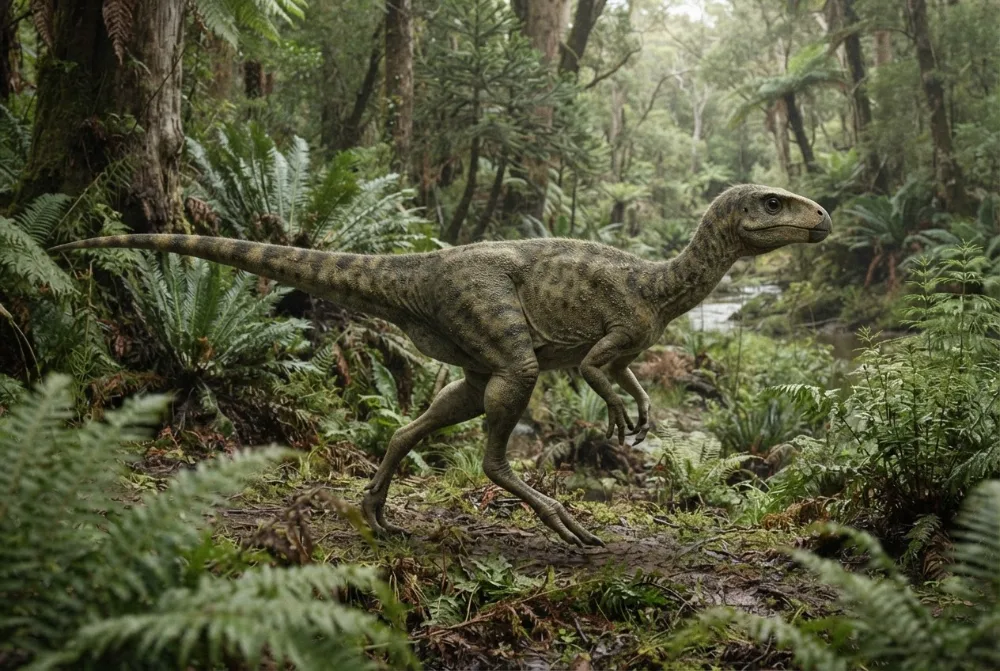
Eyona mibuzo ibuzwa kakhulu: Qantassaurus
?How big was Qantassaurus?
About 1.8 metres long and about 1 metre tall.3
?Why is it called Qantassaurus?
It was named after the Australian airline Qantas, which helped transport the fossils.13
?Could Qantassaurus run fast?
Yes, it probably was a fast runner because it had long thighs and long shins, like its relatives.3
Kwiingcali zeedayinaso
- Igama lenzululwazi
- Qantassaurus
- Inikwe igama ngu:
- Rich and Vickers-Rich 19994
- Iqela
- Izitya-zityalo ezinemilomo
- Usapho / iclade
- Elasmaria4
- Ukuhlelwa
- Ornithischia > Ornithopoda > Iguanodontia4
- Ubudala bamatye
- 126 ukuya ku-121 izigidi zeminyaka (Barremian)4
- Izakhiwo zamatye
- Wonthaggi4
- Amazwe
- i-Ostreliya4
- Iirekhodi zeefosili
- 2 kwi-Paleobiology Database4
- Ukufunyanwa
- Qantassaurus was named by scientists Thomas Rich and Patricia Vickers-Rich in 1999. The first fossil, a complete left lower jaw, was found at the Flat Rocks site near Inverloch, Victoria, Australia.41
- Kusaxoxwa ngayo
- Scientists are not sure exactly how big Qantassaurus grew, because only jaw bones have been found.1
Apho iinyani zivela khona
- Dinosaur - Qantassaurus intrepidus - The Australian Museum (australian.museum)
- New small-bodied ornithopods (Dinosauria, Neornithischia) from the Early Cretaceous Wonthaggi Formation (Strzelecki Group) of the Australian-Antarctic rift system, with revision of Qantassaurus intrepidus Rich and Vickers-Rich, 1999 | Journal of Paleontology | Cambridge Core (cambridge.org)
- Qantassaurus (Wikipedia) (Wikipedia)
- Qantassaurus in The Paleobiology Database (CC BY 4.0): ubudala, iindawo, izakhiwo zamatye, ukuhlelwa.
Yonke inyani ekweli phepha inenombolo ebonisa umthombo wayo. Ukuba siphosisile, uxolo, sithanda iidayinaso, asiyojenali yenzululwazi. Sixelele apha: [email protected], siya kuyilungisa.
 URex ulambile! I-Dino Wiki yiprojekthi katata ukwenzela unyana wakhe othanda iidayinaso, isimahla, ayinazintengiso, ayinazilandeli. Abantu abadala banokuphakela uRex isidlwana ukuze incede ihlale kwi-intanethi.Phakela uRex
 Iguanodon
 Tenontosaurus
 Thescelosaurus
 Zalmoxes
 Camptosaurus
 Rhabdodon
 Stegosaurus
 Archaeopteryx
 Giganotosaurus
 Microraptor
 Deinonychus
 Baryonyx