 Uyiyiphi idayinaso? Ikwizi
 Idabi leedayinaso
 Ugqatso lweedayinaso
 Imidlalo emincinci yeedayinaso
 I-albhamu yezitikha
 Iilisti ze-TOP zeedayinaso
 Ndothuse!
Sauroplites
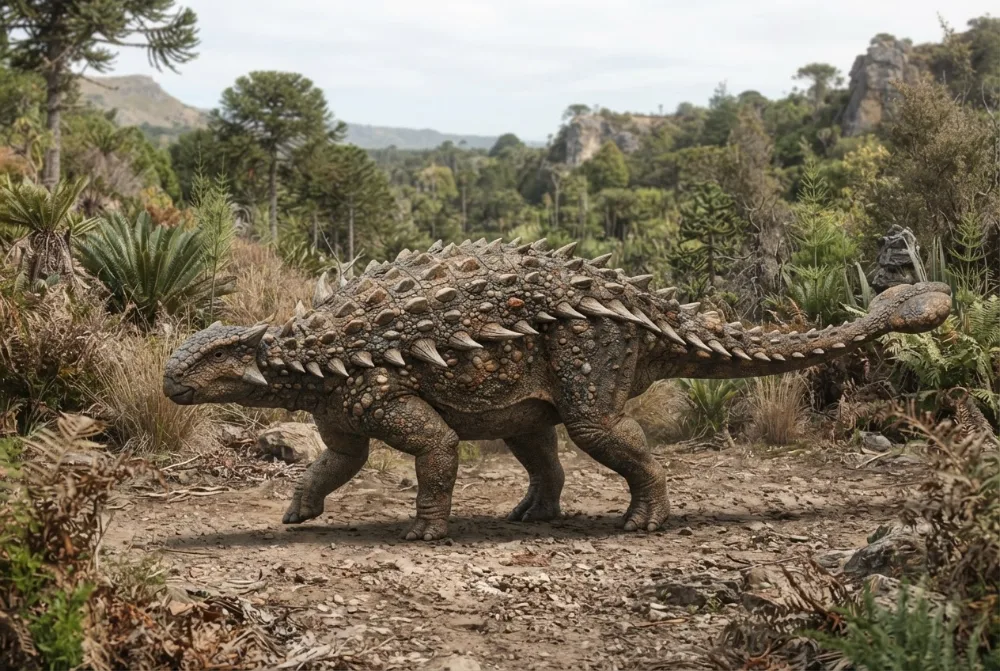
Sauroplites was an armoured dinosaur that walked on four legs and ate plants. Its back and hips were covered with a shield made of bony plates, like a suit of armour. It lived in what is now Inner Mongolia, China, during the Early Cretaceous period.14
Yaphila nini?
Yayinkulu kangakanani?
Yayinde kangakanani?
Yayiphakame kangakanani?
 inde njengezinja ezingama-6, impumlo ukuya emsileni🍌inde njengeebhanana ezingama-31 zilandelelana🏃ibinokubaleka iimitha ezili-100 ngemizuzwana engama-22 (oyena mntu ukhawulezayo udinga i-9,6)
Sauroplites wayemkhulu kangakanani xa ethelekiswa NAWE?
Yimathematika nje kwibhrawuza yakho. Akukho nto igcinwayo okanye ithunyelwe naphi na.
Yayikhawuleza kangakanani?


Iinyani ezimnandi
Sauroplites had a special shield on its hips made of fused rosettes. Each rosette had one large central bony plate surrounded by a single ring of smaller plates. No other armoured dinosaur had this exact pattern.12
The largest bony plates on its back could be up to 40 centimetres (about 16 inches) long. The plates on its sides were about 30 centimetres (12 inches) across.1
The fossils of Sauroplites were discovered in 1930 by Swedish paleontologist Anders Birger Bohlin during an expedition in Inner Mongolia. The dinosaur was named and described by Bohlin in 1953.1
The original fossil bones of Sauroplites are lost today, but some casts (copies) are kept at the American Museum of Natural History in New York.1
For a long time, scientists thought Sauroplites might be a doubtful name because the fossils were so fragmentary. But in 2014, researcher Victoria Megan Arbour found a unique feature on the hip shield that proved it was a real, valid dinosaur.1
Eyona mibuzo ibuzwa kakhulu: Sauroplites
?How big was Sauroplites?
Nobody knows for sure because the fossils are very fragmentary. The largest bony plates on its back could be up to 40 centimetres (about 16 inches) long, but no complete skeleton has been found to estimate its full size.1
?What did Sauroplites eat?
Sauroplites was an herbivore, meaning it ate plants. It had a plant-eating dinosaur's body and teeth suited for chewing vegetation.1
?Is Sauroplites a dinosaur?
Yes, Sauroplites is a dinosaur. It is an ankylosaurian dinosaur from the Early Cretaceous of China.1
Kwiingcali zeedayinaso
- Igama lenzululwazi
- Sauroplites
- Inikwe igama ngu:
- Bohlin 19534
- Iqela
- Iidayinaso ezinesikrweqe
- Usapho / iclade
- Nodosauridae4
- Ukuhlelwa
- Ornithischia > Ankylosauria > Nodosauridae > Thyreophora4
- Ubudala bamatye
- 121 ukuya ku-113 izigidi zeminyaka (Aptian)4
- Amazwe
- iTshayina4
- Iirekhodi zeefosili
- 1 kwi-Paleobiology Database4
- Ukufunyanwa
- Swedish paleontologist Anders Birger Bohlin discovered the fossils of Sauroplites in 1930 near Tebch in Inner Mongolia, during the Swedish-Chinese expeditions of Sven Hedin. He named and described the dinosaur in 1953.1
- Kusaxoxwa ngayo
- Scientists are not sure whether Sauroplites belonged to the Nodosauridae family or the Ankylosauridae family. Some studies place it with nodosaurids because of its hip shield, but nodosaurids are rare in Asia.1
Apho iinyani zivela khona
- Sauroplites (en.wikipedia.org)
- PBDB Taxon (paleobiodb.org)
- Sauroplites — Facts, Size, Diet & Pronunciation | Types of Dinosaurs (typesofdinosaurs.com)
- Sauroplites in The Paleobiology Database (CC BY 4.0): ubudala, iindawo, izakhiwo zamatye, ukuhlelwa.
Yonke inyani ekweli phepha inenombolo ebonisa umthombo wayo. Ukuba siphosisile, uxolo, sithanda iidayinaso, asiyojenali yenzululwazi. Sixelele apha: [email protected], siya kuyilungisa.
 URex ulambile! I-Dino Wiki yiprojekthi katata ukwenzela unyana wakhe othanda iidayinaso, isimahla, ayinazintengiso, ayinazilandeli. Abantu abadala banokuphakela uRex isidlwana ukuze incede ihlale kwi-intanethi.Phakela uRex
 Ankylosaurus
 Sauropelta
 Pinacosaurus
 Scutellosaurus
 Struthiosaurus
 Euoplocephalus
 Stegosaurus
 Iguanodon
 Archaeopteryx
 Giganotosaurus
 Microraptor
 Deinonychus