 Uyiyiphi idayinaso? Ikwizi
 Idabi leedayinaso
 Ugqatso lweedayinaso
 Imidlalo emincinci yeedayinaso
 I-albhamu yezitikha
 Iilisti ze-TOP zeedayinaso
 Ndothuse!
Wintonotitan
Wintonotitan was a long-necked sauropod that lived in Australia about 100 million years ago. It was a plant-eater with a relatively slender body and front legs longer than its back legs. Scientists call it 'Clancy' after a poem by Banjo Patterson.2
Yaphila nini?
Yayinkulu kangakanani?
Yayinde kangakanani?
Yayiphakame kangakanani?
Yayinzima kangakanani?

 inde njengeemoto ezingama-4 zipakwe zilandelelana🍌inde njengeebhanana ezingama-89 zilandelelanainzima njengeemoto ezingama-10🍉inzima njengamavatala angama-3000🎒inzima njengamagumbi okufundela apheleleyo abantwana angama-19🐻❄️inzima njengeebhere ezimhlophe ezingama-33🏃ibinokubaleka iimitha ezili-100 ngemizuzwana engama-26 (oyena mntu ukhawulezayo udinga i-9,6)
Wintonotitan wayemkhulu kangakanani xa ethelekiswa NAWE?
Yimathematika nje kwibhrawuza yakho. Akukho nto igcinwayo okanye ithunyelwe naphi na.
Yayikhawuleza kangakanani?


Iinyani ezimnandi
Wintonotitan was one of three new dinosaurs named from the Winton Formation in 2009, along with Diamantinasaurus and Australovenator.1
Its fossils were first discovered in the 1970s by Keith Watts, who donated them to the Queensland Museum. The species name wattsi honors him.2
Wintonotitan had unique tail bones that were biconvex (rounded on both ends) near the tip, which is different from most other sauropods.2
It lived in a river plain environment with large rivers, swamps, and lakes, after the Eromanga Sea had retreated. The climate was subtropical with abundant rainfall.2
Wintonotitan was a relatively small titanosaur, reaching about 15 to 16 metres long, while some other titanosaurs could grow to 35 metres.2
The fossils found include most of the front limb and shoulder girdle, tail vertebrae, ribs, and hip bones, but no skull or teeth have been discovered yet.2
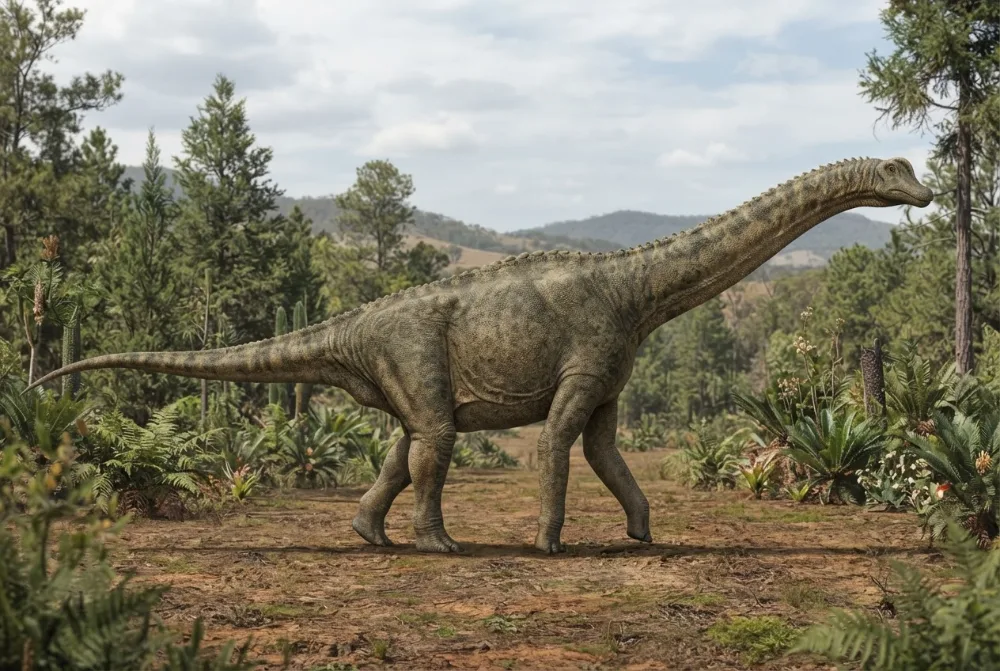
Eyona mibuzo ibuzwa kakhulu: Wintonotitan
?How much did Wintonotitan weigh?
About 10 to 15 tonnes (22,000 to 33,000 pounds). That is roughly as heavy as a large truck.2
?What plants did Wintonotitan eat?
It ate ferns, ginkgoes, conifers, cycads, and early flowering plants that grew in its river-plain home.2
?How did Wintonotitan get its name?
Its name means 'Winton titan', after the town of Winton in Queensland, Australia, where its fossils were found.3
?When did Wintonotitan live?
It lived during the Cretaceous Period, about 100 million years ago.2
Kwiingcali zeedayinaso
- Igama lenzululwazi
- Wintonotitan
- Inikwe igama ngu:
- Hocknull et al. 20094
- Iqela
- Iintamo-nde
- Usapho / iclade
- Diamantinasauria4
- Ukuhlelwa
- Sauropodomorpha > Sauropoda > Macronaria4
- Ubudala bamatye
- 100 ukuya ku-90 izigidi zeminyaka (Cenomanian / Turonian)4
- Izakhiwo zamatye
- Winton4
- Amazwe
- i-Ostreliya4
- Iirekhodi zeefosili
- 7 kwi-Paleobiology Database4
- Ukufunyanwa
- Wintonotitan was named by Scott Hocknull and colleagues in 2009 based on fossils found near Winton, Queensland. The bones were first collected in the 1970s by Keith Watts and later excavated by the Queensland Museum in the 1980s.12
- Kusaxoxwa ngayo
- Scientists are not sure what Wintonotitan's skull looked like because no skull bones have been found. They also debate whether it was a basal titanosauriform or a more derived titanosaur.21
Apho iinyani zivela khona
- New Mid-Cretaceous (Latest Albian) Dinosaurs from Winton, Queensland, Australia | PLOS One (journals.plos.org)
- Dinosaurs - Wintonotitan wattsi - The Australian Museum (australian.museum)
- Wintonotitan (Wikipedia) (Wikipedia)
- Wintonotitan in The Paleobiology Database (CC BY 4.0): ubudala, iindawo, izakhiwo zamatye, ukuhlelwa.
Yonke inyani ekweli phepha inenombolo ebonisa umthombo wayo. Ukuba siphosisile, uxolo, sithanda iidayinaso, asiyojenali yenzululwazi. Sixelele apha: [email protected], siya kuyilungisa.
 URex ulambile! I-Dino Wiki yiprojekthi katata ukwenzela unyana wakhe othanda iidayinaso, isimahla, ayinazintengiso, ayinazilandeli. Abantu abadala banokuphakela uRex isidlwana ukuze incede ihlale kwi-intanethi.Phakela uRex
 Brachiosaurus
 Diplodocus
 Brontosaurus
 Argentinosaurus
 Camarasaurus
 Morosaurus
 Tyrannosaurus
 Triceratops
 Velociraptor
 Spinosaurus
 Ankylosaurus
 Parasaurolophus