 Watter dino is jy? Kwis
 Dinogeveg
 Dinoresies
 Dino-minispeletjies
 Plakkeralbum
 Dino TOP-lyste
 Verras my!
Wanneer het dit geleef?

Hoe groot was dit?
Hoe swaar was dit?
Hoe groot was Eopengornis vergeleke met JOU?
Net wiskunde in jou blaaier. Niks word gestoor of êrens heen gestuur nie.
Hoe vinnig was dit?


Prettige feite
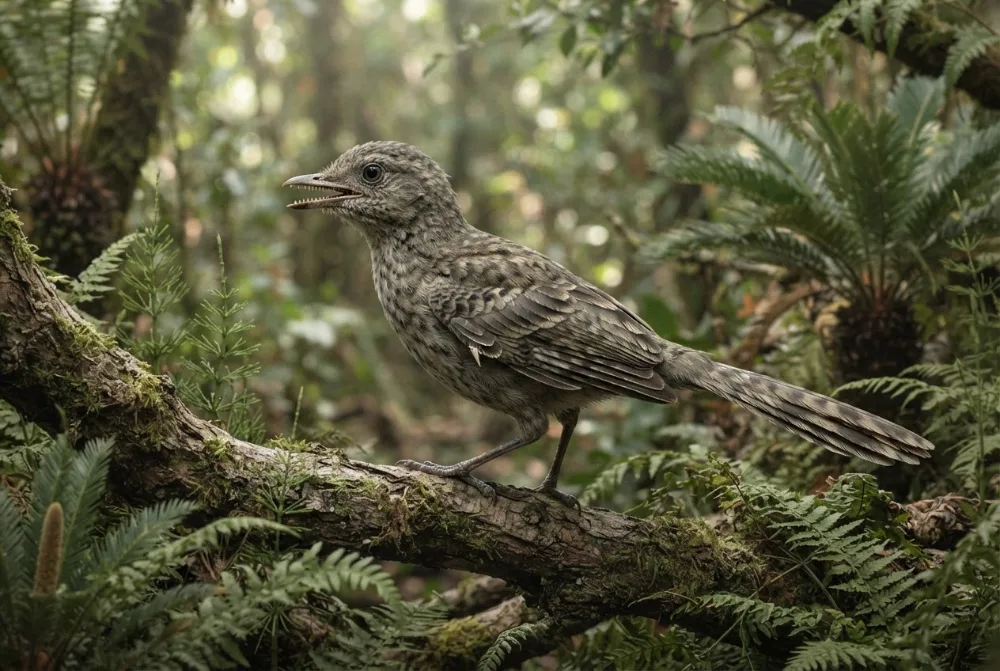
Eopengornis had special tail feathers with a strong central shaft, called a rachis, which helped it fly and show off.12
It belonged to a group of early birds called enantiornithes, which were very common during the time of dinosaurs.1
The only known species is called Eopengornis martini.1
Its fossils were found in rocks that are about 132 to 125 million years old, from a time called the Hauterivian.5
Eopengornis is part of the pengornithid family, a group of early birds that lived in Asia.1
Vir dino-kenners
- Wetenskaplike naam
- Eopengornis
- Benoem deur
- Wang et al. 20145
- Groep
- Vroeë voëls
- Familie / klade
- Pengornithidae5
- Klassifikasie
- Theropoda > Avialae5
- Ouderdom van die rotse
- 133 tot 126 miljoen jaar (Hauterivian)5
- Rotsformasies
- Huajiying5
- Lande
- China5
- Fossielrekords
- 1 in The Paleobiology Database5
- Ontdekking
- Eopengornis was named and described by scientists Wang, O'Connor, Zheng, Wang, Hu, and Zhou in 2014, based on a fossil found in China.15
- Steeds omstrede
- Scientists are still studying exactly how Eopengornis used its strong tail feathers for flight and display.12
Waar die feite vandaan kom
- Eopengornis (en.wikipedia.org)
- Insights into the evolution of rachis dominated tail feathers from a new basal enantiornithine (Aves: Ornithothoraces) (bionames.org)
- Quantitative investigation of pengornithid enantiornithine diet reveals macrocarnivorous ecology evolved in birds by Early Cretaceous (pmc.ncbi.nlm.nih.gov)
- Quantitative investigation of pengornithid enantiornithine diet reveals macrocarnivorous ecology evolved in birds by Early Cretaceous: iScience (cell.com)
- Eopengornis in The Paleobiology Database (CC BY 4.0): ouderdom, plekke, rotsformasies, klassifikasie.
Elke feit op hierdie bladsy het 'n nommer wat na sy bron wys. As ons iets verkeerd het, jammer, ons is dino-aanhangers, nie 'n wetenskapjoernaal nie. Laat weet ons by [email protected] en ons maak dit reg.
 Rex is honger! Dino Wiki is 'n pa se projek vir sy seun wat mal is oor dino's, gratis met geen advertensies en geen spoorsnyers nie. Grootmense kan vir Rex 'n peuselhappie gee om te help om dit aanlyn te hou.Voer Rex
 Archaeopteryx
 Hesperornis
 Ichthyornis
 Baptornis
 Jurapteryx
 Gobipteryx
 Stegosaurus
 Iguanodon
 Giganotosaurus
 Microraptor
 Deinonychus
 Baryonyx