 Watter dino is jy? Kwis
 Dinogeveg
 Dinoresies
 Dino-minispeletjies
 Plakkeralbum
 Dino TOP-lyste
 Verras my!
Longipteryx
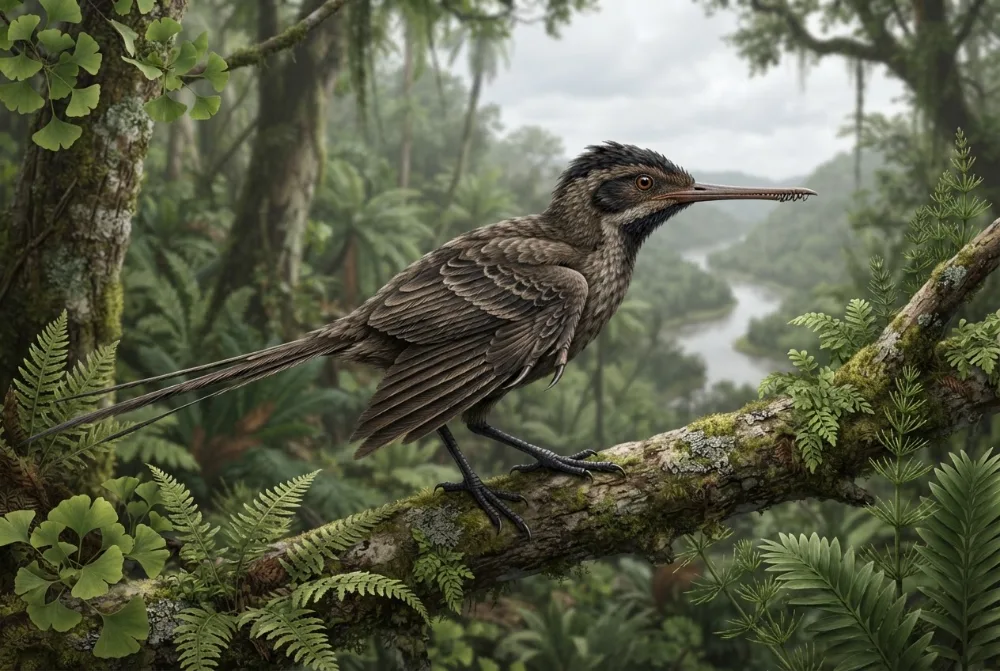
Longipteryx was a tiny bird that lived about 120 million years ago in what is now China. It had long, strong wings and a very long snout with hooked teeth at the tip. This little bird was a great flyer and could perch on branches like modern birds.12
Wanneer het dit geleef?
Hoe groot was dit?
Hoe wyd was sy vlerke?
Hoe swaar was dit?
Hoe groot was Longipteryx vergeleke met JOU?
Net wiskunde in jou blaaier. Niks word gestoor of êrens heen gestuur nie.
Hoe vinnig was dit?


Prettige feite
Longipteryx had a very long snout that was longer than the rest of its head, with a few hooked teeth at the tip.1
Its wings were much longer than its legs, with the upper arm bone (humerus) being 1.56 times the length of the thigh bone (femur).1
Unlike most other early birds, Longipteryx had uncinate processes on its ribs, which helped strengthen its ribcage and improve breathing.12
Its feet were built for perching, with all four toe bones (metatarsals) ending at nearly the same level, just like modern perching birds.2
Scientists once thought Longipteryx ate fish or insects, but in 2024 a study found it actually ate seeds and fruits.1
Longipteryx had a big breastbone with a well-developed keel, which gave it powerful flight muscles.2
Mees gevraagde vrae oor Longipteryx
?How big was Longipteryx?
Longipteryx was very small, with a wingspan of about 46.3 cm (1.52 ft) and a body mass of about 193 g (6.8 oz).1
?What did Longipteryx eat?
Longipteryx ate fish. A 2024 study found fish remains in its stomach, showing it was a piscivore.13
?Did Longipteryx have feathers?
Yes, Longipteryx had feathers. The holotype preserves body feathers, wing coverts and down, but no long tail feathers.1
?Could Longipteryx fly?
Yes, Longipteryx was a good flyer. It had long, strong wings and a well-developed breastbone with a keel for powerful flight muscles.1
Mite-breker
Mite: Longipteryx was a fish-eater because of its long snout and teeth.
Waarheid: Scientists now know from fossil evidence that Longipteryx ate seeds and fruits, not fish.1
Vir dino-kenners
- Wetenskaplike naam
- Longipteryx
- Benoem deur
- Zhang et al. 20004
- Groep
- Vroeë voëls
- Familie / klade
- Longipterygidae4
- Klassifikasie
- Theropoda > Avialae4
- Ouderdom van die rotse
- 121 tot 113 miljoen jaar (Aptian)4
- Rotsformasies
- Jiufotang4
- Lande
- China4
- Fossielrekords
- 3 in The Paleobiology Database4
- Ontdekking
- Longipteryx was named in 2000 by Zhang Fucheng and colleagues from a nearly complete skeleton found in the Jiufotang Formation in Chaoyang, China.42
- Steeds omstrede
- Scientists are not sure whether Longipteryx used its long snout and teeth to catch prey or for some other purpose.1
Waar die feite vandaan kom
- Longipteryx (en.wikipedia.org)
- Early diversification of birds: Evidence from a new opposite bird (ivpp.cas.cn)
- Direct evidence of frugivory in the Mesozoic bird Longipteryx contradicts morphological proxies for diet (cell.com)
- Longipteryx in The Paleobiology Database (CC BY 4.0): ouderdom, plekke, rotsformasies, klassifikasie.
Elke feit op hierdie bladsy het 'n nommer wat na sy bron wys. As ons iets verkeerd het, jammer, ons is dino-aanhangers, nie 'n wetenskapjoernaal nie. Laat weet ons by [email protected] en ons maak dit reg.
 Rex is honger! Dino Wiki is 'n pa se projek vir sy seun wat mal is oor dino's, gratis met geen advertensies en geen spoorsnyers nie. Grootmense kan vir Rex 'n peuselhappie gee om te help om dit aanlyn te hou.Voer Rex
 Archaeopteryx
 Hesperornis
 Ichthyornis
 Baptornis
 Jurapteryx
 Gobipteryx
 Stegosaurus
 Iguanodon
 Giganotosaurus
 Microraptor
 Deinonychus
 Baryonyx