 Woyɛ dino bɛn? Nsɛmmisa agoro
 Dino ko
 Dino mmirikatuo
 Dino agodie nketewa
 Stika nwoma
 Dino TOP nhyehyɛeɛ
 Ma me nwanwa!
Argentinosaurus
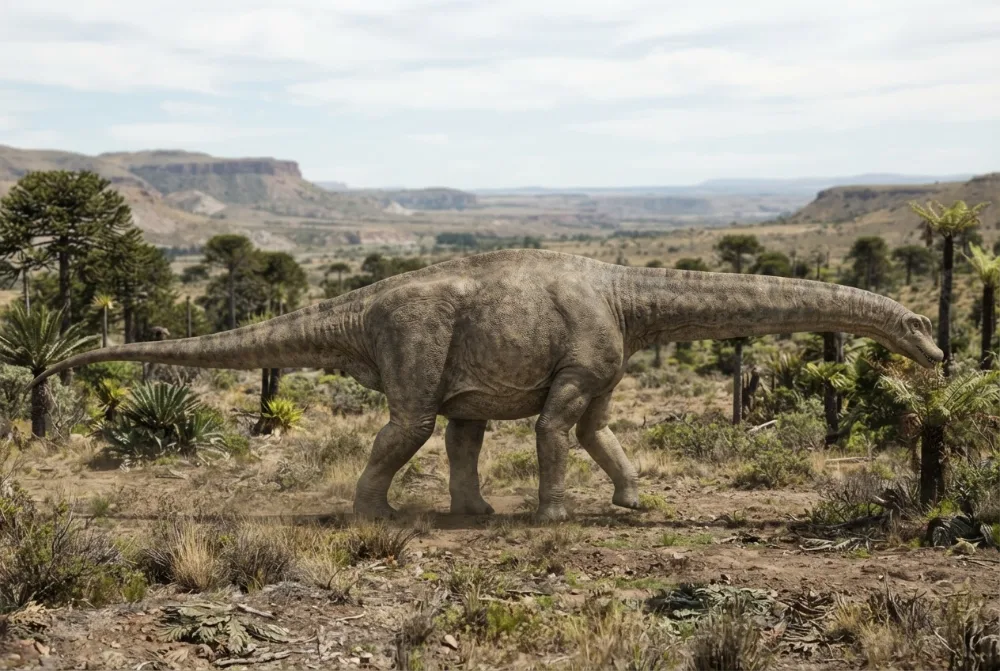
Argentinosaurus was one of the biggest land animals that ever lived. This giant plant-eater had a long neck and tail, and it weighed as much as a herd of elephants. It lived in what is now Argentina during the Cretaceous Period.51
Berɛ bɛn na ɛtenaa ase?
Na ne kɛseɛ yɛ sɛn?
Na ne tenten yɛ sɛn?
Na ne korɔn yɛ sɛn?
Na ne mu yɛ duru sɛn?

 ne tenten te sɛ kaa 9 a wɔde agyina toatoa so🍌ne tenten te sɛ kwadu 220 a wɔde abɔ toatoa so🍉ne mu duru te sɛ watamɛlɔn 20000🦒ɔkorɔn sen gyiraf🎒ne mu duru te sɛ sukuu klaas mũ 120 mu mmofra🏢ne korɔn bɛtumi ahwɛ mfɛnsere mu wɔ abansoro 3 so🏃anka ɔbɛtumi atu mmirika mita 100 wɔ sikɛn 51 mu (onipa a ɔyɛ ntɛm sen biara hia 9.6)
Argentinosaurus kɛseɛ yɛ sɛn sɛ wode toto WO ho a?
Akontaa nko ara wɔ wo browser mu. Yɛnkora biribiara so, na yɛmmfa biribiara nkɔ baabiara.
Na ɛyɛ ntɛm sɛn?


Nsɛm a ɛyɛ anigye
Argentinosaurus is known from only a few bones: six back vertebrae, part of the hip, a rib, and a shin bone.1
The back vertebrae had extra joints called hyposphene-hypantrum, which helped support its huge body.1
Its ribs were hollow and tube-shaped, making the skeleton lighter.1
Argentinosaurus lived about 110 to 106 million years ago, during the Albian stage of the Cretaceous.5
The fossils were found on a farm called Las Overas, near the town of Plaza Huincul.1
Nsɛm a wɔbisa bebree fa Argentinosaurus ho
?How big was Argentinosaurus?
It was one of the largest land animals ever, measuring about 30 to 35 metres long and weighing 65 to 80 tonnes.3
?What did Argentinosaurus eat?
It was a plant-eater (herbivore) that used its long neck to reach high or low vegetation and stripped leaves with its teeth.4
?Was Argentinosaurus bigger than T. rex?
Yes, Argentinosaurus was much bigger than T. rex. It was about 30 to 35 metres long, while T. rex was about 12 metres long.3
?Where was Argentinosaurus found?
Its fossils were found in Argentina, near the town of Plaza Huincul in Neuquén Province.3
?How fast could Argentinosaurus run?
A computer model estimated its maximum speed at about 7.2 km/h, which is a slow walk.3
?Is Argentinosaurus a dinosaur?
Yes, it is a dinosaur. It was a giant sauropod, a type of long-necked plant-eating dinosaur.3
?What did Argentinosaurus look like?
It had a very long neck and tail, a huge body, and walked on four legs. Its ribs were hollow and tube-shaped to make the skeleton lighter.3
?How do we know about Argentinosaurus?
We know it from only a few bones: six back vertebrae, part of the hip, a rib, and a shin bone. Scientists compare these to more complete relatives to estimate its size.3
?What would happen if Argentinosaurus was alive today?
It would be one of the biggest land animals, but it would need huge amounts of plants to eat and would be very slow, moving at about 7 km/h.3
Atosɛm sɛefoɔ
Atosɛm: Argentinosaurus is the largest dinosaur ever discovered.
Nokorɛ: Scientists are not sure. Because only a few bones have been found, its size is an estimate. Other giant sauropods like Patagotitan may have been similar in size.1
Ma dino ho animdefoɔ
- Nyansahu din
- Argentinosaurus
- Obi a ɔtoo din
- Bonaparte and Coria 19935
- Kuo
- Kɔn tenten
- Abusua / kuo kɛseɛ
- Eutitanosauria5
- Nkyekyɛmu
- Sauropodomorpha > Sauropoda > Titanosauria > Macronaria5
- Abotan no mfeɛ
- mfeɛ ɔpepem 110 kɔsi 106 (Albian)5
- Abotan nhyehyɛeɛ
- Huincul5
- Aman
- Argentina5
- Fɔsil nkyerɛwee
- 1 wɔ The Paleobiology Database mu5
- Nhunumu
- A farmer named Guillermo Heredia found the first bone on his land in Neuquén, Argentina. In 1989, a team from the Museo Argentino de Ciencias Naturales dug up the fossils. José Bonaparte and Rodolfo Coria named it Argentinosaurus huinculensis in 1993.1
- Wɔda so gye ho akyinnye
- Scientists debate exactly how big Argentinosaurus was, because only a few bones have been found. Its total length and weight are rough estimates.1
Baabi a nsɛm no firi
- A NEW AND HUGE TITANOSAUR SAUROPOD FROM THE RÍO LIMAY FORMATION (ALBIAN-CENOMANIAN) OF NEUQUÉN PROVINCE, ARGENTINA* (naturalhistory.si.edu)
- UN NUEVO Y GIGANTESCO SAUROPODO TITANOSAURIO DE LA FORMACION RIO LIMAY (ALBIANO-CENOMANIANO) DE LA PROVINCIA DEL NEUQUEN, ARGENTINA | Ameghiniana (ameghiniana.org.ar)
- Argentinosaurus (en.wikipedia.org)
- Argentinosaurus | Natural History Museum (nhm.ac.uk)
- Argentinosaurus in The Paleobiology Database (CC BY 4.0): mfeɛ, mmeaeɛ, abotan nhyehyɛeɛ, nkyekyɛmu.
Asɛm biara a ɛwɔ krataafa yi so wɔ nɔma a ɛkyerɛ baabi a ɛfiri. Sɛ yɛfom biribi a, kafra, yɛyɛ dino dɔfoɔ, yɛnyɛ nyansahu nsɛmma krataa. Ka kyerɛ yɛn wɔ [email protected] na yɛbɛsiesie.
 Ɔkɔm de Rex! Dino Wiki yɛ agya bi adwuma a ɔyɛɛ maa ne babarima a ɔdɔ dino. Ɛyɛ kwa, dawurubɔ biara nni mu, akyidifoɔ biara nni mu. Mpanimfoɔ bɛtumi ama Rex aduane kakra, na aboa ama Dino Wiki atena intanɛt so.Ma Rex aduane
 Brachiosaurus
 Diplodocus
 Brontosaurus
 Camarasaurus
 Morosaurus
 Massospondylus
 Stegosaurus
 Iguanodon
 Archaeopteryx
 Giganotosaurus
 Microraptor
 Deinonychus