 Woyɛ dino bɛn? Nsɛmmisa agoro
 Dino ko
 Dino mmirikatuo
 Dino agodie nketewa
 Stika nwoma
 Dino TOP nhyehyɛeɛ
 Ma me nwanwa!
Berɛ bɛn na ɛtenaa ase?

Na ne kɛseɛ yɛ sɛn?
Na ne tenten yɛ sɛn?
Na ne korɔn yɛ sɛn?
Na ne mu yɛ duru sɛn?
 ne tenten te sɛ nkraman 7 firi hwene kɔsi dua🍌ne tenten te sɛ kwadu 37 a wɔde abɔ toatoa so🍉ne mu duru te sɛ watamɛlɔn 260🧸ne mu duru te sɛ nkɔkɔaa sukuu mmofra 68🎒ne mu duru te sɛ sukuu mmofra 41🐻❄️ne mu duru te sɛ polar bea 3🏃anka ɔbɛtumi atu mmirika mita 100 wɔ sikɛn 11 mu (onipa a ɔyɛ ntɛm sen biara hia 9.6)
Eolambia kɛseɛ yɛ sɛn sɛ wode toto WO ho a?
Akontaa nko ara wɔ wo browser mu. Yɛnkora biribiara so, na yɛmmfa biribiara nkɔ baabiara.
Na ɛyɛ ntɛm sɛn?


Nsɛm a ɛyɛ anigye
Eolambia is known from hundreds of bones, including both adults and babies, so scientists have a good picture of its skeleton.1
The first Eolambia fossil was found by Carole and Ramal Jones in 1993, and the species name honors Carole.1
Young Eolambia were hunted by big crocodile-like reptiles that lived in the lakes, but adults were too big for them.1
Grown-up Eolambia, at least eight or nine years old, were hunted by large meat-eating dinosaurs like Siats.1
Eolambia lived in a floodplain with lakes that changed water levels over about 21,000-year cycles.1
The name Eolambia was suggested by paleoartist Michael Skrepnick, replacing an earlier informal name.1
Nsɛm a wɔbisa bebree fa Eolambia ho
?How big was Eolambia?
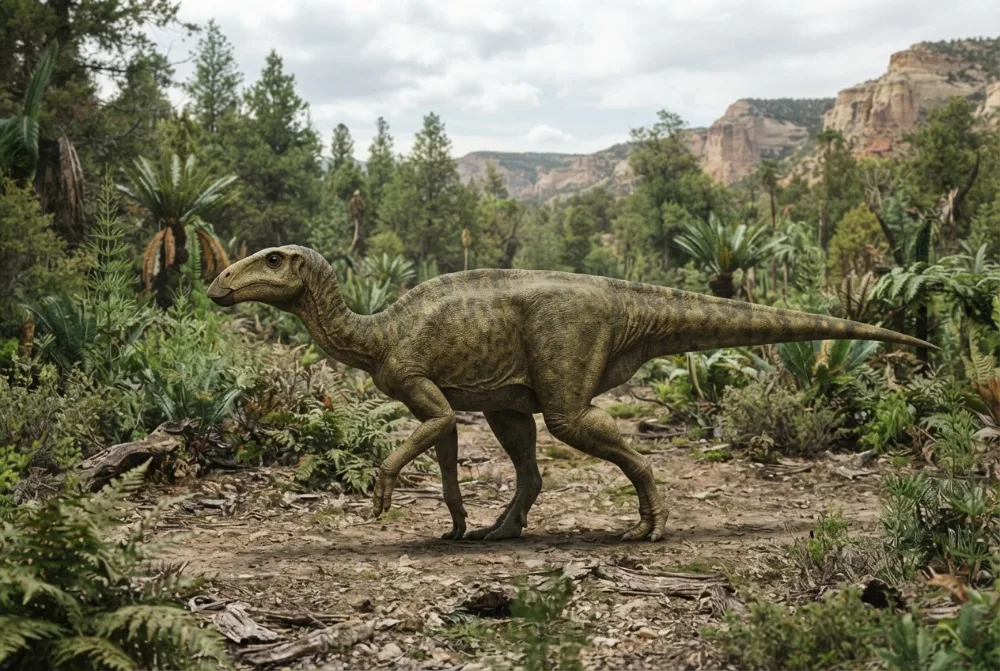
About 6 metres (20 feet) long. That is about as long as a large van.1
?What does the name Eolambia mean?
It means 'dawn lambeosaurine', because scientists first thought it was an early member of the lambeosaurine group.1
?Was Eolambia a hadrosaur?
No, it is a hadrosauroid, an early cousin of the true duck-billed dinosaurs (hadrosaurs).1
?How old could Eolambia get?
Scientists estimate it lived at least 8 to 9 years, based on a subadult specimen.4
Atosɛm sɛefoɔ
Atosɛm: Eolambia was a duck-billed dinosaur like later hadrosaurs.
Nokorɛ: Eolambia was an early relative of hadrosaurs, but it was not a true hadrosaurid. Scientists place it outside the hadrosaurid family.2
Ma dino ho animdefoɔ
- Nyansahu din
- Eolambia
- Obi a ɔtoo din
- Kirkland 19985
- Kuo
- Ahabandifoɔ a wɔwɔ anomaa ano
- Abusua / kuo kɛseɛ
- Hadrosauroidea5
- Nkyekyɛmu
- Ornithischia > Ornithopoda > Iguanodontia5
- Abotan no mfeɛ
- mfeɛ ɔpepem 121 kɔsi 94 (Aptian / Cenomanian)5
- Abotan nhyehyɛeɛ
- Cedar Mountain5
- Aman
- Amerika5
- Fɔsil nkyerɛwee
- 12 wɔ The Paleobiology Database mu5
- Nhunumu
- The first Eolambia fossils were found in 1993 by Carole and Ramal Jones in Utah. Paleontologist James Kirkland named it Eolambia caroljonesa in 1998.1
- Wɔda so gye ho akyinnye
- Scientists debate exactly where Eolambia sits on the family tree, with some originally thinking it was a lambeosaurine hadrosaurid, but later studies place it as a more basal hadrosauroid.2
Baabi a nsɛm no firi
- Eolambia (en.wikipedia.org)
- Osteology of the Basal Hadrosauroid Eolambia caroljonesa (Dinosauria: Ornithopoda) from the Cedar Mountain Formation of Utah | PLOS One (journals.plos.org)
- Eolambia caroljonesa | Dinosaur Database by DinoAnimals.com (dinoanimals.com)
- Anatomy, taphonomy, and phylogenetic implications of a new specimen of Eolambia caroljonesa (Dinosauria: Ornithopoda) from the Cedar Mountain Formation, Utah, USA (pmc.ncbi.nlm.nih.gov)
- Eolambia in The Paleobiology Database (CC BY 4.0): mfeɛ, mmeaeɛ, abotan nhyehyɛeɛ, nkyekyɛmu.
Asɛm biara a ɛwɔ krataafa yi so wɔ nɔma a ɛkyerɛ baabi a ɛfiri. Sɛ yɛfom biribi a, kafra, yɛyɛ dino dɔfoɔ, yɛnyɛ nyansahu nsɛmma krataa. Ka kyerɛ yɛn wɔ [email protected] na yɛbɛsiesie.
 Ɔkɔm de Rex! Dino Wiki yɛ agya bi adwuma a ɔyɛɛ maa ne babarima a ɔdɔ dino. Ɛyɛ kwa, dawurubɔ biara nni mu, akyidifoɔ biara nni mu. Mpanimfoɔ bɛtumi ama Rex aduane kakra, na aboa ama Dino Wiki atena intanɛt so.Ma Rex aduane
 Iguanodon
 Tenontosaurus
 Thescelosaurus
 Zalmoxes
 Camptosaurus
 Rhabdodon
 Stegosaurus
 Archaeopteryx
 Giganotosaurus
 Microraptor
 Deinonychus
 Baryonyx