 Woyɛ dino bɛn? Nsɛmmisa agoro
 Dino ko
 Dino mmirikatuo
 Dino agodie nketewa
 Stika nwoma
 Dino TOP nhyehyɛeɛ
 Ma me nwanwa!
Epidexipteryx
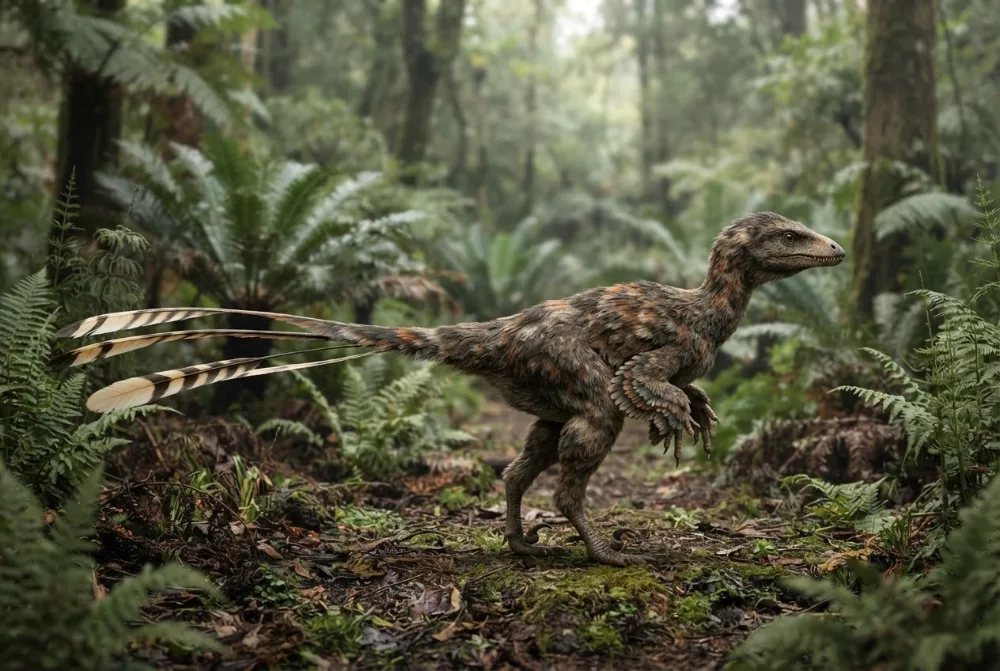
Epidexipteryx was a tiny, pigeon-sized dinosaur that lived in the Jurassic period. It had four long, ribbon-like feathers on its tail that it probably used to show off, not to fly. This little dinosaur was a meat-eater and is one of the oldest known dinosaurs with display feathers.1
Berɛ bɛn na ɛtenaa ase?
Na ne kɛseɛ yɛ sɛn?
Na ne tenten yɛ sɛn?
Na ne korɔn yɛ sɛn?
nsusuiɛ
Na ne mu yɛ duru sɛn?
Epidexipteryx kɛseɛ yɛ sɛn sɛ wode toto WO ho a?
Akontaa nko ara wɔ wo browser mu. Yɛnkora biribiara so, na yɛmmfa biribiara nkɔ baabiara.
Na ɛyɛ ntɛm sɛn?


Nsɛm a ɛyɛ anigye
Epidexipteryx had four long, ribbon-like feathers on its tail that were probably used for display, not for flying.1
It weighed only about 164 grams, which is less than a can of soda.1
Its front teeth were much larger than its back teeth, and they stuck out forward, similar to the dinosaur Masiakasaurus.1
Epidexipteryx lived about 165 to 161 million years ago, during the Middle to Late Jurassic.6
The only known fossil is a nearly complete skeleton of a young individual, found in Inner Mongolia, China.1
It had a short tail compared to its close relative Epidendrosaurus, with only 16 tail bones instead of more than 40.1
Epidexipteryx could not fly because it lacked the long flight feathers on its arms that birds use.1
Nsɛm a wɔbisa bebree fa Epidexipteryx ho
?How big was Epidexipteryx?
It was tiny, about 25 to 30 cm long, not counting the tail feathers. That is about the size of a pigeon.3
?Did Epidexipteryx have feathers?
Yes, it had four long, ribbon-like feathers on its tail and a covering of simpler body feathers. The tail feathers were probably used for display, not for flying.34
?Could Epidexipteryx fly?
No, it could not fly. It lacked the long flight feathers on its arms that birds use, though it may have had a membrane wing for gliding.35
?What did Epidexipteryx eat?
It was a meat-eater. It may have used its long claws to rummage through trees for grubs, like an aye-aye.3
?When did Epidexipteryx live?
It lived during the Middle to Late Jurassic, about 165 to 154 million years ago, in what is now Inner Mongolia, China.3
Ma dino ho animdefoɔ
- Nyansahu din
- Epidexipteryx
- Obi a ɔtoo din
- Zhang et al. 20086
- Kuo
- Dino a wɔwe nam
- Abusua / kuo kɛseɛ
- Paraves6
- Nkyekyɛmu
- Theropoda6
- Abotan no mfeɛ
- mfeɛ ɔpepem 165 kɔsi 162 (Callovian)6
- Abotan nhyehyɛeɛ
- Tiaojishan6
- Aman
- Kyaena6
- Fɔsil nkyerɛwee
- 1 wɔ The Paleobiology Database mu6
- Nhunumu
- Epidexipteryx was named in 2008 by scientists Fucheng Zhang, Zhonghe Zhou, Xing Xu, Xiaolin Wang, and Corwin Sullivan. The name honors the late paleontologist Yaoming Hu. The fossil was found in the Daohugou area of Inner Mongolia, China.1
- Wɔda so gye ho akyinnye
- Scientists are not sure exactly how old the rocks where Epidexipteryx was found are. They could be from the Middle Jurassic or the Late Jurassic, between 152 and 168 million years old.1
Baabi a nsɛm no firi
- LETTERS (ivpp.cas.cn)
- Epidexipteryx Zhang et al. 2008 - Encyclopedia of Life (eol.org)
- Epidexipteryx (en.wikipedia.org)
- Access : A bizarre Jurassic maniraptoran from China with elongate ribbon-like feathers : Nature (web.archive.org)
- nature.com (nature.com)
- Epidexipteryx in The Paleobiology Database (CC BY 4.0): mfeɛ, mmeaeɛ, abotan nhyehyɛeɛ, nkyekyɛmu.
Asɛm biara a ɛwɔ krataafa yi so wɔ nɔma a ɛkyerɛ baabi a ɛfiri. Sɛ yɛfom biribi a, kafra, yɛyɛ dino dɔfoɔ, yɛnyɛ nyansahu nsɛmma krataa. Ka kyerɛ yɛn wɔ [email protected] na yɛbɛsiesie.
 Ɔkɔm de Rex! Dino Wiki yɛ agya bi adwuma a ɔyɛɛ maa ne babarima a ɔdɔ dino. Ɛyɛ kwa, dawurubɔ biara nni mu, akyidifoɔ biara nni mu. Mpanimfoɔ bɛtumi ama Rex aduane kakra, na aboa ama Dino Wiki atena intanɛt so.Ma Rex aduane
 Allosaurus
 Carnotaurus
 Dilophosaurus
 Giganotosaurus
 Compsognathus
 Paronychodon
 Ichthyosaurus
 Khudiakovia
 Ophthalmosaurus
 Pterodactylus
 Peloneustes
 Rhamphocephalus