 Woyɛ dino bɛn? Nsɛmmisa agoro
 Dino ko
 Dino mmirikatuo
 Dino agodie nketewa
 Stika nwoma
 Dino TOP nhyehyɛeɛ
 Ma me nwanwa!
Iani
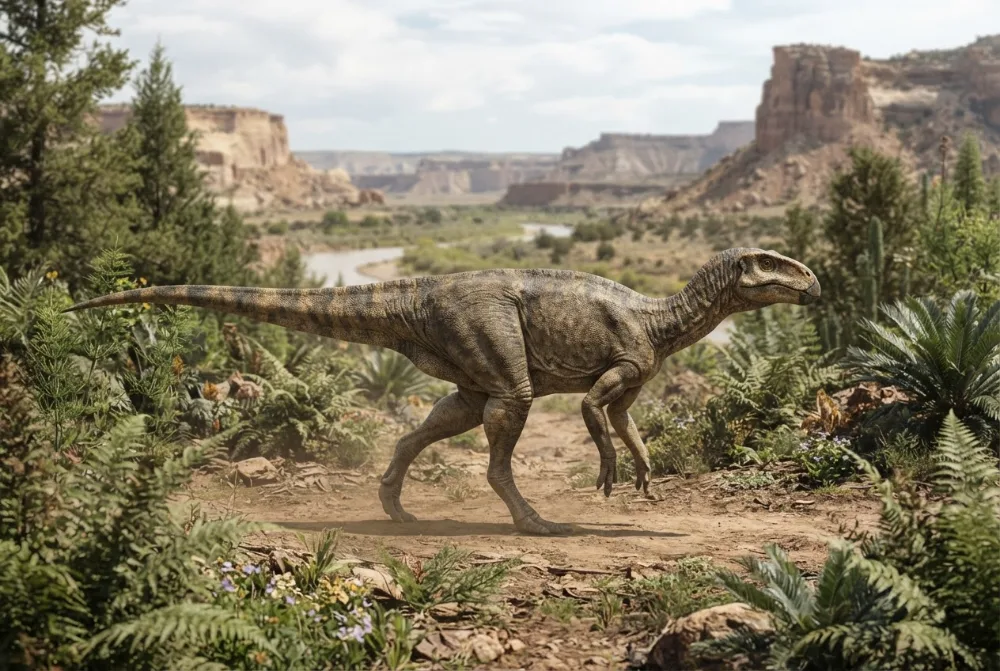
Iani was a plant-eating dinosaur that lived about 99 million years ago in what is now Utah. It had a powerful jaw with teeth perfect for chewing tough plants, and it might have been one of the last of its kind before duckbill dinosaurs took over.1
Berɛ bɛn na ɛtenaa ase?
Na ɛyɛ ntɛm sɛn?


Nsɛm a ɛyɛ anigye
Iani is named after Janus, the Roman god of change, because it lived during a time when Earth's climate was warming and dinosaur populations were shifting.1
The only known skeleton of Iani is from a juvenile and includes a nearly complete skull, vertebrae, and parts of the arms and legs.1
Iani belongs to a group of dinosaurs called rhabdodontomorphs, which were mostly known from Europe before this discovery.1
During Iani's time, giant sauropods were disappearing from North America, and new dinosaurs like early duckbills and tyrannosaurs were arriving from Asia.1
Scientists think Iani might have been one of the last survivors of a dinosaur lineage that was eventually replaced by duckbill dinosaurs.1
Nsɛm a wɔbisa bebree fa Iani ho
?How big was Iani?
Iani was about 3 metres (10 feet) long, about the size of a small car. It was a plant-eater that stood on two legs.3
?What did Iani eat?
Iani was a vegetarian. It had a powerful jaw and teeth with many ridges to chew through tough plant material.34
Ma dino ho animdefoɔ
- Nyansahu din
- Iani
- Obi a ɔtoo din
- Zanno et al. 20235
- Kuo
- Ahabandifoɔ a wɔwɔ anomaa ano
- Abusua / kuo kɛseɛ
- Tenontosauridae5
- Nkyekyɛmu
- Ornithischia > Ornithopoda > Iguanodontia5
- Abotan no mfeɛ
- mfeɛ ɔpepem 100 kɔsi 94 (Cenomanian)5
- Abotan nhyehyɛeɛ
- Cedar Mountain5
- Aman
- Amerika5
- Fɔsil nkyerɛwee
- 1 wɔ The Paleobiology Database mu5
- Nhunumu
- The only known specimen of Iani was discovered in 2014 in Utah's Cedar Mountain Formation. It was named Iani smithi in 2023 by Lindsay Zanno and her team, with the species name honoring paleontologist Joshua Aaron Smith.21
- Wɔda so gye ho akyinnye
- Scientists are still debating whether Iani is a rhabdodontomorph, a group of dinosaurs mostly found in Europe, which would mean this lineage survived longer in North America than previously thought.1
Baabi a nsɛm no firi
- New Dino, ‘Iani,’ Was Face of a Changing Planet | NC State News (news.ncsu.edu)
- Iani (en.wikipedia.org)
- Dinosaurs: New vegetarian dinosaur discovered in Utah - BBC Newsround (bbc.co.uk)
- An early-diverging iguanodontian (Dinosauria: Rhabdodontomorpha) from the Late Cretaceous of North America | PLOS One (journals.plos.org)
- Iani in The Paleobiology Database (CC BY 4.0): mfeɛ, mmeaeɛ, abotan nhyehyɛeɛ, nkyekyɛmu.
Asɛm biara a ɛwɔ krataafa yi so wɔ nɔma a ɛkyerɛ baabi a ɛfiri. Sɛ yɛfom biribi a, kafra, yɛyɛ dino dɔfoɔ, yɛnyɛ nyansahu nsɛmma krataa. Ka kyerɛ yɛn wɔ [email protected] na yɛbɛsiesie.
 Ɔkɔm de Rex! Dino Wiki yɛ agya bi adwuma a ɔyɛɛ maa ne babarima a ɔdɔ dino. Ɛyɛ kwa, dawurubɔ biara nni mu, akyidifoɔ biara nni mu. Mpanimfoɔ bɛtumi ama Rex aduane kakra, na aboa ama Dino Wiki atena intanɛt so.Ma Rex aduane
 Iguanodon
 Tenontosaurus
 Thescelosaurus
 Zalmoxes
 Camptosaurus
 Rhabdodon
 Tyrannosaurus
 Triceratops
 Velociraptor
 Spinosaurus
 Ankylosaurus
 Parasaurolophus