 Woyɛ dino bɛn? Nsɛmmisa agoro
 Dino ko
 Dino mmirikatuo
 Dino agodie nketewa
 Stika nwoma
 Dino TOP nhyehyɛeɛ
 Ma me nwanwa!
Megacephalosaurus
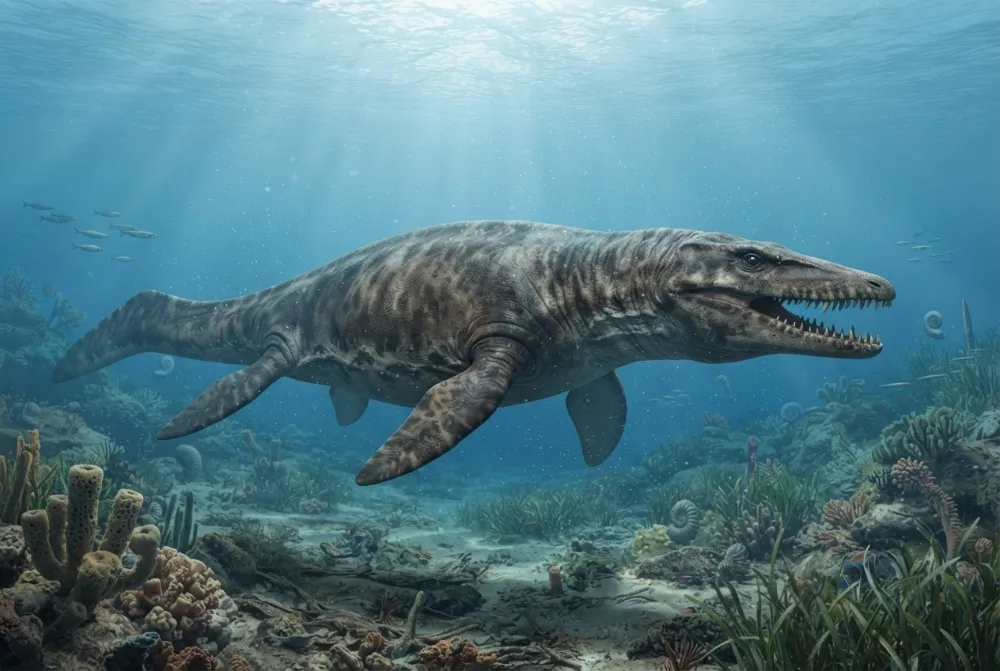
Megacephalosaurus was a huge, short-necked plesiosaur that swam in the ancient sea that split North America in two. It had a massive head, the biggest of any plesiosaur found on the continent, and used its long snout to catch smaller prey.1
Berɛ bɛn na ɛtenaa ase?
Na ne kɛseɛ yɛ sɛn?
Na ne tenten yɛ sɛn?
 ne tenten te sɛ kaa 2 a wɔde agyina toatoa so🍌ne tenten te sɛ kwadu 50 a wɔde abɔ toatoa so🏊anka ɔbɛtumi aguare nsuguarebea kɛseɛ (50 m) tenten wɔ sikɛn 7.8 mu
Megacephalosaurus kɛseɛ yɛ sɛn sɛ wode toto WO ho a?
Akontaa nko ara wɔ wo browser mu. Yɛnkora biribiara so, na yɛmmfa biribiara nkɔ baabiara.
Na ɛyɛ ntɛm sɛn?


Nsɛm a ɛyɛ anigye
Megacephalosaurus was one of the last pliosaurs, living about 94 to 93 million years ago during the Turonian stage of the Late Cretaceous.1
Its skull was up to 1.75 meters (5.7 feet) long, making it the largest skull of any plesiosaur known from North America.1
The teeth had long, thin ridges called apicobasal ridges that helped grip and puncture slippery prey.1
It shared its ocean home with sharks like Cretoxyrhina and Squalicorax, as well as other marine reptiles like mosasaurs and sea turtles.1
The first fossils were found in 1950 and were originally thought to belong to a different pliosaur called Brachauchenius lucasi.1
It was not until 2013 that scientists realized the fossils were from a new, distinct animal and named it Megacephalosaurus.1
Nsɛm a wɔbisa bebree fa Megacephalosaurus ho
?How big was Megacephalosaurus?
It was one of the largest marine reptiles of its time, estimated to be 6 to 9 meters (20 to 30 ft) long. Its skull alone could reach 1.75 meters (5.7 ft) in length.1
?What did Megacephalosaurus eat?
It likely ate smaller prey, because it had a long snout and teeth that were all about the same size. Its teeth had ridges that helped grip and puncture slippery animals.12
?When did Megacephalosaurus live?
It lived about 94 to 93 million years ago, during the Turonian stage of the Late Cretaceous. It was among the last of the pliosaurs.1
?Is Megacephalosaurus a dinosaur?
No, it is not a dinosaur. It is a plesiosaur, a type of marine reptile that lived in the ocean at the same time as dinosaurs.1
Ma dino ho animdefoɔ
- Nyansahu din
- Megacephalosaurus
- Obi a ɔtoo din
- Schumacher et al. 20133
- Kuo
- Plesiosɔɔ
- Abusua / kuo kɛseɛ
- Pliosauridae3
- Nkyekyɛmu
- Plesiosauria > Pliosauridae > Sauropterygia3
- Abotan no mfeɛ
- mfeɛ ɔpepem 94 kɔsi 90 (Turonian)3
- Abotan nhyehyɛeɛ
- Carlile Shale, Greenhorn Limestone3
- Aman
- Amerika3
- Fɔsil nkyerɛwee
- 2 wɔ The Paleobiology Database mu3
- Nhunumu
- The first fossils were discovered in 1950 by George F. Sternberg in Kansas. They were later studied by Bruce Schumacher, Kenneth Carpenter, and Mike Everhart, who named the new species Megacephalosaurus eulerti in 2013.1
- Wɔda so gye ho akyinnye
- Scientists are still debating how the last brachauchenine pliosaurs, including Megacephalosaurus, are related to each other and what their teeth tell us about their evolution.2
Baabi a nsɛm no firi
- Megacephalosaurus (en.wikipedia.org)
- Morphological and phylogenetic aspects of the dentition of Megacephalosaurus eulerti , a pliosaurid from the Turonian of Kansas, USA, with remarks on the cranial anatomy of the taxon (cambridge.org)
- Megacephalosaurus in The Paleobiology Database (CC BY 4.0): mfeɛ, mmeaeɛ, abotan nhyehyɛeɛ, nkyekyɛmu.
Asɛm biara a ɛwɔ krataafa yi so wɔ nɔma a ɛkyerɛ baabi a ɛfiri. Sɛ yɛfom biribi a, kafra, yɛyɛ dino dɔfoɔ, yɛnyɛ nyansahu nsɛmma krataa. Ka kyerɛ yɛn wɔ [email protected] na yɛbɛsiesie.
 Ɔkɔm de Rex! Dino Wiki yɛ agya bi adwuma a ɔyɛɛ maa ne babarima a ɔdɔ dino. Ɛyɛ kwa, dawurubɔ biara nni mu, akyidifoɔ biara nni mu. Mpanimfoɔ bɛtumi ama Rex aduane kakra, na aboa ama Dino Wiki atena intanɛt so.Ma Rex aduane
 Elasmosaurus
 Pliosaurus
 Plesiosaurus
 Cimoliasaurus
 Colymbosaurus
 Trinacromerum
 Tyrannosaurus
 Triceratops
 Velociraptor
 Spinosaurus
 Ankylosaurus
 Parasaurolophus