 Woyɛ dino bɛn? Nsɛmmisa agoro
 Dino ko
 Dino mmirikatuo
 Dino agodie nketewa
 Stika nwoma
 Dino TOP nhyehyɛeɛ
 Ma me nwanwa!
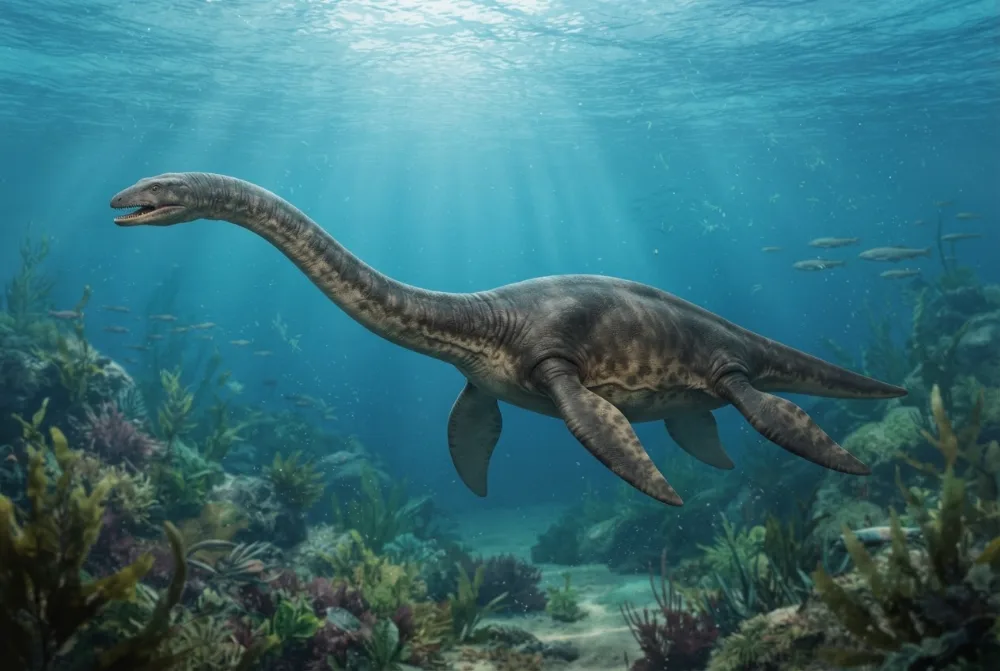
Plesiosaurus
Plesiosaurus was a marine reptile that swam in the oceans while dinosaurs lived on land. It had a long neck, a small head, and four flipper-like limbs to push through the water. It was about 3.5 metres long and ate small prey like fish and crustaceans.1
Berɛ bɛn na ɛtenaa ase?
Na ne kɛseɛ yɛ sɛn?
Na ne tenten yɛ sɛn?
 ne tenten te sɛ nkraman 4 firi hwene kɔsi dua🍌ne tenten te sɛ kwadu 19 a wɔde abɔ toatoa so🏊anka ɔbɛtumi aguare nsuguarebea kɛseɛ (50 m) tenten wɔ sikɛn 6.2 mu
Plesiosaurus kɛseɛ yɛ sɛn sɛ wode toto WO ho a?
Akontaa nko ara wɔ wo browser mu. Yɛnkora biribiara so, na yɛmmfa biribiara nkɔ baabiara.
Na ɛyɛ ntɛm sɛn?


Nsɛm a ɛyɛ anigye
Plesiosaurus was named in 1821 by William Conybeare and Henry Thomas De la Beche, and the name means 'near reptile'.1
Mary Anning discovered an almost complete Plesiosaurus skeleton in 1823, which helped scientists understand what these animals looked like.1
Plesiosaurs swam with four flipper-like limbs, and experiments with robot flippers showed they could generate 60% more thrust from their back flipper by timing both limbs carefully.1
Plesiosaurs were unable to return to land, so they likely gave birth to live young in the open water, as supported by a preserved foetus in a related species.1
Plesiosaurs survived for more than 140 million years, making it through multiple extinctions that wiped out other groups.1
Some plesiosaurs swallowed stones that stayed in their stomachs, possibly to help break up food or to help with buoyancy.1
Nsɛm a wɔbisa bebree fa Plesiosaurus ho
?Is Plesiosaurus a dinosaur?
No, it is a marine reptile that lived in the oceans while dinosaurs lived on land. It is only distantly related to dinosaurs.1
?What did Plesiosaurus eat?
It ate small prey like fish and crustaceans.1
?When did Plesiosaurus live?
It lived during the Early Jurassic, about 203 to 174 million years ago.3
?Who discovered Plesiosaurus?
Mary Anning discovered the first complete skeleton in 1823 near Lyme Regis, England.31
?Did Plesiosaurus have live babies?
Yes, it gave birth to live young in the water. A fossil of a related species shows a single large baby inside its mother.14
?Could Plesiosaurus go on land?
No, it was fully adapted to life in the water and could not return to land.1
Atosɛm sɛefoɔ
Atosɛm: Plesiosaurs are often thought to be dinosaurs, especially because they lived at the same time.
Nokorɛ: Plesiosaurs are marine reptiles and are only distantly related to dinosaurs, which lived on land.1
Ma dino ho animdefoɔ
- Nyansahu din
- Plesiosaurus
- Obi a ɔtoo din
- de la Beche and Conybeare 18215
- Kuo
- Plesiosɔɔ
- Abusua / kuo kɛseɛ
- Plesiosauroidea5
- Nkyekyɛmu
- Plesiosauria > Sauropterygia5
- Abotan no mfeɛ
- mfeɛ ɔpepem 206 kɔsi 66 (Rhaetian / Maastrichtian)5
- Abotan nhyehyɛeɛ
- Kimmeridge Clay, Charmouth Mudstone, Westbury5
- Aman
- Engiresi, Frɛnse, Amerika, Bɛlgyium, New Zealand, Afrika Anaafoɔ5
- Fɔsil nkyerɛwee
- 55 wɔ The Paleobiology Database mu5
- Nhunumu
- Plesiosaurus was named in 1821 by William Conybeare and Henry Thomas De la Beche, and Mary Anning discovered an almost complete skeleton in 1823.1
- Wɔda so gye ho akyinnye
- Scientists still debate how plesiosaurs used their four flippers to swim, and whether the stones they swallowed helped with digestion or buoyancy.1
Baabi a nsɛm no firi
- What is a plesiosaur? The prehistoric sea creatures that inspired the Loch Ness Monster | Natural History Museum (nhm.ac.uk)
- PBDB Taxon (paleobiodb.org)
- Plesiosaurus (Wikipedia) (Wikipedia)
- Plesiosaur (en.wikipedia.org)
- Plesiosaurus in The Paleobiology Database (CC BY 4.0): mfeɛ, mmeaeɛ, abotan nhyehyɛeɛ, nkyekyɛmu.
Asɛm biara a ɛwɔ krataafa yi so wɔ nɔma a ɛkyerɛ baabi a ɛfiri. Sɛ yɛfom biribi a, kafra, yɛyɛ dino dɔfoɔ, yɛnyɛ nyansahu nsɛmma krataa. Ka kyerɛ yɛn wɔ [email protected] na yɛbɛsiesie.
 Ɔkɔm de Rex! Dino Wiki yɛ agya bi adwuma a ɔyɛɛ maa ne babarima a ɔdɔ dino. Ɛyɛ kwa, dawurubɔ biara nni mu, akyidifoɔ biara nni mu. Mpanimfoɔ bɛtumi ama Rex aduane kakra, na aboa ama Dino Wiki atena intanɛt so.Ma Rex aduane
 Elasmosaurus
 Pliosaurus
 Cimoliasaurus
 Colymbosaurus
 Trinacromerum
 Cryptoclidus
 Stegosaurus
 Iguanodon
 Archaeopteryx
 Giganotosaurus
 Microraptor
 Deinonychus