 Woyɛ dino bɛn? Nsɛmmisa agoro
 Dino ko
 Dino mmirikatuo
 Dino agodie nketewa
 Stika nwoma
 Dino TOP nhyehyɛeɛ
 Ma me nwanwa!
Paralitherizinosaurus
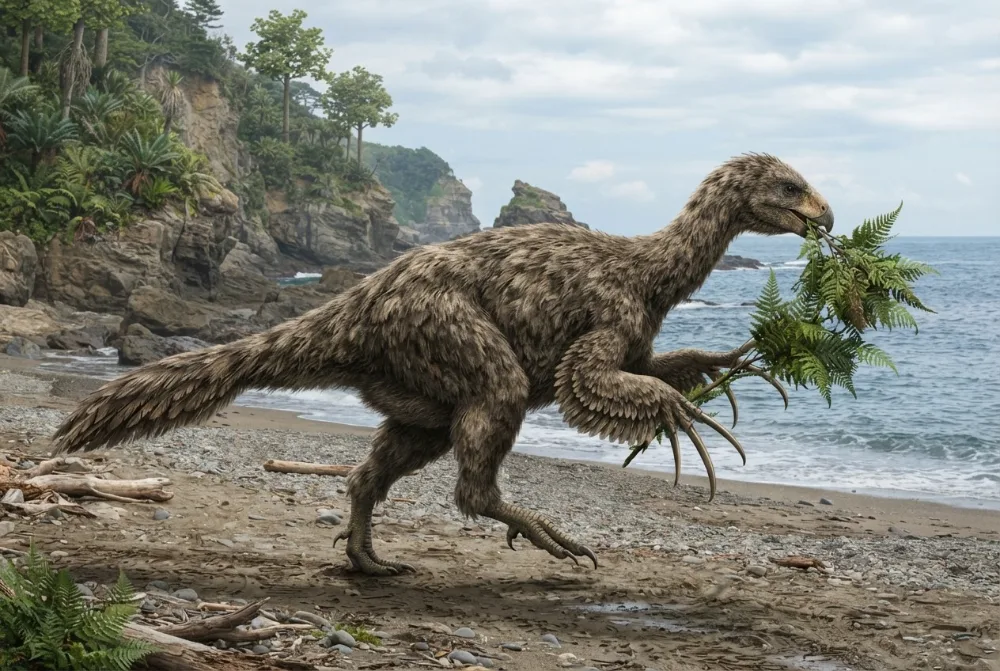
Paralitherizinosaurus was a strange, plant-eating dinosaur with long, curved claws on its hands. It lived near the coast of ancient Japan and used its claws to pull leaves and branches toward its mouth. This dinosaur was covered in feathers and looked a bit like a giant, slow-moving bird.14
Berɛ bɛn na ɛtenaa ase?
Na ne kɛseɛ yɛ sɛn?
Na ne tenten yɛ sɛn?
Na ne korɔn yɛ sɛn?
nsusuiɛ
Na ne mu yɛ duru sɛn?
 ne tenten te sɛ nkraman 4 firi hwene kɔsi dua🍌ne tenten te sɛ kwadu 20 a wɔde abɔ toatoa so🍉ne mu duru te sɛ watamɛlɔn 56🧸ne mu duru te sɛ nkɔkɔaa sukuu mmofra 15🎒ne mu duru te sɛ sukuu mmofra 9🏃anka ɔbɛtumi atu mmirika mita 100 wɔ sikɛn 13 mu (onipa a ɔyɛ ntɛm sen biara hia 9.6)
Paralitherizinosaurus kɛseɛ yɛ sɛn sɛ wode toto WO ho a?
Akontaa nko ara wɔ wo browser mu. Yɛnkora biribiara so, na yɛmmfa biribiara nkɔ baabiara.
Na ɛyɛ ntɛm sɛn?


Nsɛm a ɛyɛ anigye
Paralitherizinosaurus is the youngest therizinosaur ever found in Japan, living about 83 to 72 million years ago.1
Its fossils were discovered in a marine rock layer, meaning it lived near the coast and its body washed out to sea after death.1
Only a partial hand and a single vertebra have been found, but those bones show it had very slender, curved claws like its relative Therizinosaurus.1
The first bone of its thumb (metacarpal I) was flattened from top to bottom, a unique feature that helps scientists tell it apart from other dinosaurs.1
Its claws had weak flexor tubercles (the bump where a muscle attaches), which means it used a hook-and-pull motion to bring branches to its mouth, not to slash or stab.1
Paralitherizinosaurus is one of the few therizinosaurs found in marine sediments anywhere in the world, along with Nothronychus from North America.1
Nsɛm a wɔbisa bebree fa Paralitherizinosaurus ho
?What did Paralitherizinosaurus eat?
It was a plant-eater. It used its long, curved claws to hook and pull leaves and branches toward its mouth.1
?How big was Paralitherizinosaurus?
Nobody knows for sure because only a partial hand and a neck bone have been found. It was probably medium-sized, but its exact size is unknown.3
?Did Paralitherizinosaurus have feathers?
Yes, it was a feathered theropod dinosaur, related to other feathered dinosaurs like Therizinosaurus. It probably looked like a big, slow-moving bird.3
Ma dino ho animdefoɔ
- Nyansahu din
- Paralitherizinosaurus
- Obi a ɔtoo din
- Kobayashi et al. 20224
- Kuo
- Dino nwonwa a wɔwɔ ntakra
- Abusua / kuo kɛseɛ
- Therizinosauridae4
- Nkyekyɛmu
- Theropoda > Therizinosauria4
- Abotan no mfeɛ
- mfeɛ ɔpepem 84 kɔsi 72 (Campanian)4
- Abotan nhyehyɛeɛ
- Osoushinai4
- Aman
- Gyapan4
- Fɔsil nkyerɛwee
- 1 wɔ The Paleobiology Database mu4
- Nhunumu
- The first fossils of Paralitherizinosaurus were found in a concretion (a hard rock nodule) near a river in Hokkaido, Japan. Scientists Murakami and colleagues first described the bones in 2008, but it was not until 2022 that Kobayashi and his team named it as a new species.1
- Wɔda so gye ho akyinnye
- Scientists are not sure exactly where Paralitherizinosaurus fits on the therizinosaur family tree. It might be closely related to Therizinosaurus, Suzhousaurus, and another unnamed form from the Bissekty Formation, but the relationships are still debated.1
Baabi a nsɛm no firi
- New therizinosaurid dinosaur from the marine Osoushinai Formation (Upper Cretaceous, Japan) provides insight for function and evolution of therizinosaur claws (pmc.ncbi.nlm.nih.gov)
- Paralitherizinosaurus japonicus | Dinosaur Database by DinoAnimals.com (dinoanimals.com)
- Paralitherizinosaurus (en.wikipedia.org)
- Paralitherizinosaurus in The Paleobiology Database (CC BY 4.0): mfeɛ, mmeaeɛ, abotan nhyehyɛeɛ, nkyekyɛmu.
Asɛm biara a ɛwɔ krataafa yi so wɔ nɔma a ɛkyerɛ baabi a ɛfiri. Sɛ yɛfom biribi a, kafra, yɛyɛ dino dɔfoɔ, yɛnyɛ nyansahu nsɛmma krataa. Ka kyerɛ yɛn wɔ [email protected] na yɛbɛsiesie.
 Ɔkɔm de Rex! Dino Wiki yɛ agya bi adwuma a ɔyɛɛ maa ne babarima a ɔdɔ dino. Ɛyɛ kwa, dawurubɔ biara nni mu, akyidifoɔ biara nni mu. Mpanimfoɔ bɛtumi ama Rex aduane kakra, na aboa ama Dino Wiki atena intanɛt so.Ma Rex aduane
 Therizinosaurus
 Oviraptor
 Chirostenotes
 Citipes
 Leptorhynchos
 Avimimus
 Tyrannosaurus
 Triceratops
 Velociraptor
 Spinosaurus
 Ankylosaurus
 Parasaurolophus