
Agujaceratops
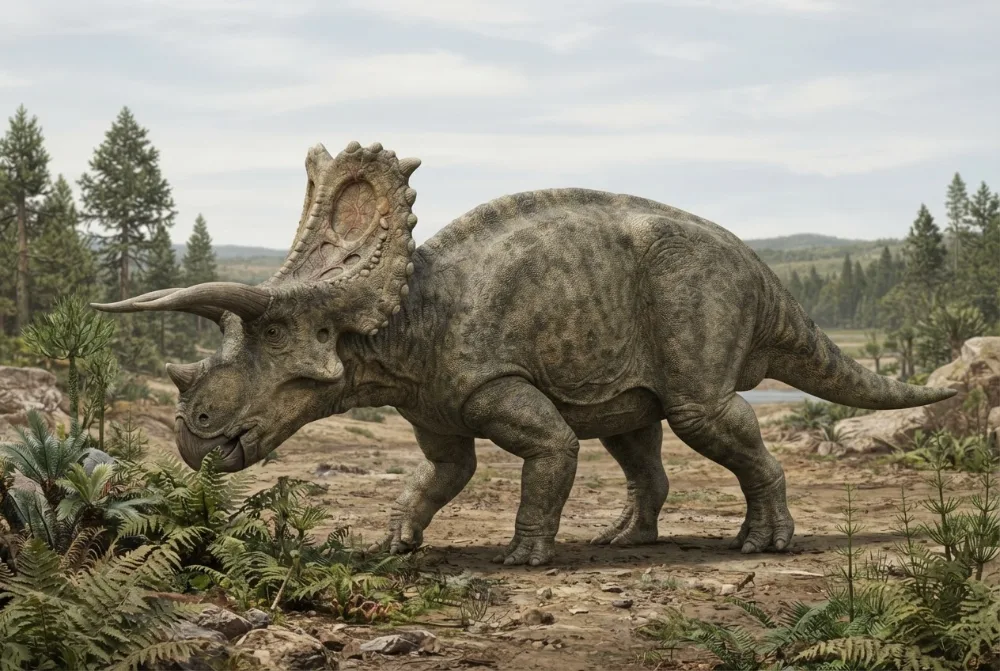
Agujaceratops was a big, four-legged plant eater with a huge frill and long horns on its face. It lived in what is now Texas and Mexico, about 77 million years ago. It looked a bit like a Triceratops, but with a longer frill and different horns.13
When did it live?
How big was it?
How big was Agujaceratops compared to YOU?
Just maths in your browser. Nothing is saved or sent anywhere.
Fun facts
Agujaceratops had a heart-shaped frill with a deep notch at the back, and the edges were covered with small, blunt hornlets that made it look scalloped.1
Its brow horns pointed up and out, then curved backwards, which is different from many other horned dinosaurs.1
There are two known species: Agujaceratops mariscalensis and Agujaceratops mavericus. The second one has longer brow horns and a longer frill.1
Many Agujaceratops fossils have been found together in one quarry, which might mean they lived in herds or were gathered by a flood.1
It lived alongside the feathered dinosaur Leptorhynchos and the small pachycephalosaur Texacephale, and was hunted by tyrannosaurs and the giant crocodilian Deinosuchus.1
The first fossils were found in 1938 in Big Bend National Park, Texas, but they were not studied until many years later.1
Most asked questions about Agujaceratops
?How big was Agujaceratops?
Agujaceratops was about 4.3 metres (14 feet) long and weighed around 1.5 metric tons (1.7 short tons). That is roughly the size of a small car.1
?What did Agujaceratops eat?
It was a four-legged plant eater, like other ceratopsids. It probably ate low-growing plants with its beak and teeth.13
?When did Agujaceratops live?
It lived about 77 million years ago, during the Late Cretaceous period. Its fossils are found in Texas and Mexico.13
?Why did Agujaceratops have a frill?
The frill and horns were probably used for showing off to other members of its species, and maybe for fighting over territory or mates.1

Ask Rex about Agujaceratops
Rex only answers questions about this page. 3 questions a day.
Rex is an AI and can make mistakes. He runs on servers in the EU and questions are never saved. Never type your name or other personal things.
Myth buster
Myth: Some people think Agujaceratops is the same as Chasmosaurus.
Truth: It was first named Chasmosaurus mariscalensis, but scientists later decided it was different enough to be its own genus, Agujaceratops.1
For dino experts
- Scientific name
- Agujaceratops
- Named by
- Lucas et al. 20063
- Group
- Horned dinos
- Family / clade
- Ceratopsidae3
- Classification
- Ornithischia > Ceratopsia > Ceratopsidae3
- Age of the rocks
- 84 to 72 million years (Campanian)3
- Rock formations
- Aguja3
- Countries
- USA, Mexico3
- Fossil records
- 16 in the Paleobiology Database3
- Discovery
- The first fossils were collected in 1938 from Big Bend National Park, Texas. In 1989, Lehman named them Chasmosaurus mariscalensis, and in 2006 Lucas, Sullivan, and Hunt gave them the new name Agujaceratops.1
- Still debated
- Scientists are not sure if the many Agujaceratops fossils found together represent a herd or just animals that died together in a drought or flood.1
Where the facts come from
- Agujaceratops (en.wikipedia.org)
- PBDB Taxon (paleobiodb.org)
- Agujaceratops in The Paleobiology Database (CC BY 4.0): age, places, rock formations, classification.
Every fact on this page has a number that points to its source. If we got something wrong, sorry, we are dino fans, not a science journal. Tell us at [email protected] and we will fix it.
Rex is hungry! Dino Wiki is a dad's project for his dino-loving son, free with no ads. Grown-ups can feed Rex a snack to help keep it online.Feed Rex Triceratops
 Protoceratops
 Ojoceratops
 Tatankaceratops
 Psittacosaurus
 Centrosaurus
 Velociraptor
 Spinosaurus
 Ankylosaurus
 Parasaurolophus
 Pteranodon