
Alamodactylus
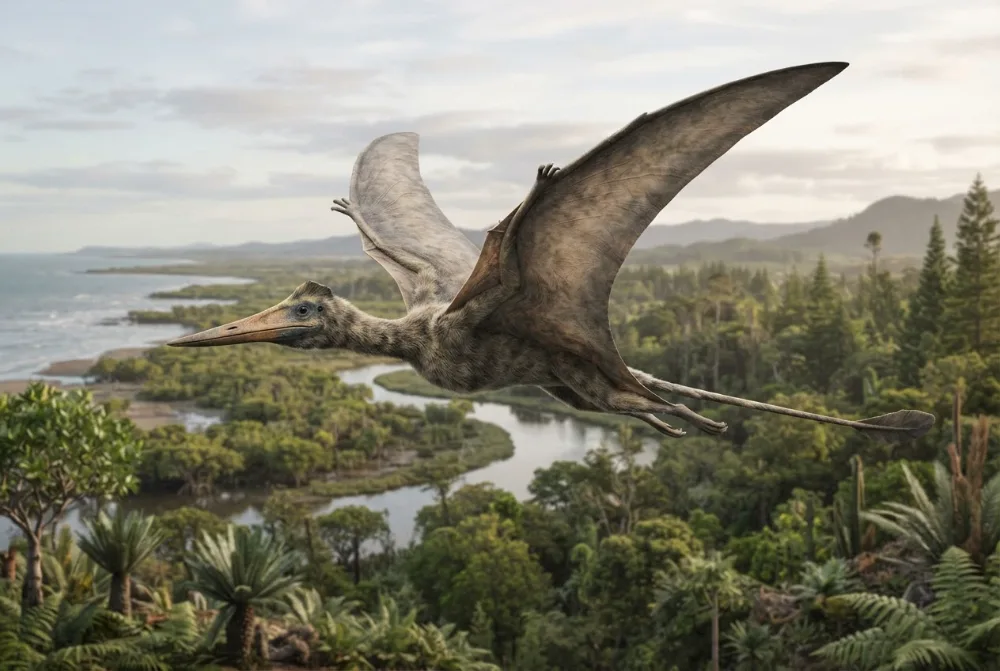
Alamodactylus was a flying reptile that soared over Texas about 88 million years ago. It had long, narrow wings and probably glided over the sea to catch fish. It was not a dinosaur, but a pterosaur, a close cousin of dinosaurs.13
When did it live?
Fun facts
Alamodactylus is known from only one partial wing, including a humerus and other bones, found in Texas.1
Its name means 'Alamo finger' because the fossil was found in Texas, the 'Alamo' state, and pterosaurs often have 'finger' in their names due to their long wing digits.1
Scientists think it was a medium-sized pterosaur, but they don't know its exact size because only a few bones have been found.1
The fossil was first thought to be from a Pteranodon, but later study showed it was a new kind of pterosaur.1
Alamodactylus lived about 89.8 to 88 million years ago, during the Late Cretaceous period.1
Its wing bones show a unique combination of features, like a constricted humerus shaft and a D-shaped cross-section, that set it apart from other pterosaurs.1
Most asked questions about Alamodactylus
?How big was Alamodactylus?
Its wingspan is estimated at about 4 to 5 metres (13 to 16.5 feet), but scientists are not sure because only a few bones have been found.2
?What did Alamodactylus eat?
It was a carnivore and probably caught fish by flying over the sea.2
?When did Alamodactylus live?
It lived about 89.8 to 88 million years ago, during the Late Cretaceous period.1

Ask Rex about Alamodactylus
Rex only answers questions about this page. 3 questions a day.
Rex is an AI and can make mistakes. He runs on servers in the EU and questions are never saved. Never type your name or other personal things.
Myth buster
Myth: Alamodactylus was a dinosaur.
Truth: It was a pterosaur, a flying reptile that is a close relative of dinosaurs, but not a dinosaur itself.1
For dino experts
- Scientific name
- Alamodactylus
- Named by
- Andres and Myers 20133
- Group
- Flying reptiles
- Family / clade
- Pteranodontia3
- Classification
- Pterosauria > Pterodactyloidea3
- Age of the rocks
- 90 to 86 million years (Coniacian)3
- Rock formations
- Atco3
- Countries
- USA3
- Fossil records
- 1 in the Paleobiology Database3
- Discovery
- The fossil was discovered by Gary Byrd, who it is named after, and first described in 2010. It was given its own genus and species name, Alamodactylus byrdi, by Brian Andres and Timothy Myers in 2013.1
- Still debated
- Scientists still debate exactly where Alamodactylus fits in the pterosaur family tree. Some studies place it close to Pteranodon, while others put it in the Nyctosauridae group.1
Where the facts come from
- Alamodactylus (en.wikipedia.org)
- Alamodactylus — Pteros (pteros.com)
- Alamodactylus in The Paleobiology Database (CC BY 4.0): age, places, rock formations, classification.
Every fact on this page has a number that points to its source. If we got something wrong, sorry, we are dino fans, not a science journal. Tell us at [email protected] and we will fix it.
Rex is hungry! Dino Wiki is a dad's project for his dino-loving son, free with no ads. Grown-ups can feed Rex a snack to help keep it online.Feed Rex Pteranodon
 Quetzalcoatlus
 Dorygnathus
 Rhamphorhynchus
 Anhanguera
 Pterodactylus
 Triceratops
 Velociraptor
 Spinosaurus
 Ankylosaurus
 Parasaurolophus