
Alanqa
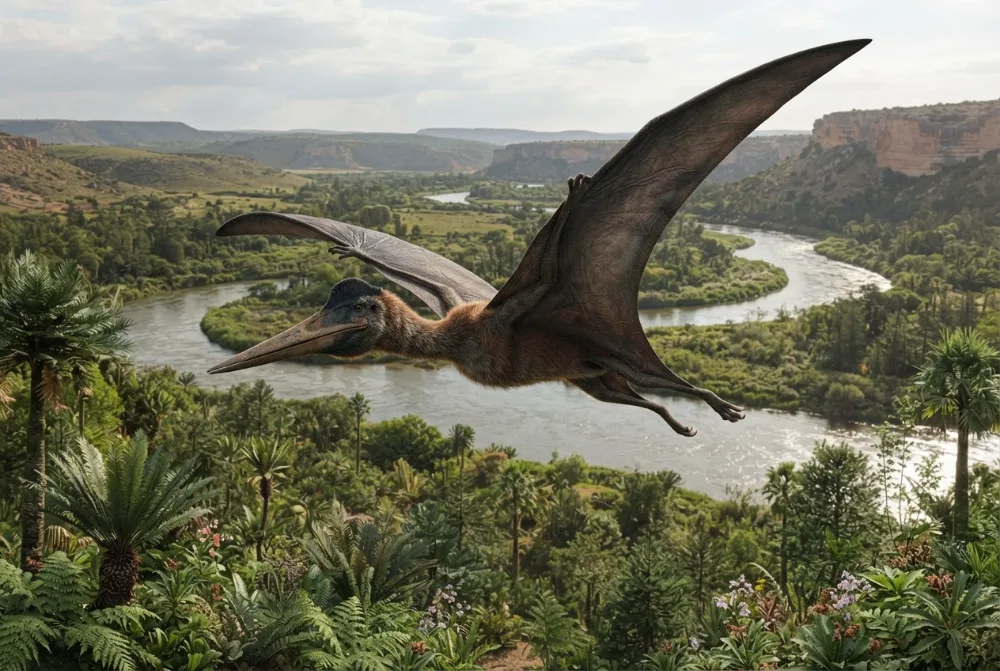
Alanqa was a giant flying reptile that soared over ancient rivers in what is now Morocco. It had a long, straight, pointed beak with no teeth, perfect for scooping up fish and other small animals.2
When did it live?
How big was it?
How wide were its wings?
How heavy was it?
How big was Alanqa compared to YOU?
Just maths in your browser. Nothing is saved or sent anywhere.
Fun facts
Alanqa is known from only five jaw fragments and possibly one neck vertebra, so scientists have not found a full skeleton yet.1
Its beak was straight and pointed, like a spear, and it had a raised bump on the top of its lower jaw near the back.2
The largest Alanqa individuals may have had a wingspan as wide as a small airplane, about 6 meters (20 feet).21
Alanqa lived alongside huge meat-eating dinosaurs like Spinosaurus and Carcharodontosaurus, which might have hunted it.1
The Kem Kem Beds where Alanqa was found were once a freshwater delta, full of rivers and swamps.1
Two of the jaw fragments were first described in 1999 but were not named until 2010, when scientists realized they belonged to a new species.1
Most asked questions about Alanqa
?How big was Alanqa?
Most Alanqa individuals had a wingspan of about 4 meters (13 feet), but a larger neck vertebra suggests some reached 6 meters (20 feet). An individual of that size would have weighed 16 to 37 kilograms (35 to 82 pounds).1
?What did Alanqa eat?
Alanqa probably ate small animals like crustaceans, mollusks, amphibians, small reptiles, and even small or juvenile dinosaurs. Grooves in its jaw suggest it also crushed hard foods like mollusks and seeds.1
?Is Alanqa a dinosaur?
No, Alanqa is a pterosaur, a flying reptile that is not a dinosaur.1
?Where was Alanqa found?
Alanqa was found in the Kem Kem Group of southeastern Morocco, in a place called Aferdou N'Chaft near the village of Begaa.1
?When did Alanqa live?
Alanqa lived during the Late Cretaceous period, specifically the Cenomanian stage, about 100 to 93 million years ago.1
?Did Alanqa have teeth?
No, Alanqa had no teeth. Its jaws were straight and pointed, like a spear, perfect for scooping up food.1

Ask Rex about Alanqa
Rex only answers questions about this page. 3 questions a day.
Rex is an AI and can make mistakes. He runs on servers in the EU and questions are never saved. Never type your name or other personal things.
For dino experts
- Scientific name
- Alanqa
- Named by
- Ibrahim et al. 20104
- Group
- Flying reptiles
- Family / clade
- Azhdarchidae4
- Classification
- Pterosauria > Pterodactyloidea > Azhdarchidae4
- Age of the rocks
- 100 to 94 million years (Cenomanian)4
- Rock formations
- Ifezouane4
- Countries
- Morocco4
- Fossil records
- 4 in the Paleobiology Database4
- Discovery
- Alanqa was named in 2010 by Ibrahim and colleagues based on a nearly complete lower jaw found at Aferdou N'Chaft, Morocco, in 2008.21
- Still debated
- Scientists are not sure if the large neck vertebra really belongs to Alanqa or to a different, even bigger pterosaur.21
Where the facts come from
- Alanqa (en.wikipedia.org)
- A New Pterosaur (Pterodactyloidea: Azhdarchidae) from the Upper Cretaceous of Morocco - PMC (pmc.ncbi.nlm.nih.gov)
- PBDB Taxon (paleobiodb.org)
- Alanqa in The Paleobiology Database (CC BY 4.0): age, places, rock formations, classification.
Every fact on this page has a number that points to its source. If we got something wrong, sorry, we are dino fans, not a science journal. Tell us at [email protected] and we will fix it.
 Rex is hungry! Dino Wiki is a dad's project for his dino-loving son, free with no ads. Grown-ups can feed Rex a snack to help keep it online.Feed Rex
 Pteranodon
 Quetzalcoatlus
 Dorygnathus
 Rhamphorhynchus
 Anhanguera
 Pterodactylus
 Tyrannosaurus
 Triceratops
 Velociraptor
 Spinosaurus
 Ankylosaurus
 Parasaurolophus