
Almas
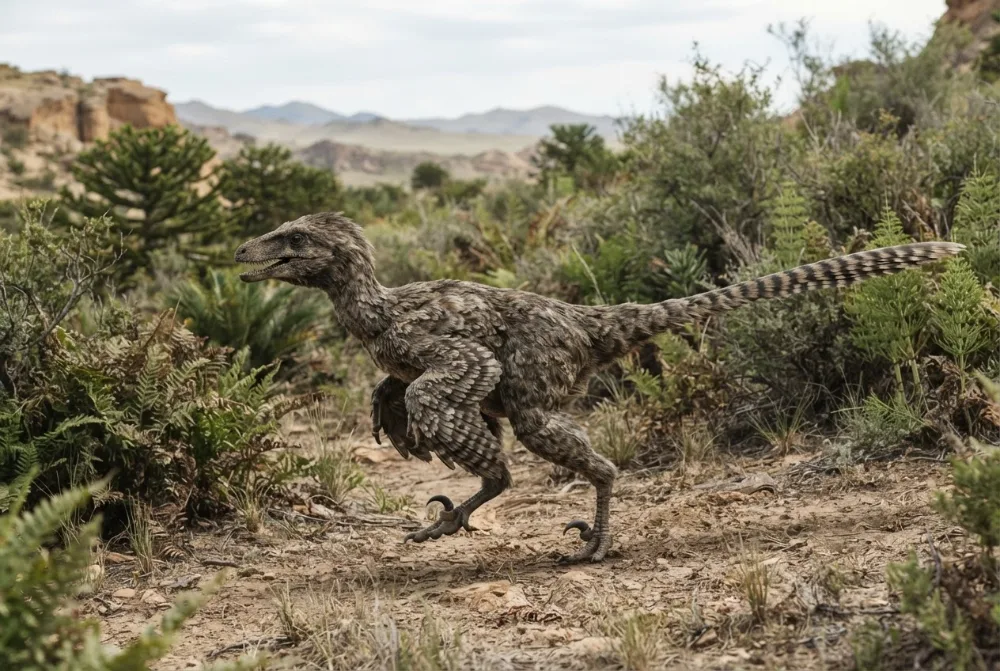
Almas was a tiny, bird-like dinosaur that lived in the desert of Mongolia. It was a smart hunter with big eyes and sharp teeth, but it was no bigger than a turkey!1
When did it live?
How big was it?
How long was it?
How big was Almas compared to YOU?
Just maths in your browser. Nothing is saved or sent anywhere.
Fun facts
Almas had a very short snout, like a puppy, which is unusual for a troodontid dinosaur.1
Its skull was only about 8 centimeters long, much smaller than other adult troodontids from the same time and place.1
Almas had a unique spike-like process on its ischium (a hip bone) that no other troodontid had.1
The third chevron (a bone under the tail) of Almas was more than three times as long as the tail vertebra above it.1
Almas lived about 75 to 71 million years ago in the Late Cretaceous, in a sandy desert.1
Its name comes from Mongolian folklore, where 'Almas' is a wild man or snowman.1

Ask Rex about Almas
Rex only answers questions about this page. 3 questions a day.
Rex is an AI and can make mistakes. He runs on servers in the EU and questions are never saved. Never type your name or other personal things.
For dino experts
- Scientific name
- Almas
- Named by
- Pei et al. 20172
- Group
- Raptors
- Family / clade
- Troodontidae2
- Classification
- Theropoda > Troodontidae2
- Age of the rocks
- 84 to 72 million years (Campanian)2
- Rock formations
- Djadokhta2
- Countries
- Mongolia2
- Fossil records
- 1 in the Paleobiology Database2
- Discovery
- Almas was discovered in 1993 by a joint expedition of the American Museum of Natural History and the Mongolian Academy of Sciences at Ukhaa Tolgod, Mongolia. It was named and described by Rui Pei and colleagues in 2017.1
- Still debated
- Scientists are not sure whether Almas was fully grown or a juvenile, because its bones show some adult features but it is very small.1
Where the facts come from
- digitallibrary.amnh.org (digitallibrary.amnh.org)
- Almas in The Paleobiology Database (CC BY 4.0): age, places, rock formations, classification.
Every fact on this page has a number that points to its source. If we got something wrong, sorry, we are dino fans, not a science journal. Tell us at [email protected] and we will fix it.
 Rex is hungry! Dino Wiki is a dad's project for his dino-loving son, free with no ads. Grown-ups can feed Rex a snack to help keep it online.Feed Rex
 Velociraptor
 Microraptor
 Deinonychus
 Asiamericana
 Richardoestesia
 Saurornitholestes
 Tyrannosaurus
 Triceratops
 Spinosaurus
 Ankylosaurus
 Parasaurolophus
 Pteranodon