 Home
 All dinos
 Dino groups
 Explore
 Dinos by country
 Dino vs dino
 How big were they?
 Dinos A to Z
 Who ate what?
 What dino are you? Quiz
 Dino games
 Dino battle
 Dino race
 Dino mini-games
 Sticker album
 Dino TOP lists
 Timeline
 Surprise me!
 Language: English

Apatorhamphus
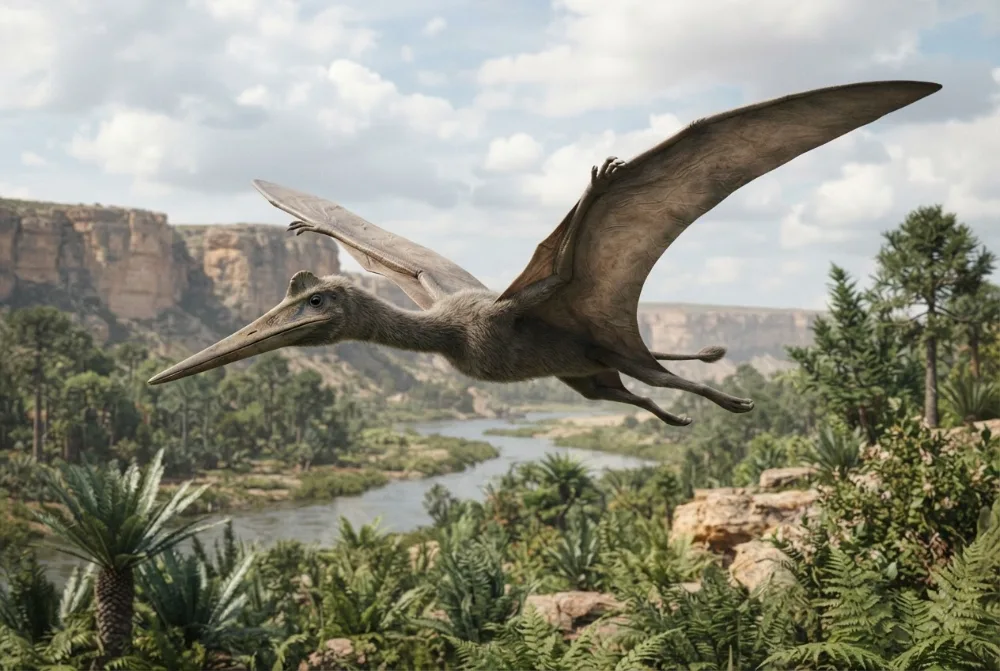
Apatorhamphus was a flying reptile that lived in what is now Morocco during the Cretaceous period. It had a long, toothless beak and probably ate fish. Scientists think it was a medium to large pterosaur with a wingspan of about 3 to 7 metres.12
 Morocco
When did it live?
Apatorhamphus: 106 to 94 million years ago
How big was it?
How wide were its wings?
 wings as wide as 4 bicycles in a row⚽could fly across a whole football pitch in 4.8 seconds
How big was Apatorhamphus compared to YOU?
Just maths in your browser. Nothing is saved or sent anywhere.
How fast was it?


Fun facts
Apatorhamphus is only known from a few snout fragments, making it a mysterious pterosaur.2
Its name means 'deceptive beak' because scientists found it hard to identify the toothless beak.1
It lived alongside other pterosaurs like Alanqa and Afrotapejara in a landscape with rivers and lakes.2
The holotype fossil was bought from miners by paleontologist David Martill in 2016.2
Apatorhamphus might belong to the Chaoyangopteridae family, which includes toothless pterosaurs with long beaks.1
Scientists think large adults and young Apatorhamphus may have eaten different foods to avoid competition.2
Most asked questions about Apatorhamphus
For dino experts
- Scientific name
- Apatorhamphus
- Named by
- McPhee et al. 20203
- Group
- Flying reptiles
- Family / clade
- Chaoyangopteridae3
- Classification
- Pterosauria > Pterodactyloidea3
- Age of the rocks
- 106 to 94 million years (Albian / Cenomanian)3
- Rock formations
- Ifezouane3
- Countries
- Morocco3
- Fossil records
- 3 in the Paleobiology Database3
- Discovery
- Apatorhamphus was named in 2020 by James McPhee and colleagues based on a snout fragment found in the Kem Kem beds of Morocco.31
- Still debated
- Scientists are not sure if Apatorhamphus belongs to the Chaoyangopteridae family or another group of toothless pterosaurs.1
Where the facts come from
- A new ?chaoyangopterid (Pterosauria: Pterodactyloidea) from the Cretaceous Kem Kem beds of southern Morocco (sciencedirect.com)
- Apatorhamphus (en.wikipedia.org)
- Apatorhamphus in The Paleobiology Database (CC BY 4.0): age, places, rock formations, classification.
Every fact on this page has a number that points to its source. If we got something wrong, sorry, we are dino fans, not a science journal. Tell us at hello@dinowiki.app and we will fix it.
 Rex is hungry! Dino Wiki is a dad's project for his dino-loving son, free with no ads and no cookies. Grown-ups can feed Rex a snack to help keep it online.Feed Rex
 Pteranodon
 Quetzalcoatlus
 Dorygnathus
 Rhamphorhynchus
 Anhanguera
 Pterodactylus
 Tyrannosaurus
 Triceratops
 Velociraptor
 Spinosaurus
 Ankylosaurus
 Parasaurolophus