
Arrhinoceratops
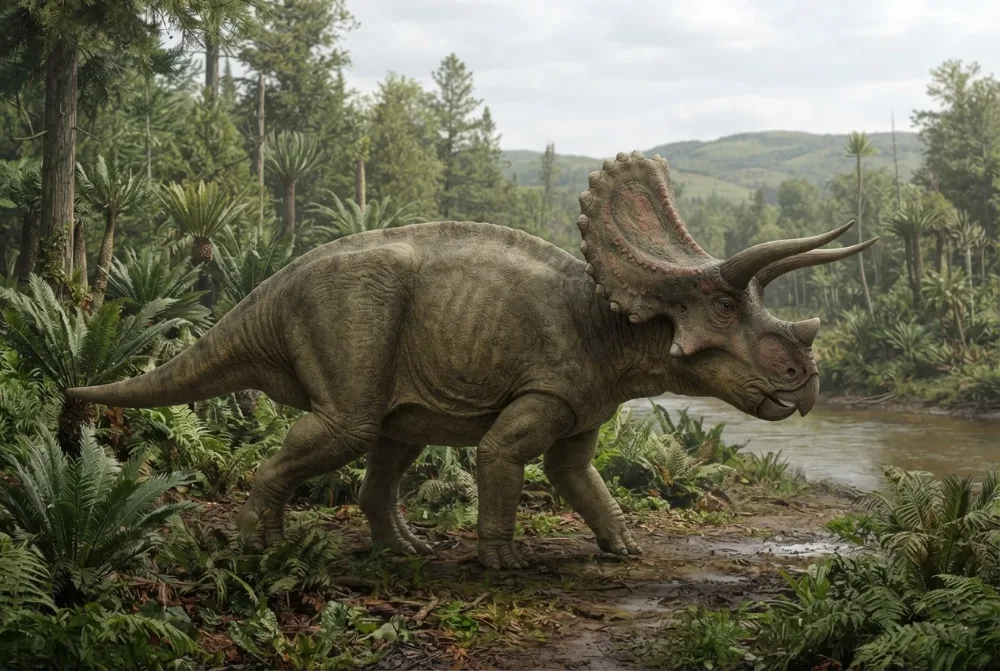
Arrhinoceratops was a horned dinosaur that lived in Canada near the end of the Age of Dinosaurs. It had a big frill on its head and two long brow horns, but its nose horn was short and blunt. Scientists know it mostly from one skull found in Alberta.12
When did it live?
How big was it?
How long was it?
How tall was it?
at the hips
How heavy was it?
How big was Arrhinoceratops compared to YOU?
Just maths in your browser. Nothing is saved or sent anywhere.
Fun facts
Arrhinoceratops lived a few million years before its famous relative Triceratops.1
The name 'Arrhinoceratops' means 'no nose-horn face', but scientists later realized it actually did have a nose horn, just a short one.1
Only one complete skull of Arrhinoceratops has been found, so scientists do not know much about the rest of its body.12
Its skull had a broad, square frill with two oval openings and a scalloped rear edge.1
The frill of Arrhinoceratops was decorated with about nine bony bumps called osteoderms along the sides.1
Arrhinoceratops lived in a wet coastal environment with warm summers and cool winters, and may have been hunted by the tyrannosaur Albertosaurus.1
The first Arrhinoceratops skull was found by a University of Toronto expedition in 1923 along the Red Deer River in Alberta.1
Most asked questions about Arrhinoceratops
?How big was Arrhinoceratops?
Estimates vary. Some popular science books estimate it was about 6 metres (20 ft) long, while Gregory S. Paul estimated 4.5 metres (15 ft) and 1.3 tonnes (2,900 lb).12
?What did Arrhinoceratops eat?
Arrhinoceratops was a herbivore. It likely ate ferns, cycads and conifers, using its sharp beak to bite off leaves or needles.1
?When did Arrhinoceratops live?
It lived during the Late Cretaceous, about 72 to 67 million years ago, a few million years before Triceratops.21
?Where was Arrhinoceratops found?
Its remains have been found in Canada, specifically along the Red Deer River in Alberta.12
?Did Arrhinoceratops have a nose horn?
Yes, it did have a nose horn, but it was short and blunt. The name 'no nose-horn face' was based on a misunderstanding.1
Ask Rex about Arrhinoceratops
Rex only answers questions about this page. 10 questions a month.
Rex is an AI and can make mistakes. He runs on servers in the EU and questions are never saved. Never type your name or other personal things.
Myth buster
Myth: Arrhinoceratops had no nose horn at all.
Truth: It actually had a short, blunt nose horn, like many other horned dinosaurs.1
For dino experts
- Scientific name
- Arrhinoceratops
- Named by
- Parks 19254
- Group
- Horned dinos
- Family / clade
- Ceratopsidae4
- Classification
- Ornithischia > Ceratopsia > Ceratopsidae4
- Age of the rocks
- 84 to 66 million years (Campanian / Maastrichtian)4
- Rock formations
- Horseshoe Canyon4
- Countries
- Canada4
- Fossil records
- 3 in the Paleobiology Database4
- Discovery
- William Arthur Parks named Arrhinoceratops in 1925 based on a skull found in Alberta, Canada, by a University of Toronto expedition in 1923.14
- Still debated
- Scientists are not sure exactly how Arrhinoceratops is related to other horned dinosaurs like Torosaurus and Anchiceratops.1
Where the facts come from
- Arrhinoceratops (en.wikipedia.org)
- Arrhinoceratops | Natural History Museum (nhm.ac.uk)
- Arrhinoceratops | Part of the Ceratopsian Family of Dinosaurs (dinosaurmadness.com)
- Arrhinoceratops in The Paleobiology Database (CC BY 4.0): age, places, rock formations, classification.
Every fact on this page has a number that points to its source. If we got something wrong, sorry, we are dino fans, not a science journal. Tell us at [email protected] and we will fix it.
 Rex is hungry! Dino Wiki is a dad's project for his dino-loving son, free with no ads. Grown-ups can feed Rex a snack to help keep it online.Feed Rex
 Triceratops
 Protoceratops
 Ojoceratops
 Tatankaceratops
 Psittacosaurus
 Centrosaurus
 Tyrannosaurus
 Velociraptor
 Spinosaurus
 Ankylosaurus
 Parasaurolophus
 Pteranodon