
Aussiedraco
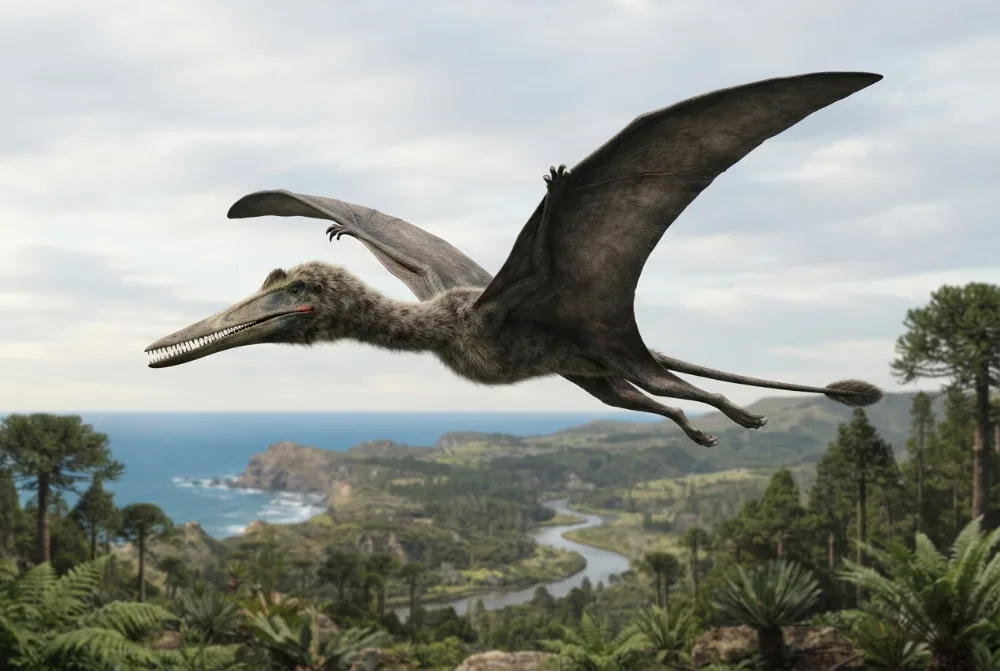
Aussiedraco was a flying reptile that soared over the ancient seas of Australia about 105 million years ago. It had a long, toothy beak and likely snatched fish from the water. Only a piece of its lower jaw has been found, but that was enough for scientists to name it a new species.21
When did it live?
How fast was it?
Fun facts
Aussiedraco is only the second pterosaur ever named from Australia.3
Its name means 'Australian dragon', 'Aussie' is a nickname for Australian, and 'draco' is Latin for dragon.1
The only known fossil is a piece of the lower jaw, called a mandibular symphysis, that is 88 mm long.1
The jaw has five tooth sockets on each side, and one still held a tiny replacement tooth.1
Aussiedraco lived during the Albian age of the Early Cretaceous, about 106 to 100 million years ago.2
Most asked questions about Aussiedraco
?How big was Aussiedraco?
Nobody knows for sure because only a piece of its lower jaw, 88 mm long, has been found. Scientists cannot estimate its full size from just that fragment.41
?What did Aussiedraco eat?
Aussiedraco likely ate fish. Its long, toothy beak and the way its teeth could interlock suggest it snatched fish from the water.4
?When did Aussiedraco live?
Aussiedraco lived during the Early Cretaceous, about 105 to 100 million years ago, in the Albian age.4
?Is Aussiedraco a dinosaur?
No. Aussiedraco is a pterosaur, a flying reptile, not a dinosaur.4

Ask Rex about Aussiedraco
Rex only answers questions about this page. 10 questions a month.
Rex is an AI and can make mistakes. He runs on servers in the EU and questions are never saved. Never type your name or other personal things.
For dino experts
- Scientific name
- Aussiedraco
- Named by
- Kellner et al. 20115
- Group
- Flying reptiles
- Family / clade
- Pteranodontoidea5
- Classification
- Pterosauria > Pterodactyloidea5
- Age of the rocks
- 106 to 100 million years (Albian)5
- Rock formations
- Toolebuc5
- Countries
- Australia5
- Fossil records
- 1 in the Paleobiology Database5
- Discovery
- The fossil was first reported in 1980 by Ralph Molnar and others, who thought it belonged to a pterosaur from England. In 2011, scientists Alexander Kellner, Taissa Rodrigues and Fabiana Costa studied it again and named it Aussiedraco molnari after Molnar.13
- Still debated
- Scientists are not sure exactly how big Aussiedraco was, because only a piece of its jaw has been found.1
Where the facts come from
- Short note on a pteranodontoid pterosaur (Pterodactyloidea) from western Queensland, Australia (scielo.br)
- PBDB Taxon (paleobiodb.org)
- Short note on a Pteranodontoid pterosaur (Pterodactyloidea) from western Queensland, Australia (pubmed.ncbi.nlm.nih.gov)
- Aussiedraco (en.wikipedia.org)
- Aussiedraco in The Paleobiology Database (CC BY 4.0): age, places, rock formations, classification.
Every fact on this page has a number that points to its source. If we got something wrong, sorry, we are dino fans, not a science journal. Tell us at [email protected] and we will fix it.
 Rex is hungry! Dino Wiki is a dad's project for his dino-loving son, free with no ads. Grown-ups can feed Rex a snack to help keep it online.Feed Rex
 Pteranodon
 Quetzalcoatlus
 Dorygnathus
 Rhamphorhynchus
 Anhanguera
 Pterodactylus
 Stegosaurus
 Iguanodon
 Archaeopteryx
 Giganotosaurus
 Microraptor
 Deinonychus