
Balaur
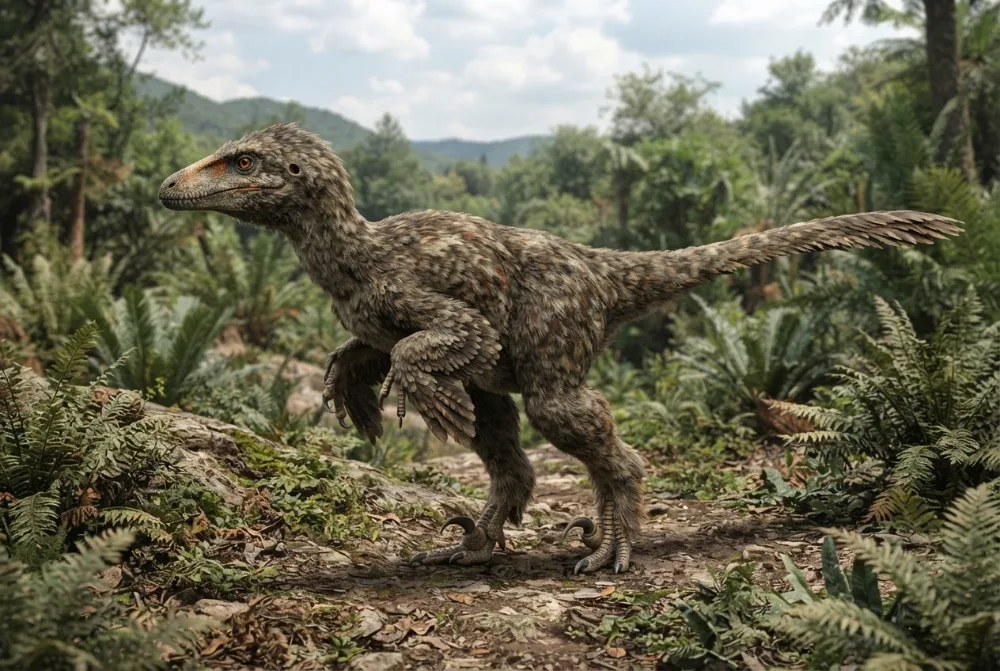
Balaur was a small, fierce raptor that lived on an ancient island in what is now Romania. It had two big claws on each foot instead of one, and its arms were short and strong. Scientists think it was a top predator on its island home.1
When did it live?
How big was it?
How long was it?
How big was Balaur compared to YOU?
Just maths in your browser. Nothing is saved or sent anywhere.
Fun facts
Balaur had two sickle-shaped claws on each foot, unlike most raptors which have only one per foot.1
Its arms were very short and its hand bones were fused together, making its hands stiff and strong.1
Balaur lived on an island during the Late Cretaceous, about 72 to 66 million years ago.2
The first Balaur skeleton was found in Romania in 2010 and is the most complete predatory dinosaur from the Late Cretaceous of Europe.1
Balaur's closest relatives were raptors from Asia and North America, showing that animals could travel between continents even on islands.1

Ask Rex about Balaur
Rex only answers questions about this page. 3 questions a day.
Rex is an AI and can make mistakes. He runs on servers in the EU and questions are never saved. Never type your name or other personal things.
For dino experts
- Scientific name
- Balaur
- Named by
- Csiki et al. 20103
- Group
- Raptors
- Family / clade
- Dromaeosauridae3
- Classification
- Theropoda > Dromaeosauridae3
- Age of the rocks
- 72 to 66 million years (Maastrichtian)3
- Rock formations
- Densuș-Ciula, Sebeş3
- Countries
- Romania3
- Fossil records
- 2 in the Paleobiology Database3
- Discovery
- Balaur was named by Zoltán Csiki, Mátyás Vremir, Stephen Brusatte and Mark Norell in 2010. The first fossil was found in the Sebeş Formation in Romania.3
- Still debated
- Scientists are still debating whether Balaur was a dromaeosaurid raptor or a more primitive type of bird-like dinosaur.1
Where the facts come from
- An aberrant island-dwelling theropod dinosaur from the Late Cretaceous of Romania (pubmed.ncbi.nlm.nih.gov)
- PBDB Taxon (paleobiodb.org)
- Balaur in The Paleobiology Database (CC BY 4.0): age, places, rock formations, classification.
Every fact on this page has a number that points to its source. If we got something wrong, sorry, we are dino fans, not a science journal. Tell us at [email protected] and we will fix it.
 Rex is hungry! Dino Wiki is a dad's project for his dino-loving son, free with no ads. Grown-ups can feed Rex a snack to help keep it online.Feed Rex
 Velociraptor
 Microraptor
 Deinonychus
 Asiamericana
 Richardoestesia
 Saurornitholestes
 Tyrannosaurus
 Triceratops
 Spinosaurus
 Ankylosaurus
 Parasaurolophus
 Pteranodon