
Boreonykus
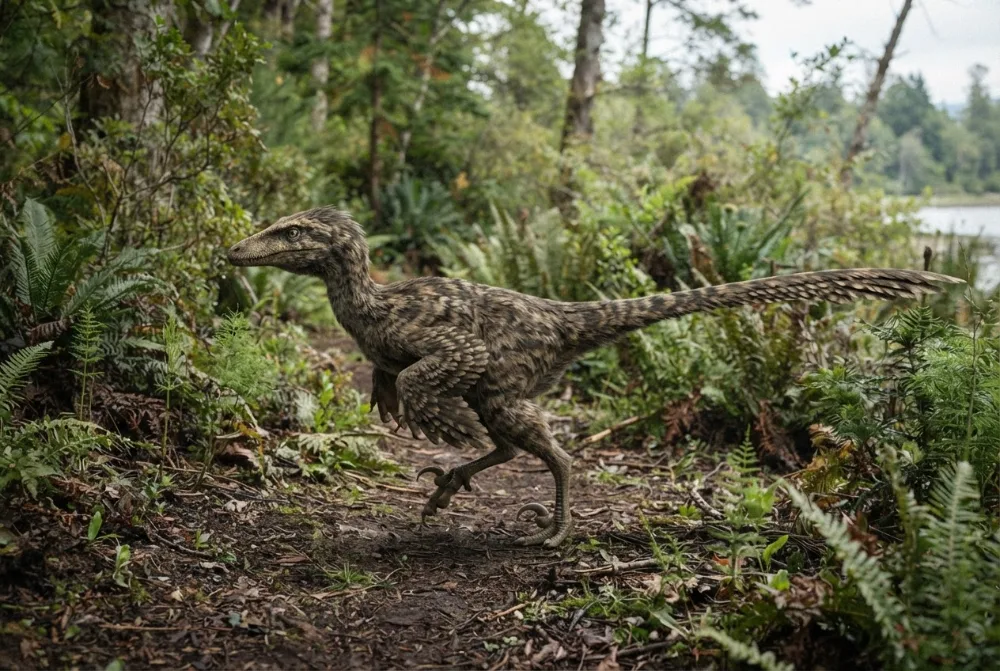
Boreonykus was a small, fast dinosaur that lived in Canada during the Late Cretaceous. It had a big sickle claw on each foot, which it used to hunt and slash its prey. This raptor was a cousin of the famous Velociraptor.1
When did it live?
How big was it?
How long was it?
How tall was it?
at the hips, estimated from related dromaeosaurids
How heavy was it?
How big was Boreonykus compared to YOU?
Just maths in your browser. Nothing is saved or sent anywhere.
Fun facts
Boreonykus was named in 2015 by scientists Phil Bell and Philip Currie.1
Its fossils were found in a bonebed that contained at least 27 individuals of the horned dinosaur Pachyrhinosaurus.1
The name Boreonykus means 'northern claw', because it lived in what is now Canada and had a large claw on its foot.1
Only a few bones of Boreonykus have been found, including a skull bone, teeth, and a sickle claw.1
Boreonykus lived about 73 million years ago, during the Late Cretaceous period.1
Scientists think Boreonykus was a dromaeosaurid, a group of feathered dinosaurs that includes Velociraptor and Deinonychus.6
Most asked questions about Boreonykus
?How big was Boreonykus?
About 2 metres long and as tall as a dog.3
?What did Boreonykus eat?
It was a meat-eater that probably ate the carcasses of the horned dinosaur Pachyrhinosaurus. Its serrated teeth and big claws helped it hunt and slash prey. [dinomuseum.ca](https://dinomuseum.ca/2016/03/new-dinosaur-boreonykus)5
?Did Boreonykus have feathers?
Yes, because it was a dromaeosaurid, a group of feathered dinosaurs that includes Velociraptor. [wikipedia.org](https://en.wikipedia.org/wiki/Boreonykus)1
?Where was Boreonykus found?
In the Pipestone Creek bonebed in central Alberta, Canada, about 20 kilometres southwest of Grande Prairie. [cbc.ca](https://www.cbc.ca/news/canada/edmonton/sharp-toothed-boreonykus-a-dog-sized-dinosaur-found-near-grande-prairie-1.3494699)3
Ask Rex about Boreonykus
Rex only answers questions about this page. 3 questions a day.
Rex is an AI and can make mistakes. He runs on servers in the EU and questions are never saved. Never type your name or other personal things.
For dino experts
- Scientific name
- Boreonykus
- Named by
- Bell and Currie 20166
- Group
- Raptors
- Family / clade
- Dromaeosauridae6
- Classification
- Theropoda > Dromaeosauridae6
- Age of the rocks
- 84 to 72 million years (Campanian)6
- Rock formations
- Wapiti6
- Countries
- Canada6
- Fossil records
- 2 in the Paleobiology Database6
- Discovery
- Boreonykus was named and described by Phil Bell and Philip Currie in 2015. The fossils were found in the 1980s at Pipestone Creek in Alberta, Canada, during digs for the horned dinosaur Pachyrhinosaurus.1
- Still debated
- Scientists are not sure whether Boreonykus was a velociraptorine or a dromaeosaurine, because different studies place it in different groups.1
Where the facts come from
- Boreonykus (en.wikipedia.org)
- PBDB Taxon (paleobiodb.org)
- Sharp-toothed Boreonykus, a dog-sized dinosaur, found near Grande Prairie | CBC News (cbc.ca)
- Boreonykus certekorum | Dinosaur Database by DinoAnimals.com (dinoanimals.com)
- What Big Claws You Have: Northern Alberta Welcomes New Raptor Dinosaur - Philip J. Currie Dinosaur Museum (dinomuseum.ca)
- Boreonykus in The Paleobiology Database (CC BY 4.0): age, places, rock formations, classification.
Every fact on this page has a number that points to its source. If we got something wrong, sorry, we are dino fans, not a science journal. Tell us at [email protected] and we will fix it.
 Rex is hungry! Dino Wiki is a dad's project for his dino-loving son, free with no ads. Grown-ups can feed Rex a snack to help keep it online.Feed Rex
 Velociraptor
 Microraptor
 Deinonychus
 Asiamericana
 Richardoestesia
 Saurornitholestes
 Tyrannosaurus
 Triceratops
 Spinosaurus
 Ankylosaurus
 Parasaurolophus
 Pteranodon