
Bravoceratops
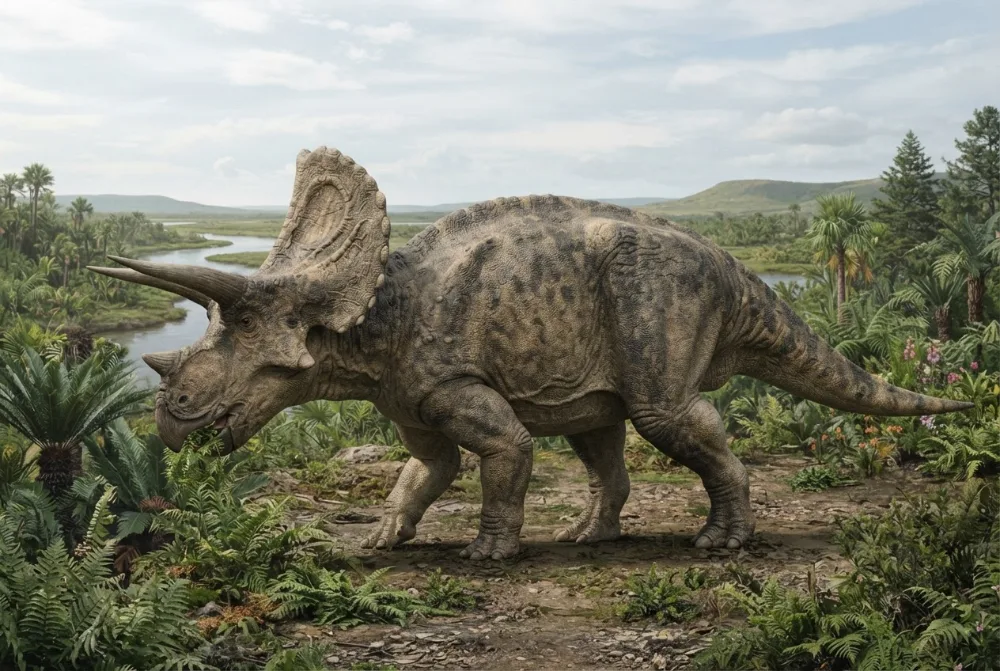
Bravoceratops was a big, plant-eating dinosaur with a huge frill on its head and a beak like a parrot. It lived in what is now Texas, USA, about 70 million years ago. This dinosaur is known from just one skull, but it helps scientists understand how horned dinosaurs changed over time.1
When did it live?
How big was it?
How big was Bravoceratops compared to YOU?
Just maths in your browser. Nothing is saved or sent anywhere.
Fun facts
Bravoceratops had a fan-shaped bone in the middle of its frill with a hollow spot that looked like a single eye, which is why it was named after the cyclops Polyphemus.1
Its name comes from the Rio Bravo del Norte, the Mexican name for the Rio Grande river.1
The only known fossil of Bravoceratops was found in Big Bend National Park in Texas.1
Bravoceratops lived during the Maastrichtian age, about 70 million years ago, near the end of the dinosaur era.1
Some scientists think Bravoceratops might be the same as another dinosaur, but others say it is a valid genus with unique features.1
Bravoceratops had two brow horns that were taller than they were wide, not round like in some other horned dinosaurs.1
Most asked questions about Bravoceratops
?How big was Bravoceratops?
Bravoceratops was one of the largest chasmosaurine horned dinosaurs. Its skull was about 2.1 metres long, and its brow horns were each over 0.9 metres long. It was similar in size to Triceratops, which weighed up to about 6,800 kilograms.3
?What did Bravoceratops eat?
Bravoceratops was a plant-eater. It had a beak like a parrot for snipping plants.1
?When did Bravoceratops live?
Bravoceratops lived about 70 million years ago, during the Late Cretaceous period.1

Ask Rex about Bravoceratops
Rex only answers questions about this page. 3 questions a day.
Rex is an AI and can make mistakes. He runs on servers in the EU and questions are never saved. Never type your name or other personal things.
Myth buster
Myth: Bravoceratops had a single horn on its frill like a cyclops eye.
Truth: The hollow spot on its frill was probably the base for a small horn, but the horn itself is not preserved in the fossil.1
For dino experts
- Scientific name
- Bravoceratops
- Named by
- Wick and Lehman 20134
- Group
- Horned dinos
- Family / clade
- Ceratopsidae4
- Classification
- Ornithischia > Ceratopsia > Ceratopsidae4
- Age of the rocks
- 72 to 66 million years (Maastrichtian)4
- Rock formations
- Javelina4
- Countries
- USA4
- Fossil records
- 1 in the Paleobiology Database4
- Discovery
- Bravoceratops was named by Steven L. Wick and Thomas M. Lehman in 2013 based on a skull found in the Javelina Formation of Texas.1
- Still debated
- Scientists are not sure if Bravoceratops is a valid genus or if its fossil was reconstructed upside down, making it a nomen dubium.1
Where the facts come from
- Bravoceratops (en.wikipedia.org)
- PBDB Taxon (paleobiodb.org)
- Horned Dinosaur Discovery - Big Bend National Park (U.S. National Park Service) (nps.gov)
- Bravoceratops in The Paleobiology Database (CC BY 4.0): age, places, rock formations, classification.
Every fact on this page has a number that points to its source. If we got something wrong, sorry, we are dino fans, not a science journal. Tell us at [email protected] and we will fix it.
Rex is hungry! Dino Wiki is a dad's project for his dino-loving son, free with no ads. Grown-ups can feed Rex a snack to help keep it online.Feed Rex Triceratops
 Protoceratops
 Ojoceratops
 Tatankaceratops
 Psittacosaurus
 Centrosaurus
 Velociraptor
 Spinosaurus
 Ankylosaurus
 Parasaurolophus
 Pteranodon