
Caenagnathasia
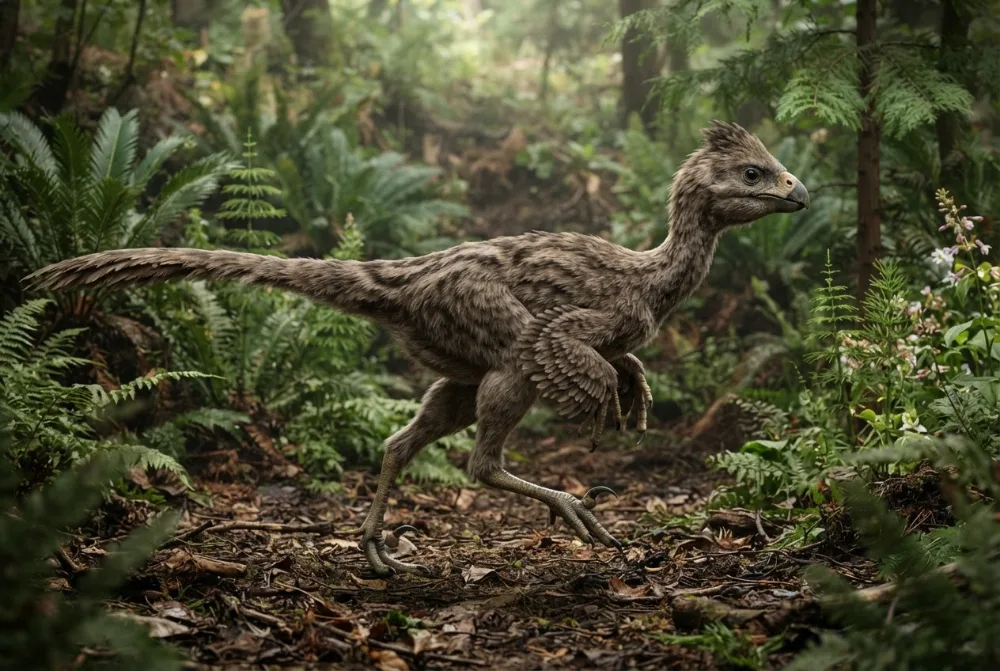
Caenagnathasia was a tiny, feathered dinosaur that looked a bit like a bird. It had a beak and long legs, and it was one of the smallest dinosaurs ever found. It lived in Asia during the Late Cretaceous period.1
When did it live?
How big was it?
How big was Caenagnathasia compared to YOU?
Just maths in your browser. Nothing is saved or sent anywhere.
Fun facts
Caenagnathasia is the smallest known oviraptorosaur and one of the smallest non-avian dinosaurs. Its skull was only about 7.6 centimetres (3 inches) long.1
It lived about 90 million years ago, making it the oldest known caenagnathoid.1
The first fossils were just two fused lower jaw bones, found in Uzbekistan.1
Scientists think it was feathered, like other oviraptorosaurs, and looked bird-like with a beak and long neck.1
In 2015, new bones were found, including vertebrae, a dentary, and a femur, which helped confirm it belonged to the Caenagnathidae family.1
The name honors Gerbert Genrikhovich Martinson, a scientist, in the species name martinsoni.1
Most asked questions about Caenagnathasia
?How big was Caenagnathasia?
It was tiny. About 0.6 metres (2 feet) long and weighed around 1.4 kilograms (3 pounds). Its skull was only about 7.6 centimetres (3 inches) long.1
?What did Caenagnathasia eat?
Scientists think it ate plants or small animals, because it had a beak and a special shelf in its mouth for grinding food, like other oviraptorosaurs.12
?Did Caenagnathasia have feathers?
Yes. It was a feathered dinosaur, like other oviraptorosaurs, and looked bird-like with a beak and long neck.1
?When did Caenagnathasia live?
It lived about 90 million years ago, during the Late Cretaceous period. It is the oldest known caenagnathoid.1

Ask Rex about Caenagnathasia
Rex only answers questions about this page. 3 questions a day.
Rex is an AI and can make mistakes. He runs on servers in the EU and questions are never saved. Never type your name or other personal things.
Myth buster
Myth: Some people think Caenagnathasia was a bird because it had a beak and feathers.
Truth: It was a dinosaur, not a bird. It belonged to a group of feathered theropods called oviraptorosaurs, which are closely related to birds but not birds themselves.1
For dino experts
- Scientific name
- Caenagnathasia
- Named by
- Currie et al. 19943
- Group
- Odd feathered dinos
- Family / clade
- Caenagnathidae3
- Classification
- Theropoda > Oviraptorosauria3
- Age of the rocks
- 94 to 72 million years (Turonian / Campanian)3
- Rock formations
- Bissekty, Iren Dabasu3
- Countries
- Uzbekistan, China3
- Fossil records
- 7 in the Paleobiology Database3
- Discovery
- Caenagnathasia was named in 1994 by Philip J. Currie, Stephen Godfrey, and Lev Nessov. The first fossils were found near Dzharakuduk in Uzbekistan, in the Bissekty Formation.1
- Still debated
- Scientists are still debating exactly where Caenagnathasia sits in the dinosaur family tree. Some think it was a primitive member of the Caenagnathidae, while others suggest it might be more basal within Oviraptorosauria.1
Where the facts come from
- Caenagnathasia (en.wikipedia.org)
- New material of Caenagnathasia martinsoni (Dinosauria: Theropoda: Oviraptorosauria) from the Bissekty Formation (Upper Cretaceous: Turonian) of Uzbekistan › SPbU Researchers Portal (pureportal.spbu.ru)
- Caenagnathasia in The Paleobiology Database (CC BY 4.0): age, places, rock formations, classification.
Every fact on this page has a number that points to its source. If we got something wrong, sorry, we are dino fans, not a science journal. Tell us at [email protected] and we will fix it.
Rex is hungry! Dino Wiki is a dad's project for his dino-loving son, free with no ads. Grown-ups can feed Rex a snack to help keep it online.Feed Rex Therizinosaurus
 Oviraptor
 Chirostenotes
 Citipes
 Leptorhynchos
 Avimimus
 Triceratops
 Velociraptor
 Spinosaurus
 Ankylosaurus
 Parasaurolophus