
Caenagnathus
Caenagnathus was a big, bird-like dinosaur with a toothless beak. It lived in what is now Canada and the United States during the Late Cretaceous. Scientists think it ate both plants and meat, like a modern-day crow.31
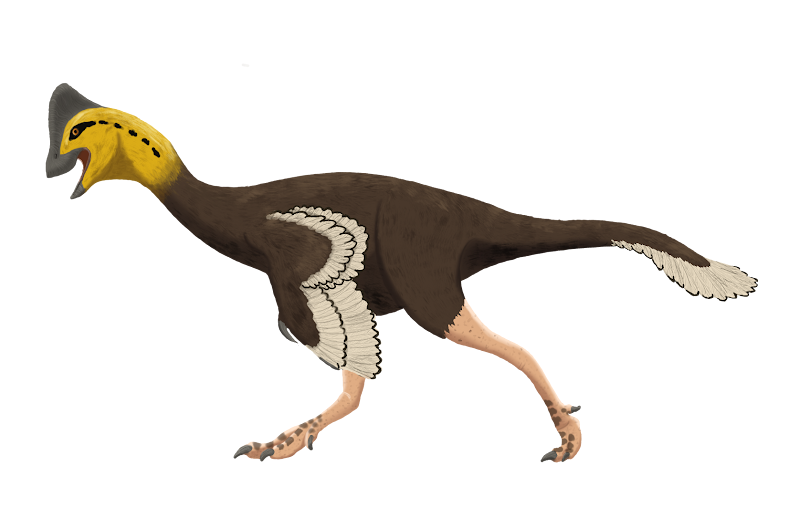
When did it live?
How big was it?
Fun facts
Caenagnathus was first thought to be a bird because its jaw looked so bird-like.3
It was one of the largest caenagnathids, rivaling the size of Anzu wyliei.1
Its beak had three ridges on the tip, which may have helped it grip food.2
Caenagnathus lived alongside other caenagnathids like Citipes and Chirostenotes in the Dinosaur Park Formation.1
The type specimen is a lower jaw (mandible) found in Alberta, Canada.2
It was a ground-dwelling dinosaur that walked on two legs.3
Myth buster
Myth: Caenagnathus was a bird.
Truth: Caenagnathus was a feathered dinosaur, not a bird. It belongs to the oviraptorosaur group.3
For dino experts
- Scientific name
- Caenagnathus
- Named by
- Sternberg 19403
- Group
- Odd feathered dinos
- Family / clade
- Caenagnathidae3
- Classification
- Theropoda > Oviraptorosauria3
- Age of the rocks
- 84 to 66 million years (Campanian to Maastrichtian)3
- Rock formations
- Dinosaur Park, Hell Creek3
- Countries
- Canada, USA3
- Fossil records
- 8 in the Paleobiology Database3
- Discovery
- Caenagnathus was named by R. M. Sternberg in 1940 based on a jaw fossil from the Dinosaur Park Formation in Alberta, Canada.3
- Still debated
- Scientists are still debating whether some fossils belong to Caenagnathus or to other similar caenagnathids.1
Where the facts come from
- Caenagnathids of the Dinosaur Park Formation (Campanian) of Alberta, Canada: anatomy, osteohistology, taxonomy, and evolution | Vertebrate Anatomy Morphology Palaeontology (journals.library.ualberta.ca)
- PBDB Taxon (paleobiodb.org)
- Caenagnathus in The Paleobiology Database (CC BY 4.0): age, places, rock formations, classification.
Every fact on this page has a number that points to its source. If we got something wrong, sorry, we are dino fans, not a science journal. Tell us at [email protected] and we will fix it.
 Rex is hungry! Dino Wiki is free with no ads. Grown-ups can feed Rex a snack to keep it that way.Feed Rex
 Therizinosaurus
 Oviraptor
 Chirostenotes
 Citipes
 Leptorhynchos
 Avimimus
 Triceratops
 Velociraptor
 Spinosaurus
 Ankylosaurus
 Parasaurolophus