
Caiuajara
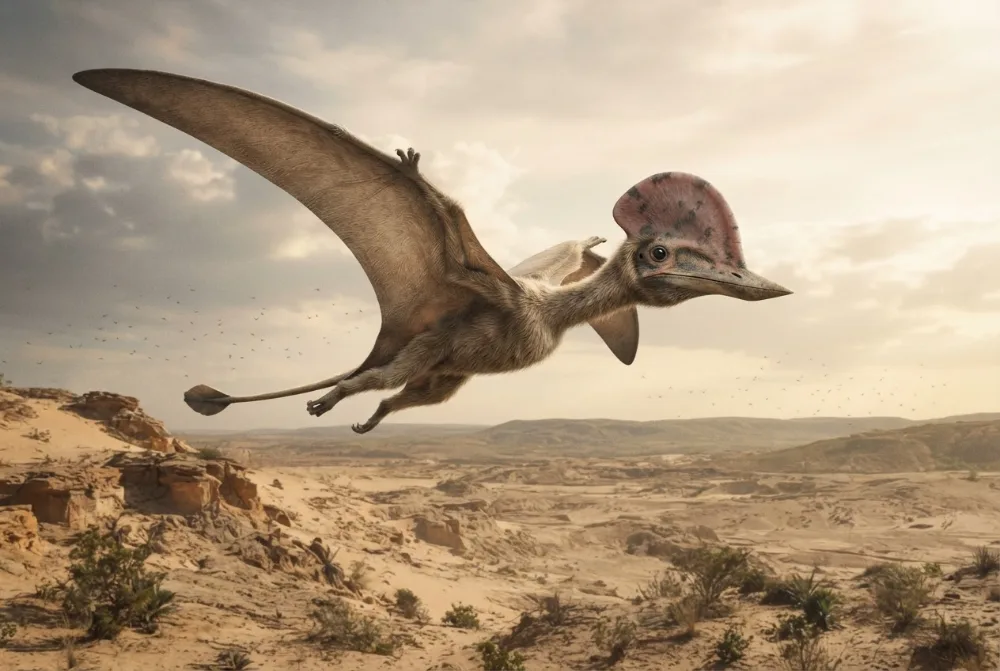
Caiuajara was a flying reptile that lived in a hot desert. It had a big crest on its head that grew steeper as it got older. Dozens of Caiuajara fossils were found together, showing they lived in colonies.1
When did it live?
How big was it?
How big was Caiuajara compared to YOU?
Just maths in your browser. Nothing is saved or sent anywhere.
Fun facts
Caiuajara is the first pterosaur found in southern Brazil. All other Brazilian pterosaurs come from the northeast.1
At least 47 individuals were found in one bone bed, which is very rare for pterosaurs.1
Young Caiuajara had a small, slanted head crest (about 115°). Adults had a larger, steeper crest (about 90°).1
Caiuajara could probably fly at a very young age. This is called being precocial.1
It lived around an oasis lake in a Cretaceous desert. Storms may have carried dead pterosaurs into the lake.1
Caiuajara belongs to a group called Tapejaridae, which had no teeth and are thought to have eaten fruit.1
Most asked questions about Caiuajara
?How big was Caiuajara?
The largest Caiuajara had a wingspan of about 2.35 meters (7.7 feet). The smallest juveniles had a wingspan of about 0.65 meters (2.1 feet).13
?Did Caiuajara have teeth?
No, Caiuajara had no teeth. It belonged to a group of toothless pterosaurs called Tapejaridae.13
?What did Caiuajara eat?
Scientists think Caiuajara ate fruit, because other tapejarid pterosaurs are thought to have been frugivorous. However, no direct food remains have been found with the fossils.13
?Could Caiuajara fly?
Yes, Caiuajara could fly. Even very young individuals had well-developed flight muscles and could probably fly soon after hatching.13

Ask Rex about Caiuajara
Rex only answers questions about this page. 3 questions a day.
Rex is an AI and can make mistakes. He runs on servers in the EU and questions are never saved. Never type your name or other personal things.
For dino experts
- Scientific name
- Caiuajara
- Named by
- Manzig et al. 20144
- Group
- Flying reptiles
- Family / clade
- Tapejaridae4
- Classification
- Pterosauria > Pterodactyloidea4
- Age of the rocks
- 121 to 72 million years (Aptian / Campanian)4
- Rock formations
- Goio-Erê4
- Countries
- Brazil4
- Fossil records
- 1 in the Paleobiology Database4
- Discovery
- Caiuajara was named in 2014 by Manzig and colleagues. The fossils were found near Cruzeiro do Oeste in southern Brazil.21
- Still debated
- Scientists are not sure exactly how old the rocks are. Caiuajara could be the youngest known tapejarid pterosaur, or the rocks might be older than thought.1
Where the facts come from
- Discovery of a Rare Pterosaur Bone Bed in a Cretaceous Desert with Insights on Ontogeny and Behavior of Flying Reptiles | PLOS One (journals.plos.org)
- PBDB Taxon (paleobiodb.org)
- Caiuajara (en.wikipedia.org)
- Caiuajara in The Paleobiology Database (CC BY 4.0): age, places, rock formations, classification.
Every fact on this page has a number that points to its source. If we got something wrong, sorry, we are dino fans, not a science journal. Tell us at [email protected] and we will fix it.
Rex is hungry! Dino Wiki is a dad's project for his dino-loving son, free with no ads. Grown-ups can feed Rex a snack to help keep it online.Feed Rex Pteranodon
 Quetzalcoatlus
 Dorygnathus
 Rhamphorhynchus
 Anhanguera
 Pterodactylus
 Triceratops
 Velociraptor
 Spinosaurus
 Ankylosaurus
 Parasaurolophus