When did it live?

How big was it?
How big was Canadaga compared to YOU?
Just maths in your browser. Nothing is saved or sent anywhere.
Fun facts
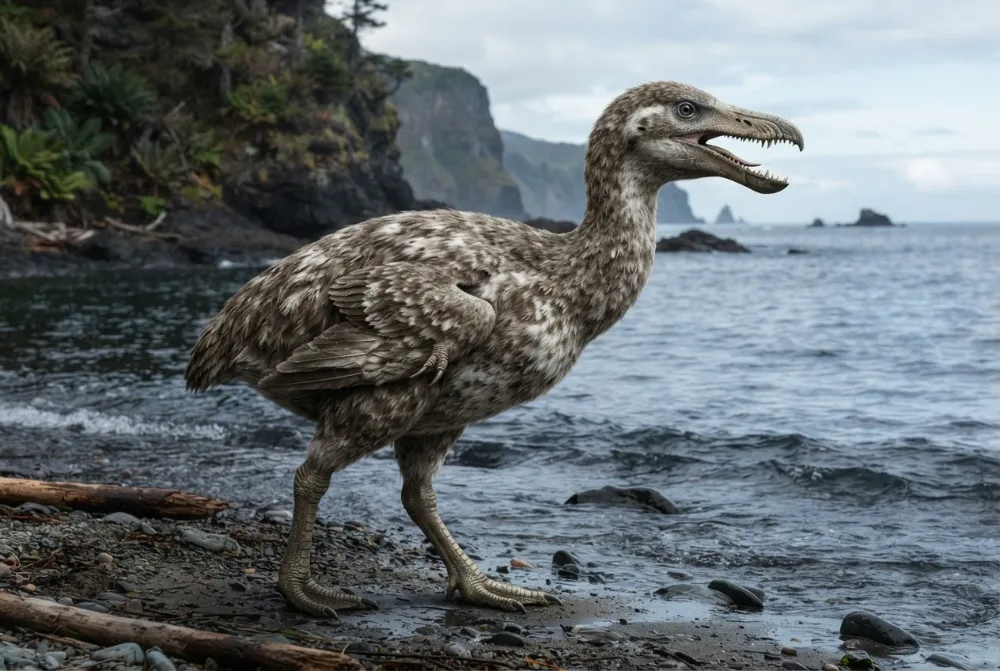
Canadaga is one of the largest known members of its group, reaching about 2.2 metres (7.2 feet) long.1
It lived in the Arctic, which is unusual because most of its relatives lived in warmer waters.1
Canadaga was one of the last of its kind, living about 67 million years ago, just before the dinosaurs went extinct.1
Its fossils were found in rocks from the Kanguk Formation, which is from the Late Cretaceous period.1
Scientists found only a few bones: three neck vertebrae, one tail vertebra, and two thigh bones.1
Canadaga could not fly, but it was a great swimmer, using its legs to push through the water.1
Most asked questions about Canadaga
?Was Canadaga a dinosaur?
Yes, Canadaga was a dinosaur. Like all birds, it belongs to the group of dinosaurs called theropods.1
?How big was Canadaga?
Canadaga was about 2.2 metres (7.2 feet) long, making it one of the largest known members of its group.1
?Could Canadaga fly?
No, Canadaga could not fly. It was a flightless bird that used its strong legs to dive and swim in the sea.1

Ask Rex about Canadaga
Rex only answers questions about this page. 3 questions a day.
Rex is an AI and can make mistakes. He runs on servers in the EU and questions are never saved. Never type your name or other personal things.
Myth buster
Myth: Some people think Canadaga was a dinosaur.
Truth: Canadaga was a bird, not a dinosaur, even though it lived during the age of dinosaurs.1
For dino experts
- Scientific name
- Canadaga
- Named by
- Hou 19993
- Group
- Early birds
- Family / clade
- Hesperornithidae3
- Classification
- Theropoda > Avialae3
- Age of the rocks
- 84 to 66 million years (Campanian / Maastrichtian)3
- Rock formations
- Kanguk3
- Countries
- Canada3
- Fossil records
- 2 in the Paleobiology Database3
- Discovery
- The fossils were collected from Bylot Island, Canada, and were studied by Chinese scientist Hou Lian-Hai, who named the species Canadaga arctica in 1999.12
- Still debated
- Scientists are still debating why Canadaga and other large hesperornithids went extinct, with some thinking their large size and special features played a role.2
Where the facts come from
- Canadaga (en.wikipedia.org)
- NEW HESPERORMTHID (AVES) FROM THE CANADIAN ARCTIC (vertpala.ac.cn)
- Canadaga in The Paleobiology Database (CC BY 4.0): age, places, rock formations, classification.
Every fact on this page has a number that points to its source. If we got something wrong, sorry, we are dino fans, not a science journal. Tell us at [email protected] and we will fix it.
Rex is hungry! Dino Wiki is a dad's project for his dino-loving son, free with no ads. Grown-ups can feed Rex a snack to help keep it online.Feed Rex Archaeopteryx
 Hesperornis
 Ichthyornis
 Baptornis
 Jurapteryx
 Gobipteryx
 Triceratops
 Velociraptor
 Spinosaurus
 Ankylosaurus
 Parasaurolophus