
Castignovolucris
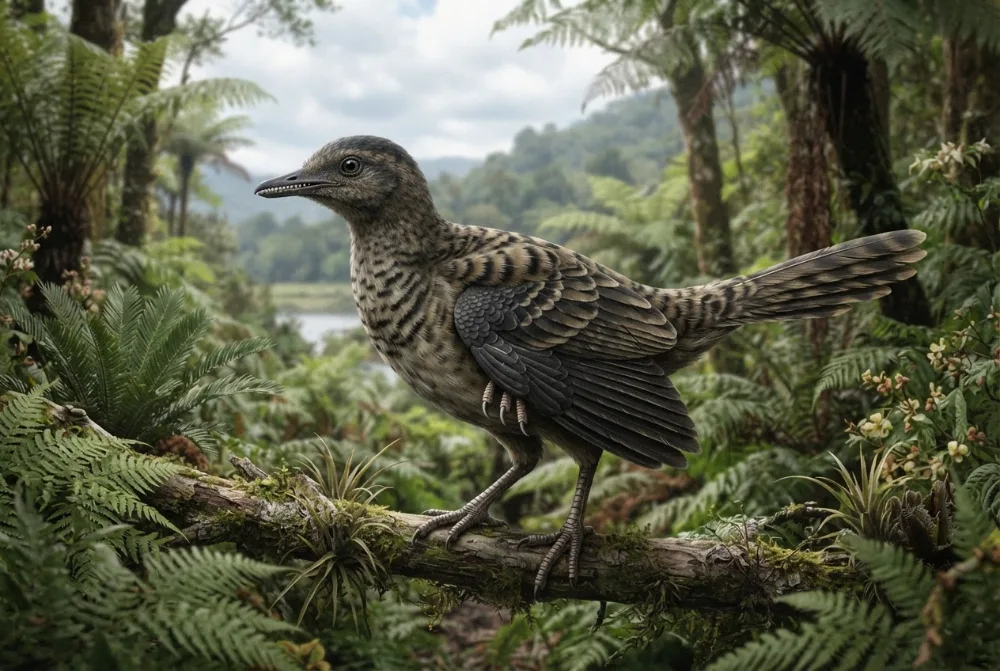
Castignovolucris was a big, ancient bird that lived in what is now France, about 74 to 72 million years ago. It was one of the largest enantiornithine birds ever found, maybe as big as a Canada goose. It had strong wings and could fly.21
When did it live?
How big was it?
How long was it?
How big was Castignovolucris compared to YOU?
Just maths in your browser. Nothing is saved or sent anywhere.
Fun facts
Castignovolucris is known from just one bone, a right coracoid (a shoulder bone).2
This bird lived on the Ibero-Armorican island, which was a large island in what is now Europe during the Late Cretaceous.1
The fossil was found by a man named Stéphane Sèbe in the 1990s and later donated to the Musée de Cruzy.1
Castignovolucris was one of the largest enantiornithine birds, a group of ancient birds that had teeth and claws on their wings.1
The name Castignovolucris means 'Castigno valley bird' after the place where it was found.1

Ask Rex about Castignovolucris
Rex only answers questions about this page. 3 questions a day.
Rex is an AI and can make mistakes. He runs on servers in the EU and questions are never saved. Never type your name or other personal things.
For dino experts
- Scientific name
- Castignovolucris
- Named by
- Buffetaut et al. 20233
- Group
- Early birds
- Family / clade
- Enantiornithes3
- Classification
- Theropoda > Avialae3
- Age of the rocks
- 84 to 66 million years (Campanian / Maastrichtian)3
- Rock formations
- Saint-Chinian3
- Countries
- France3
- Fossil records
- 1 in the Paleobiology Database3
- Discovery
- Castignovolucris was named and described in 2023 by paleontologists Eric Buffetaut, Delphine Angst, and Haiyan Tong, based on a single shoulder bone found in southern France.13
- Still debated
- Scientists are not sure about the exact size of Castignovolucris because only one bone has been found. The wingspan and length are estimates.1
Where the facts come from
- Castignovolucris (en.wikipedia.org)
- A new enantiornithine bird from Upper Cretaceous non-marine deposits at Villespassans (Hérault, southern France) - ADS (ui.adsabs.harvard.edu)
- Castignovolucris in The Paleobiology Database (CC BY 4.0): age, places, rock formations, classification.
Every fact on this page has a number that points to its source. If we got something wrong, sorry, we are dino fans, not a science journal. Tell us at [email protected] and we will fix it.
 Rex is hungry! Dino Wiki is a dad's project for his dino-loving son, free with no ads. Grown-ups can feed Rex a snack to help keep it online.Feed Rex
 Archaeopteryx
 Hesperornis
 Ichthyornis
 Baptornis
 Jurapteryx
 Gobipteryx
 Tyrannosaurus
 Triceratops
 Velociraptor
 Spinosaurus
 Ankylosaurus
 Parasaurolophus