
Cerebavis
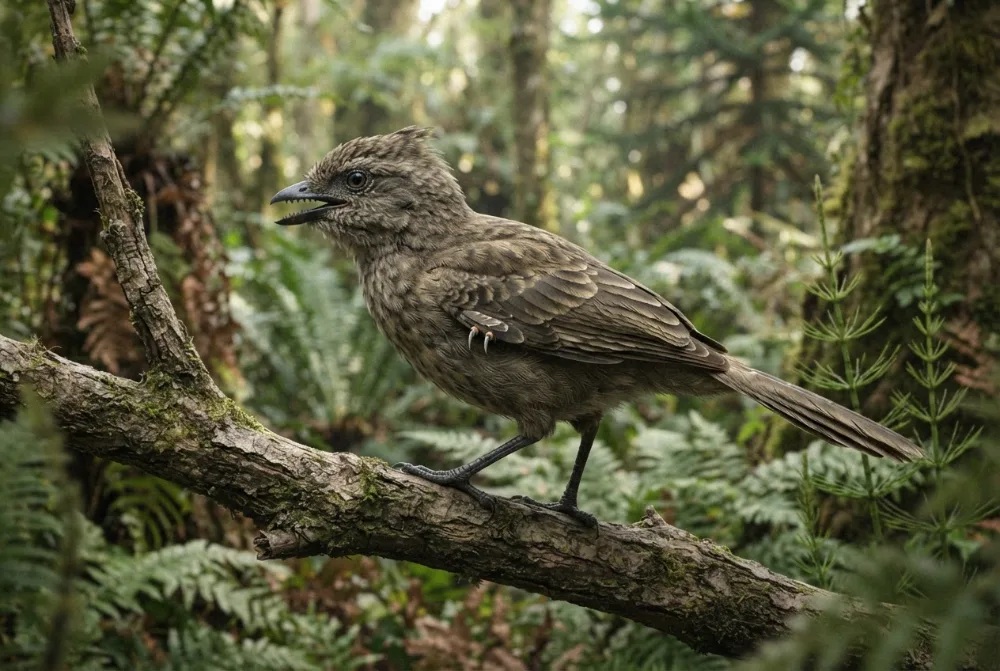
Cerebavis was a bird that lived about 95 million years ago, during the time of the dinosaurs. It had a brain that looked surprisingly modern, almost like the brains of birds you see today. Its skull was found in Russia and scientists used special scans to study its brain shape.2
When did it live?
Fun facts
Cerebavis is known from just one partial skull, which was first thought to be a fossilized brain.1
Scientists now know the specimen is actually a skull, not a brain, and they used CT scans to see the brain shape inside.2
Cerebavis had no temporal fenestrae, which are openings in the skull behind the eyes. This is a feature of ornithurine birds, not enantiornithines.2
The brain of Cerebavis was more like a modern bird's brain than the brain of Archaeopteryx, an early bird.2
Cerebavis did not have a wulst, a special part of the brain that helps modern birds with vision and touch. This feature had not yet evolved 93 million years ago.2
The skull bones of Cerebavis were very fused together, which is a sign of advanced flight adaptation, similar to modern flying birds.2

Ask Rex about Cerebavis
Rex only answers questions about this page. 3 questions a day.
Rex is an AI and can make mistakes. He runs on servers in the EU and questions are never saved. Never type your name or other personal things.
Myth buster
Myth: Cerebavis was a dinosaur with a brain that looked very strange and different from any other animal.
Truth: Scientists originally thought the brain was very unusual, but new CT scans show it was actually quite similar to the brains of modern birds.2
For dino experts
- Scientific name
- Cerebavis
- Named by
- Kurochkin and Saveliev 20063
- Group
- Early birds
- Family / clade
- Ornithurae3
- Classification
- Theropoda > Avialae3
- Age of the rocks
- 100 to 94 million years (Cenomanian)3
- Rock formations
- Melovatka3
- Countries
- Russia3
- Fossil records
- 1 in the Paleobiology Database3
- Discovery
- The only known fossil of Cerebavis was found in 1993 in the Melovatskaya Formation in Russia. It was named Cerebavis cenomanica by Evgeny Kurochkin and colleagues in 2006.12
- Still debated
- Scientists are not sure exactly how big Cerebavis was because only a skull has been found, and no body fossils.2
Where the facts come from
- Cerebavis (en.wikipedia.org)
- A reappraisal of Cerebavis cenomanica (Aves, Ornithurae), from Melovatka, Russia (pmc.ncbi.nlm.nih.gov)
- Cerebavis in The Paleobiology Database (CC BY 4.0): age, places, rock formations, classification.
Every fact on this page has a number that points to its source. If we got something wrong, sorry, we are dino fans, not a science journal. Tell us at [email protected] and we will fix it.
 Rex is hungry! Dino Wiki is a dad's project for his dino-loving son, free with no ads. Grown-ups can feed Rex a snack to help keep it online.Feed Rex
 Archaeopteryx
 Hesperornis
 Ichthyornis
 Baptornis
 Jurapteryx
 Gobipteryx
 Tyrannosaurus
 Triceratops
 Velociraptor
 Spinosaurus
 Ankylosaurus
 Parasaurolophus