
Chaoyangsaurus
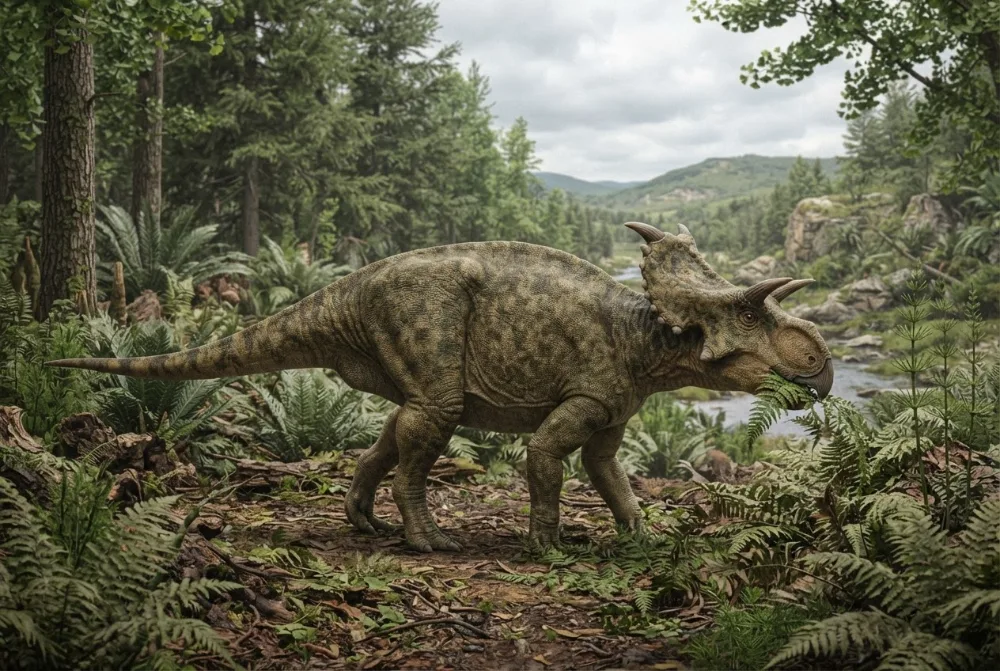
Chaoyangsaurus was one of the very first horned dinosaurs, a small plant-eater that lived in what is now China. It had a beak like a parrot and tiny teeth to munch on tough plants.21
When did it live?
How big was it?
How big was Chaoyangsaurus compared to YOU?
Just maths in your browser. Nothing is saved or sent anywhere.
Fun facts
Chaoyangsaurus is the earliest known ceratopsian, or horned dinosaur, that scientists have found.2
Its skull was only about 14 centimetres long, about the size of a large apple.1
It had a beak made of horn on its upper jaw, with four bumps on the cutting edge.1
Chaoyangsaurus had two pointy teeth in the front of its upper jaw, called premaxillary teeth.1
The name Chaoyangsaurus went through several spellings before it was officially published in 1999.1

Ask Rex about Chaoyangsaurus
Rex only answers questions about this page. 3 questions a day.
Rex is an AI and can make mistakes. He runs on servers in the EU and questions are never saved. Never type your name or other personal things.
For dino experts
- Scientific name
- Chaoyangsaurus
- Named by
- Zhao et al. 19993
- Group
- Horned dinos
- Family / clade
- Chaoyangsauridae3
- Classification
- Ornithischia > Ceratopsia3
- Age of the rocks
- 152 to 133 million years (Kimmeridgian / Valanginian)3
- Rock formations
- Tuchengzi3
- Countries
- China3
- Fossil records
- 1 in the Paleobiology Database3
- Discovery
- The first fossils of Chaoyangsaurus were found in 1976 by Cheng Zhengwu in Liaoning, China. It was officially named Chaoyangsaurus youngi by Zhao Xijin, Cheng Zhengwu, and Xu Xing in 1999.1
- Still debated
- Scientists are not sure whether Chaoyangsaurus was a very early ceratopsian or already a neoceratopsian, a more advanced horned dinosaur.1
Where the facts come from
- Chaoyangsaurus (en.wikipedia.org)
- Chaoyangsaurus | Natural History Museum (nhm.ac.uk)
- Chaoyangsaurus in The Paleobiology Database (CC BY 4.0): age, places, rock formations, classification.
Every fact on this page has a number that points to its source. If we got something wrong, sorry, we are dino fans, not a science journal. Tell us at [email protected] and we will fix it.
Rex is hungry! Dino Wiki is a dad's project for his dino-loving son, free with no ads. Grown-ups can feed Rex a snack to help keep it online.Feed Rex Triceratops
 Protoceratops
 Ojoceratops
 Tatankaceratops
 Psittacosaurus
 Centrosaurus
 Stegosaurus
 Iguanodon
 Archaeopteryx
 Giganotosaurus
 Microraptor
 Deinonychus