
Chinchenia
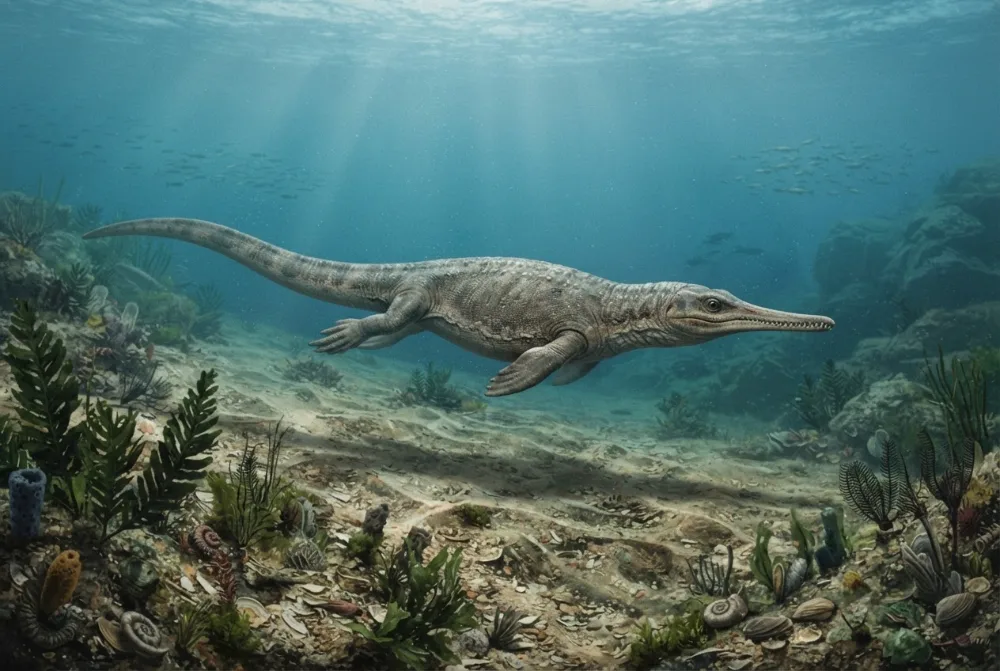
Chinchenia was a marine reptile that swam in the seas of China about 247 to 237 million years ago. It was a pistosauroid, a relative of the long-necked plesiosaurs. Only a few scattered bones have been found, so scientists are still learning about it.12
When did it live?
Fun facts
Chinchenia is known from at least four very incomplete skeletons, all found together near Qingzhen in China.1
The name Chinchenia comes from Chinchen, an old spelling of the city of Qingzhen where the fossils were discovered.1
Chinchenia lived during the Middle Triassic period, about 247 to 237 million years ago.2
The main fossil used to describe Chinchenia is the front part of a left lower jaw with five broken teeth.1
Chinchenia was a basal pistosauroid, meaning it was an early relative of the long-necked plesiosaurs that came later.1
All Chinchenia fossils are kept at the Institute of Vertebrate Paleontology and Paleoanthropology in China.1

Ask Rex about Chinchenia
Rex only answers questions about this page. 3 questions a day.
Rex is an AI and can make mistakes. He runs on servers in the EU and questions are never saved. Never type your name or other personal things.
For dino experts
- Scientific name
- Chinchenia
- Named by
- Young 19653
- Group
- Sea reptiles
- Family / clade
- Pistosauroidea3
- Classification
- Sauropterygia3
- Age of the rocks
- 247 to 237 million years ()3
- Countries
- China3
- Fossil records
- 1 in the Paleobiology Database3
- Discovery
- Chinchenia was named by Chinese paleontologist Yang Zhongjian (also known as Chung-Chien Young) in 1965. The fossils were collected near Cangxi Bridge at Shangpu, about 7 km west of Qingzhen in Guizhou Province.1
- Still debated
- Scientists are not sure exactly how big Chinchenia was, because only scattered bones have been found. They also debate whether it lived in the Anisian or Ladinian age of the Triassic.1
Where the facts come from
- Chinchenia (en.wikipedia.org)
- PBDB Taxon (paleobiodb.org)
- Chinchenia in The Paleobiology Database (CC BY 4.0): age, places, rock formations, classification.
Every fact on this page has a number that points to its source. If we got something wrong, sorry, we are dino fans, not a science journal. Tell us at [email protected] and we will fix it.
 Rex is hungry! Dino Wiki is a dad's project for his dino-loving son, free with no ads. Grown-ups can feed Rex a snack to help keep it online.Feed Rex
 Nothosaurus
 Placodus
 Lariosaurus
 Cyamodus
 Cymatosaurus
 Proneusticosaurus
 Chonespondylus
 Cymbospondylus
 Phalarodon
 Mixosaurus
 Chaohusaurus
 Chensaurus