When did it live?

Fun facts
Chupkaornis is the oldest known hesperornithiform bird from Asia, living about 89 to 83 million years ago.2
Its name comes from the Ainu word 'chupka' meaning 'eastern', because it was found in East Asia, unlike its relative Hesperornis which means 'western bird'.1
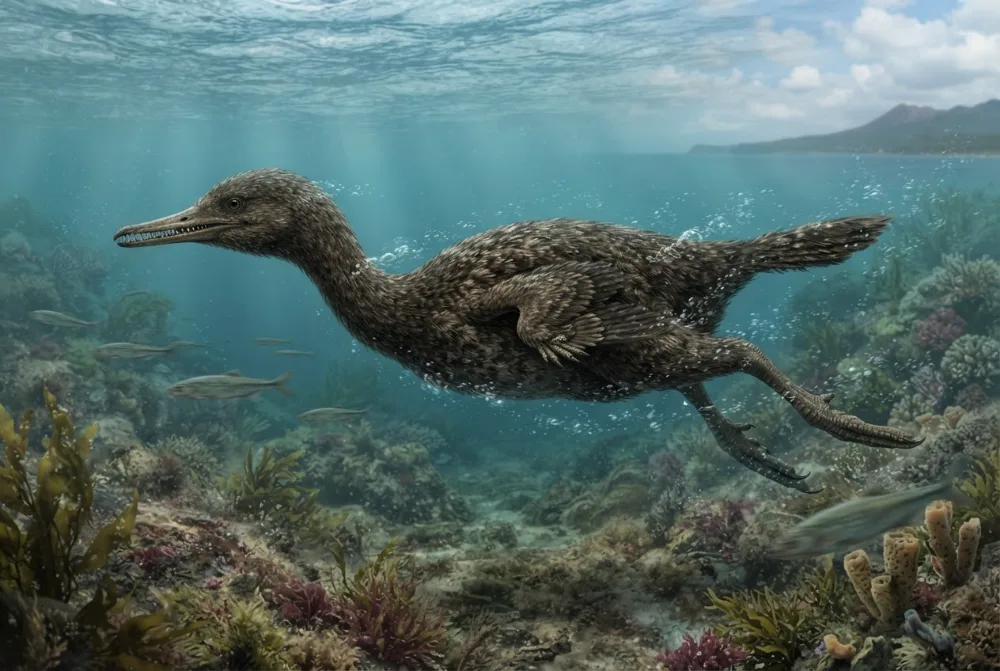
Chupkaornis could not fly. Its wings were tiny, and it used its strong legs and feet to push itself through the water.2
The only known fossil of Chupkaornis includes nine bones: neck vertebrae, back vertebrae, part of the thigh bone, and part of the shin bone.1
It was discovered in 1996 by two amateur fossil collectors, Masatoshi and Yasuji Kera, and was named after them.1
Chupkaornis had special joints in its backbone that allowed it to bend its neck and body while diving.2
Most asked questions about Chupkaornis
?How big was Chupkaornis?
Chupkaornis was about 70 to 80 centimetres (2.3 to 2.6 feet) long, roughly the size of a small penguin.1
?Could Chupkaornis fly?
No, Chupkaornis could not fly. It had very small wings and used its strong legs and webbed feet to swim underwater.12
?What did Chupkaornis eat?
Chupkaornis was a predatory diving bird that likely caught fish underwater with its sharp teeth.2
?When did Chupkaornis live?
Chupkaornis lived during the Late Cretaceous, about 89 to 83 million years ago.1

Ask Rex about Chupkaornis
Rex only answers questions about this page. 3 questions a day.
Rex is an AI and can make mistakes. He runs on servers in the EU and questions are never saved. Never type your name or other personal things.
For dino experts
- Scientific name
- Chupkaornis
- Named by
- Tanaka et al. 20184
- Group
- Early birds
- Family / clade
- Hesperornithiformes4
- Classification
- Theropoda > Avialae4
- Age of the rocks
- 90 to 84 million years (Coniacian / Santonian)4
- Rock formations
- Kashima4
- Countries
- Japan4
- Fossil records
- 1 in the Paleobiology Database4
- Discovery
- Chupkaornis was discovered in August 1996 by Masatoshi and Yasuji Kera in Hokkaido, Japan. It was named and described by Tomonori Tanaka and colleagues in 2018.13
- Still debated
- Scientists are not sure exactly how large Chupkaornis was, because only a few bones have been found.1
Where the facts come from
- Chupkaornis (en.wikipedia.org)
- The oldest Asian hesperornithiform from the Upper Cretaceous of Japan, and the phylogenetic reassessment of Hesperornithiformes (perot-m.imgix.net)
- PBDB Taxon (paleobiodb.org)
- Chupkaornis in The Paleobiology Database (CC BY 4.0): age, places, rock formations, classification.
Every fact on this page has a number that points to its source. If we got something wrong, sorry, we are dino fans, not a science journal. Tell us at [email protected] and we will fix it.
Rex is hungry! Dino Wiki is a dad's project for his dino-loving son, free with no ads. Grown-ups can feed Rex a snack to help keep it online.Feed Rex Archaeopteryx
 Hesperornis
 Ichthyornis
 Baptornis
 Jurapteryx
 Gobipteryx
 Triceratops
 Velociraptor
 Spinosaurus
 Ankylosaurus
 Parasaurolophus