
Compressidens
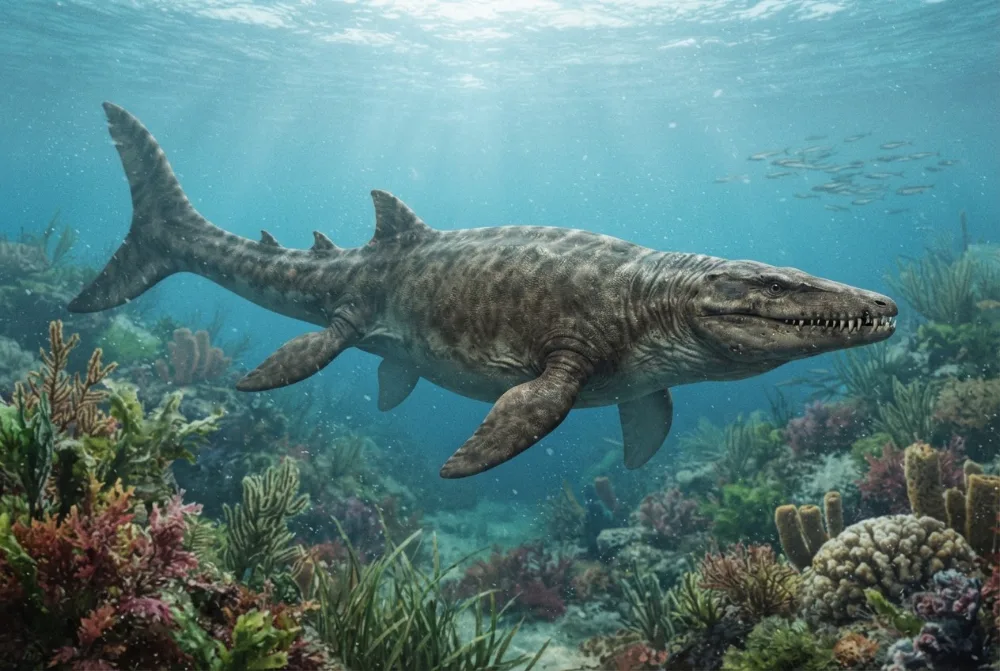
Compressidens was a small mosasaur, a marine lizard that lived in the sea during the time of the dinosaurs. It had special flat teeth for crushing hard-shelled animals like clams and sea urchins.12
When did it live?
How big was it?
How long was it?
How big was Compressidens compared to YOU?
Just maths in your browser. Nothing is saved or sent anywhere.
Fun facts
Compressidens is now called Carinodens, because the name Compressidens was already used for a different animal, a type of mollusk.1
It was one of the smallest mosasaurs, only about 2 to 2.6 metres (6.6 to 8.5 feet) long.1
Its teeth were flat and compressed from side to side, which is why it was named Compressidens, meaning 'compressed teeth'.1
Only the back five teeth were used for crushing food; the front teeth were small and pointed for grabbing prey.1
Fossils of Compressidens have been found in Europe, North America, South America, and North Africa.1
Scientists think it may have lived in deep water most of the time, only rarely coming into shallow seas.1

Ask Rex about Compressidens
Rex only answers questions about this page. 3 questions a day.
Rex is an AI and can make mistakes. He runs on servers in the EU and questions are never saved. Never type your name or other personal things.
For dino experts
- Scientific name
- Compressidens
- Named by
- Dollo 19242
- Group
- Mosasaurs
- Family / clade
- Mosasauridae2
- Classification
- Mosasauroidea2
- Age of the rocks
- 72 to 66 million years (Maastrichtian)2
- Rock formations
- Craie de Ciply2
- Countries
- Belgium2
- Fossil records
- 1 in the Paleobiology Database2
- Discovery
- The name Compressidens was given by Louis Dollo in 1924, but it was later changed to Carinodens in 1969 because the name was already taken.12
- Still debated
- Scientists are not sure what the upper jaw of Compressidens looked like, because no fossils of the upper jaw have been found.1
Where the facts come from
- Carinodens (en.wikipedia.org)
- Compressidens in The Paleobiology Database (CC BY 4.0): age, places, rock formations, classification.
Every fact on this page has a number that points to its source. If we got something wrong, sorry, we are dino fans, not a science journal. Tell us at [email protected] and we will fix it.
 Rex is hungry! Dino Wiki is a dad's project for his dino-loving son, free with no ads. Grown-ups can feed Rex a snack to help keep it online.Feed Rex
 Mosasaurus
 Prognathodon
 Tylosaurus
 Platecarpus
 Clidastes
 Globidens
 Tyrannosaurus
 Triceratops
 Velociraptor
 Spinosaurus
 Ankylosaurus
 Parasaurolophus