
Dianopachysaurus
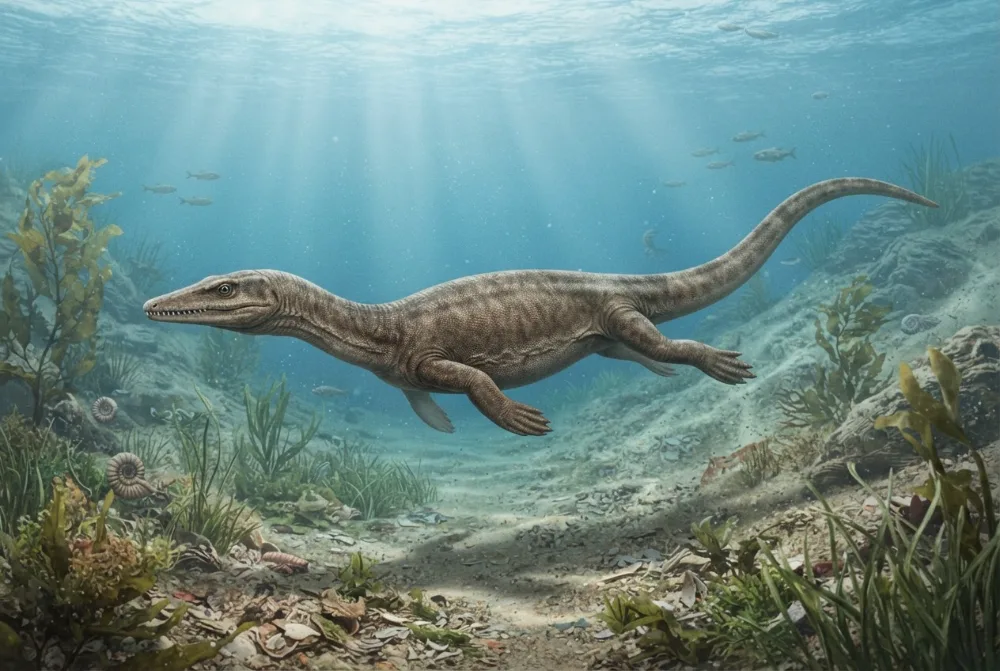
Dianopachysaurus was a tiny marine reptile that swam in warm seas about 245 million years ago. It looked a bit like a modern sea lizard but with a long tail and flippers. This little creature was only as long as a pencil!1
When did it live?
How big was it?
How big was Dianopachysaurus compared to YOU?
Just maths in your browser. Nothing is saved or sent anywhere.
Fun facts
Dianopachysaurus is a pachypleurosaur, a group of small marine reptiles that lived during the Triassic Period.1
Its closest relative is Keichousaurus, another Chinese pachypleurosaur. Both belong to the family Keichousauridae.1
The only fossil found so far is an almost complete skeleton, but the tip of the tail is missing.1
It had 20 neck vertebrae, 19 back vertebrae, 3 hip vertebrae, and at least 17 tail vertebrae.1
Dianopachysaurus lived in the eastern Tethys Ocean, which covered parts of what is now China.1
This reptile helps scientists understand how pachypleurosaurs spread from the eastern Tethys to Europe.1

Ask Rex about Dianopachysaurus
Rex only answers questions about this page. 3 questions a day.
Rex is an AI and can make mistakes. He runs on servers in the EU and questions are never saved. Never type your name or other personal things.
For dino experts
- Scientific name
- Dianopachysaurus
- Named by
- Liu et al. 20113
- Group
- Other sea reptiles
- Family / clade
- Keichousauridae3
- Classification
- Sauropterygia3
- Age of the rocks
- 244 to 243 million years ()3
- Rock formations
- Guanling3
- Countries
- China3
- Fossil records
- 1 in the Paleobiology Database3
- Discovery
- Dianopachysaurus was named in 2011 by a team of scientists led by Jun Liu. The only fossil was found in the Guanling Formation of Yunnan, China.1
- Still debated
- Scientists are not sure exactly how long the tail was, because the only known fossil is missing its tip.1
Where the facts come from
- Dianopachysaurus (en.wikipedia.org)
- PBDB Taxon (paleobiodb.org)
- Dianopachysaurus in The Paleobiology Database (CC BY 4.0): age, places, rock formations, classification.
Every fact on this page has a number that points to its source. If we got something wrong, sorry, we are dino fans, not a science journal. Tell us at [email protected] and we will fix it.
Rex is hungry! Dino Wiki is a dad's project for his dino-loving son, free with no ads. Grown-ups can feed Rex a snack to help keep it online.Feed Rex Nothosaurus
 Placodus
 Lariosaurus
 Cyamodus
 Cymatosaurus
 Proneusticosaurus
 Chonespondylus
 Cymbospondylus
 Phalarodon
 Mixosaurus
 Chaohusaurus
 Chensaurus