
Doliovertebra
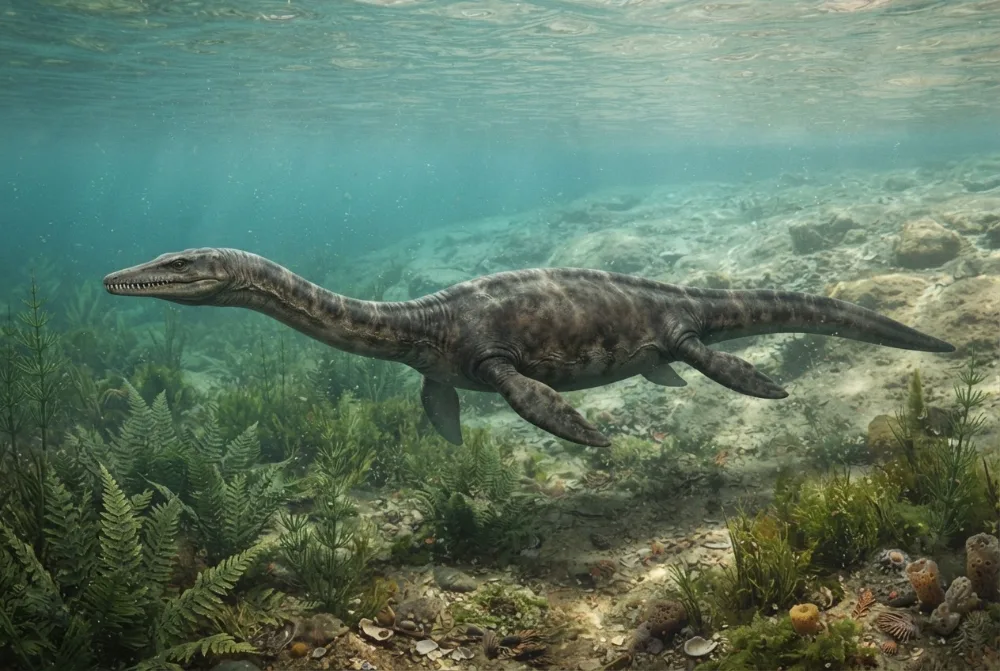
Doliovertebra was a small marine reptile that swam in the seas during the Triassic Period, about 247 to 241 million years ago. It was a sauropterygian, a group of ocean-dwelling reptiles, but it was not a dinosaur.2
When did it live?
How fast was it?
Fun facts
Doliovertebra lived in the Anisian age, which was about 247 to 241 million years ago, during the middle part of the Triassic Period.1
Its fossils were found in the Jena Formation in Germany, which was a marine environment at the time.1
The name Doliovertebra means 'barrel vertebra', which might refer to the shape of its backbone bones.2
Scientists think it was an actively moving animal that lived in the ocean, not on land.1
Doliovertebra is known from only one fossil site, making it a very rare find.1

Ask Rex about Doliovertebra
Rex only answers questions about this page. 10 questions a month.
Rex is an AI and can make mistakes. He runs on servers in the EU and questions are never saved. Never type your name or other personal things.
Myth buster
Myth: Doliovertebra was a dinosaur.
Truth: Doliovertebra was a marine reptile called a sauropterygian, not a dinosaur. Dinosaurs lived on land and had different body features.2
For dino experts
- Scientific name
- Doliovertebra
- Named by
- Huene 19022
- Group
- Sea reptiles
- Family / clade
- Pachypleurosauridae2
- Classification
- Sauropterygia2
- Age of the rocks
- 247 to 241 million years ()2
- Rock formations
- Jena2
- Countries
- Germany2
- Fossil records
- 1 in the Paleobiology Database2
- Discovery
- Doliovertebra was named by the scientist F. v. Huene in 1902. The first fossils were found at Freyburg an der Unstrut in Germany.2
- Still debated
- Scientists are not sure if Doliovertebra is a valid genus. Some researchers think it might be a nomen dubium, meaning the fossils are too incomplete to be certain about its identity.1
Where the facts come from
- PBDB Taxon (paleobiodb.org)
- Doliovertebra in The Paleobiology Database (CC BY 4.0): age, places, rock formations, classification.
Every fact on this page has a number that points to its source. If we got something wrong, sorry, we are dino fans, not a science journal. Tell us at [email protected] and we will fix it.
 Rex is hungry! Dino Wiki is a dad's project for his dino-loving son, free with no ads. Grown-ups can feed Rex a snack to help keep it online.Feed Rex
 Nothosaurus
 Placodus
 Lariosaurus
 Cyamodus
 Cymatosaurus
 Proneusticosaurus
 Chonespondylus
 Cymbospondylus
 Phalarodon
 Mixosaurus
 Chaohusaurus
 Chensaurus