
Dunhuangia
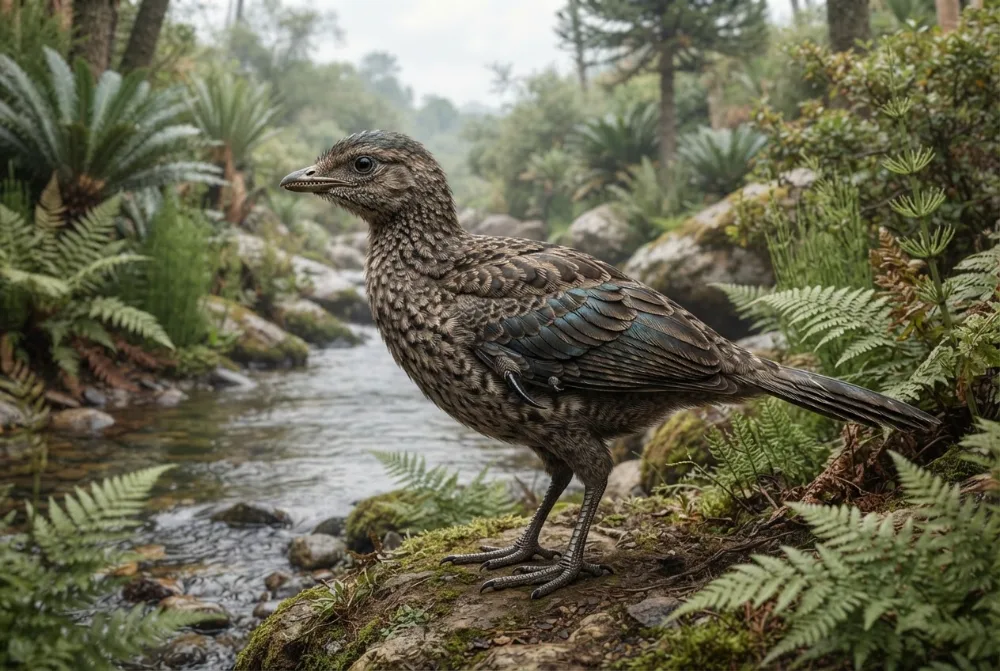
Dunhuangia was a bird that lived during the Early Cretaceous, about 121 to 113 million years ago. It was a medium-sized enantiornithine bird, a group that was very common during the time of dinosaurs. Dunhuangia had special bones in its chest that made it different from other birds.21
When did it live?
How fast was it?


Fun facts
Dunhuangia is only the second enantiornithine bird species ever named from the Changma Basin in China.1
Its fossil includes parts of the forelimbs, shoulder girdle, and breastbone, but the skull is missing.3
The end of its breastbone had a deep notch with two side projections, a feature that helps scientists tell it apart from other enantiornithine birds.1
Dunhuangia lived alongside many other animals, including fish, salamanders, turtles, and other birds like Gansus.1
The Changma Basin where Dunhuangia was found is one of the few places where more advanced ornithuromorph birds outnumbered enantiornithines like Dunhuangia.1
Scientists think Dunhuangia was a ground-dwelling bird that could fly actively.2

Ask Rex about Dunhuangia
Rex only answers questions about this page. 10 questions a month.
Rex is an AI and can make mistakes. He runs on servers in the EU and questions are never saved. Never type your name or other personal things.
For dino experts
- Scientific name
- Dunhuangia
- Named by
- Wang et al. 20154
- Group
- Early birds
- Family / clade
- Enantiornithes4
- Classification
- Theropoda > Avialae4
- Age of the rocks
- 121 to 113 million years (Aptian)4
- Rock formations
- Xiagou4
- Countries
- China4
- Fossil records
- 1 in the Paleobiology Database4
- Discovery
- Dunhuangia was named and described in 2015 by Wang Min, Li Daqing, Jingmai Kathleen O'Connor, Zhou Zhonghe, and You Hailu. The species name cuii honors Cui Guihai, who prepared many bird fossils from the Changma Basin.31
- Still debated
- Scientists are still debating whether the Changma avifauna represents a transitional stage in the dominance of ornithuromorph birds over enantiornithines like Dunhuangia.1
Where the facts come from
- Second species of enantiornithine bird from the Lower Cretaceous Changma Basin, northwestern China with implications for the taxonomic diversity of the Changma avifauna (sciencedirect.com)
- PBDB Taxon (paleobiodb.org)
- Dunhuangia (en.wikipedia.org)
- Dunhuangia in The Paleobiology Database (CC BY 4.0): age, places, rock formations, classification.
Every fact on this page has a number that points to its source. If we got something wrong, sorry, we are dino fans, not a science journal. Tell us at [email protected] and we will fix it.
 Rex is hungry! Dino Wiki is a dad's project for his dino-loving son, free with no ads. Grown-ups can feed Rex a snack to help keep it online.Feed Rex
 Archaeopteryx
 Hesperornis
 Ichthyornis
 Baptornis
 Jurapteryx
 Gobipteryx
 Stegosaurus
 Iguanodon
 Giganotosaurus
 Microraptor
 Deinonychus
 Baryonyx