
Eoenantiornis
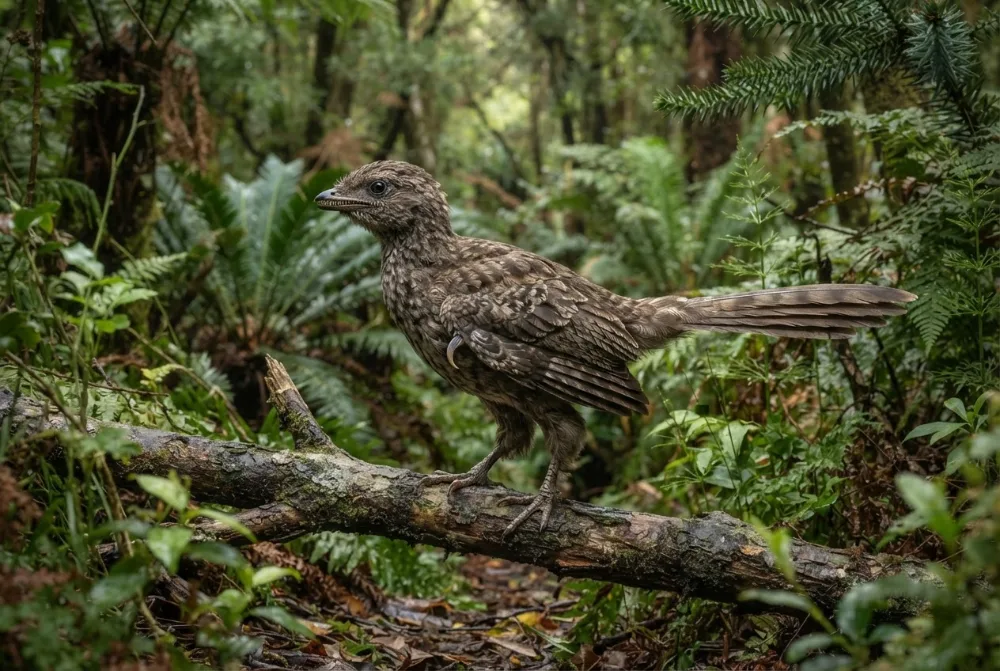
Eoenantiornis was a small, early bird that lived during the Early Cretaceous period, about 125 million years ago. It had teeth and a long bony tail, and its body was covered in feathers. This bird was a meat-eater that probably hunted insects and other small animals.13
When did it live?
How fast was it?


Fun facts
Eoenantiornis is one of the oldest known enantiornithine birds, a group often called 'opposite birds' because their shoulder joints were different from modern birds.1
The only known fossil of Eoenantiornis is a nearly complete skeleton with feather impressions, found in the Yixian Formation in China.12
This bird was not fully grown when it died, so scientists think it was a juvenile.1
Eoenantiornis lived during the Early Cretaceous, about 125 to 120 million years ago, in what is now Liaoning, China.32
The name Eoenantiornis means 'dawn Enantiornis', because scientists thought it was an early relative of the bird Enantiornis.1

Ask Rex about Eoenantiornis
Rex only answers questions about this page. 10 questions a month.
Rex is an AI and can make mistakes. He runs on servers in the EU and questions are never saved. Never type your name or other personal things.
For dino experts
- Scientific name
- Eoenantiornis
- Named by
- Hou et al. 19993
- Group
- Early birds
- Family / clade
- Enantiornithes3
- Classification
- Theropoda > Avialae3
- Age of the rocks
- 126 to 120 million years (Barremian / Aptian)3
- Rock formations
- Yixian3
- Countries
- China3
- Fossil records
- 1 in the Paleobiology Database3
- Discovery
- Eoenantiornis was named in 1999 by Hou Lianhu, Larry Martin, Zhou Zhonghe, and John Alan Feduccia. The only fossil, a nearly complete skeleton, was found at Heitizigou in Liaoning, China.13
- Still debated
- Scientists are still debating exactly where Eoenantiornis fits in the bird family tree, though it is generally placed among the enantiornithine birds.1
Where the facts come from
- Eoenantiornis (en.wikipedia.org)
- PBDB Taxon (paleobiodb.org)
- Eoenantiornis in The Paleobiology Database (CC BY 4.0): age, places, rock formations, classification.
Every fact on this page has a number that points to its source. If we got something wrong, sorry, we are dino fans, not a science journal. Tell us at [email protected] and we will fix it.
 Rex is hungry! Dino Wiki is a dad's project for his dino-loving son, free with no ads. Grown-ups can feed Rex a snack to help keep it online.Feed Rex
 Archaeopteryx
 Hesperornis
 Ichthyornis
 Baptornis
 Jurapteryx
 Gobipteryx
 Stegosaurus
 Iguanodon
 Giganotosaurus
 Microraptor
 Deinonychus
 Baryonyx