
Eonatator
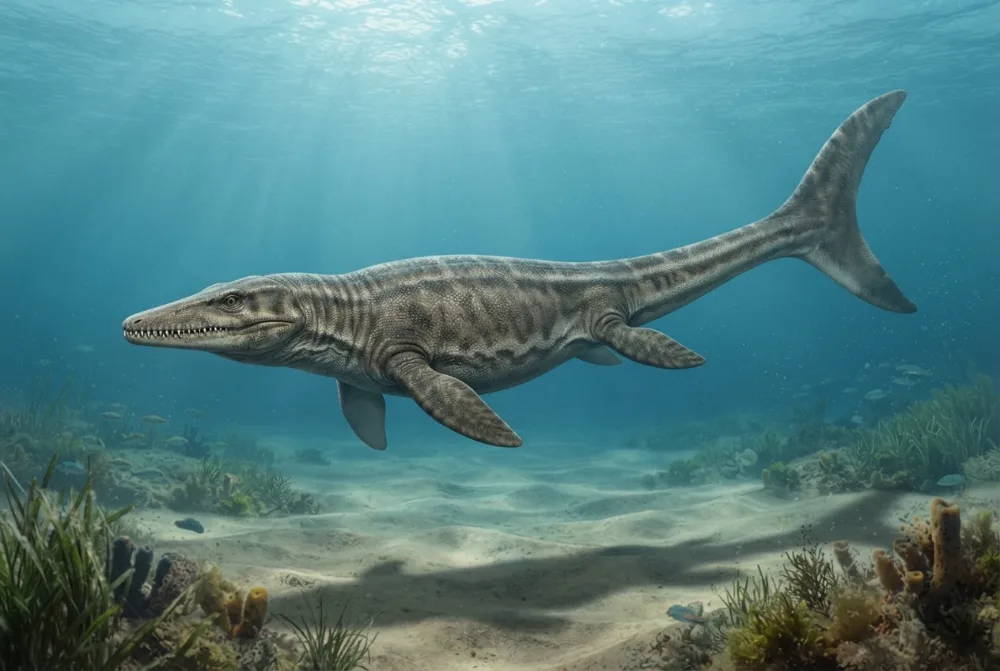
Eonatator was a small, speedy marine lizard that swam in warm Cretaceous seas. It was an early relative of the giant mosasaurs, but much smaller and more agile.1
When did it live?
How big was it?
How big was Eonatator compared to YOU?
Just maths in your browser. Nothing is saved or sent anywhere.
Fun facts
Eonatator's tail made up about 40% of its head and body length, helping it swim fast.1
The first Eonatator fossil was found in the Niobrara Chalk of Kansas in 1918 by Charles Hazelius Sternberg and his son Levi.1
Eonatator was originally thought to be a species of Clidastes or Halisaurus, but scientists gave it its own genus in 2005.1
A second species, Eonatator coellensis, was discovered in Colombia and named after the town of Coello.1
Eonatator had a smooth, triangular bone on top of its skull with a round hole called the parietal foramen.1
Like many mosasaurs, Eonatator gave birth to live young instead of laying eggs.2
Most asked questions about Eonatator
?How big was Eonatator?
Eonatator was a small mosasaur. The type specimen of Eonatator sternbergii was about 2.6 metres (8.5 ft) long, and a specimen of Eonatator coellensis measured 2.8 metres (9.2 ft) long as preserved, missing part of its tail.1
?What did Eonatator eat?
The sources do not say exactly what Eonatator ate. As a small marine lizard and a mosasaur, it likely ate fish and other small sea creatures, but no specific diet is given.1
?Where was Eonatator found?
Eonatator fossils have been found in North America (Kansas and Alabama), Colombia, and Sweden. The first fossil was discovered in the Niobrara Chalk of Kansas in 1918.1
?Is Eonatator a dinosaur?
No, Eonatator is not a dinosaur. It is a marine lizard belonging to the mosasaur family.1

Ask Rex about Eonatator
Rex only answers questions about this page. 3 questions a day.
Rex is an AI and can make mistakes. He runs on servers in the EU and questions are never saved. Never type your name or other personal things.
For dino experts
- Scientific name
- Eonatator
- Named by
- Bardet et al. 20053
- Group
- Mosasaurs
- Family / clade
- Mosasauridae3
- Classification
- Mosasauroidea3
- Age of the rocks
- 86 to 72 million years (Santonian / Campanian)3
- Rock formations
- Niobrara, Nivel de Lutitas y Arenas3
- Countries
- Sweden, USA, Colombia3
- Fossil records
- 9 in the Paleobiology Database3
- Discovery
- The first Eonatator fossil, a nearly complete skeleton, was found in Kansas in 1918 by Charles Hazelius Sternberg and his son Levi. It was named Eonatator sternbergii by Nathalie Bardet and colleagues in 2005.1
- Still debated
- Some scientists think Eonatator might actually belong to the genus Halisaurus, but most now accept it as a separate genus.1
Where the facts come from
- Eonatator (en.wikipedia.org)
- PBDB Taxon (paleobiodb.org)
- Eonatator in The Paleobiology Database (CC BY 4.0): age, places, rock formations, classification.
Every fact on this page has a number that points to its source. If we got something wrong, sorry, we are dino fans, not a science journal. Tell us at [email protected] and we will fix it.
Rex is hungry! Dino Wiki is a dad's project for his dino-loving son, free with no ads. Grown-ups can feed Rex a snack to help keep it online.Feed Rex Mosasaurus
 Prognathodon
 Tylosaurus
 Platecarpus
 Clidastes
 Globidens
 Triceratops
 Velociraptor
 Spinosaurus
 Ankylosaurus
 Parasaurolophus