
Europejara
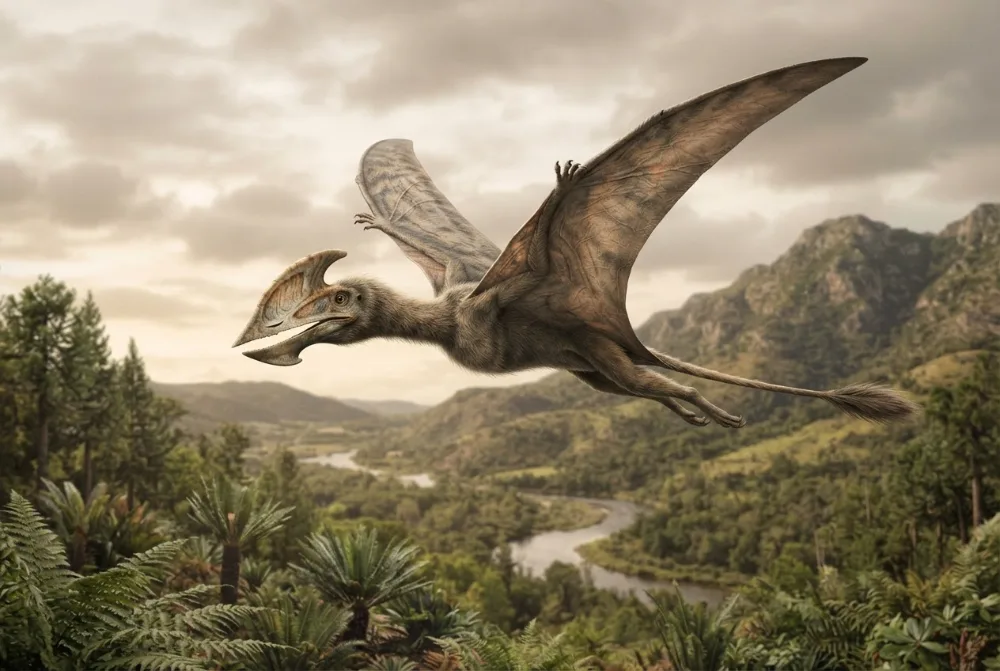
Europejara was a flying reptile with a big, bony crest on its chin that curved backwards. It lived in what is now Spain during the Early Cretaceous, about 130 to 125 million years ago. This pterosaur had no teeth and probably ate fruits and seeds.21
When did it live?
How big was it?
How wide were its wings?
 wings as wide as 2 bicycles in a row⚽could fly across a whole football pitch in 6 seconds
How big was Europejara compared to YOU?
Just maths in your browser. Nothing is saved or sent anywhere.
How fast was it?


Fun facts
Europejara is the oldest known toothless pterosaur, meaning it had no teeth at all.2
It was the first tapejarid pterosaur ever found in Europe. Before that, tapejarids were only known from China and Brazil.2
Europejara had a strange crest on its lower jaw that curved backwards, which is different from other tapejarids.2
Its wingspan was about 2 to 4 metres (6.6 to 13.1 feet), making it a medium-sized pterosaur.1
The only fossil found is a crushed skull and lower jaw, preserved in fine limestone from an ancient lake.2
Scientists think Europejara may have helped spread early flowering plants by eating their fruits and pooping out the seeds.2
Most asked questions about Europejara
?How big was Europejara?
It was a small to medium sized pterosaur. Its wingspan was about 2 to 4 metres (6.6 to 13.1 feet).1
?Did Europejara have teeth?
No, it had no teeth. It was the oldest known toothless pterosaur when it was discovered.12

Ask Rex about Europejara
Rex only answers questions about this page. 10 questions a month.
Rex is an AI and can make mistakes. He runs on servers in the EU and questions are never saved. Never type your name or other personal things.
For dino experts
- Scientific name
- Europejara
- Named by
- Vullo et al. 20123
- Group
- Flying reptiles
- Family / clade
- Azhdarchoidea3
- Classification
- Pterosauria > Pterodactyloidea3
- Age of the rocks
- 126 to 121 million years (Barremian)3
- Rock formations
- La Huérguina3
- Countries
- Spain3
- Fossil records
- 1 in the Paleobiology Database3
- Discovery
- Europejara was named in 2012 by Romain Vullo and colleagues based on a skull found at Las Hoyas in Spain. The name means 'Europe's old being' and honors the ancient Olcades people.13
- Still debated
- Scientists are not sure if Europejara was a fruit-eater or an omnivore that also ate insects and small animals. The evidence from its beak shape is not enough to be certain.2
Where the facts come from
- Europejara (en.wikipedia.org)
- A New Crested Pterosaur from the Early Cretaceous of Spain: The First European Tapejarid (Pterodactyloidea: Azhdarchoidea) | PLOS One (journals.plos.org)
- Europejara in The Paleobiology Database (CC BY 4.0): age, places, rock formations, classification.
Every fact on this page has a number that points to its source. If we got something wrong, sorry, we are dino fans, not a science journal. Tell us at [email protected] and we will fix it.
 Rex is hungry! Dino Wiki is a dad's project for his dino-loving son, free with no ads. Grown-ups can feed Rex a snack to help keep it online.Feed Rex
 Pteranodon
 Quetzalcoatlus
 Dorygnathus
 Rhamphorhynchus
 Anhanguera
 Pterodactylus
 Stegosaurus
 Iguanodon
 Archaeopteryx
 Giganotosaurus
 Microraptor
 Deinonychus