
Fortipesavis
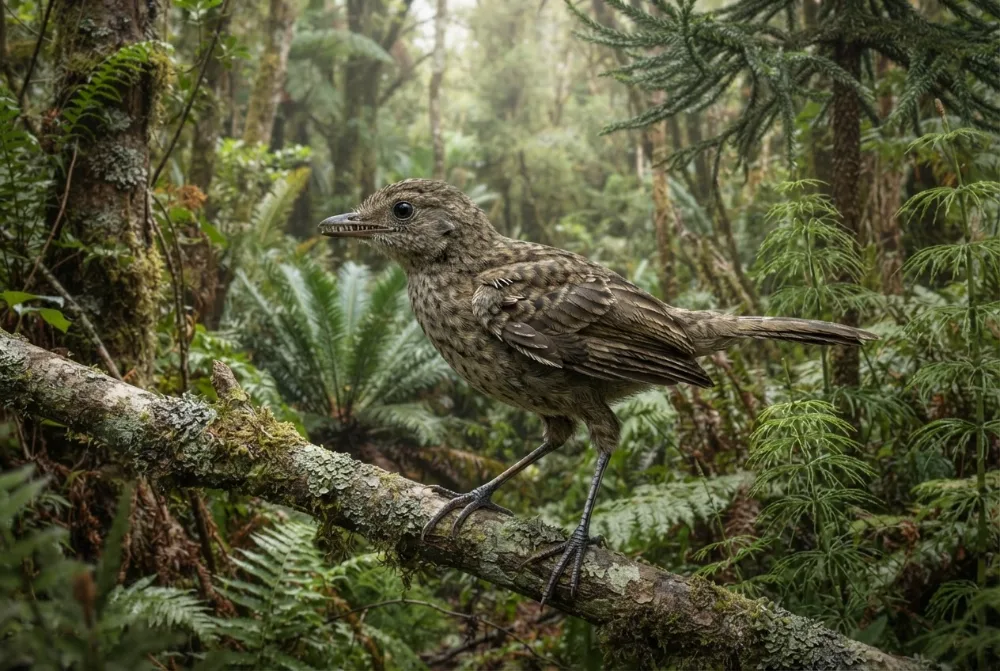
Fortipesavis was a tiny bird that lived about 98 million years ago. It had a very strong and wide fourth toe, which helped it grip onto thin, wobbly branches like a kingfisher. Its foot was so unusual that scientists named it the 'strong-footed bird'.12
When did it live?
Fun facts
Fortipesavis is known only from a partial left foot preserved in amber, which is a piece of fossilized tree resin.1
Its fourth toe was almost twice as wide as its second toe, a feature not seen in any other bird, living or extinct.12
The foot of Fortipesavis had thick, padded toes with deep grooves between them, which helped it grip tightly onto branches.2
This bird lived in a mangrove forest environment, where it probably perched on thin, swaying branches while hunting for insects.12
The fossil of Fortipesavis was found in a piece of amber that weighs only 2.68 grams and is about the size of a large coin.1
Scientists used micro-CT scanning to study the foot inside the amber without damaging the fossil.1

Ask Rex about Fortipesavis
Rex only answers questions about this page. 3 questions a day.
Rex is an AI and can make mistakes. He runs on servers in the EU and questions are never saved. Never type your name or other personal things.
For dino experts
- Scientific name
- Fortipesavis
- Named by
- Clark and O’Connor 20214
- Group
- Early birds
- Family / clade
- Enantiornithes4
- Classification
- Theropoda > Avialae4
- Age of the rocks
- 100 to 94 million years (Cenomanian)4
- Countries
- Myanmar4
- Fossil records
- 1 in the Paleobiology Database4
- Discovery
- Fortipesavis was named in 2021 by Alexander Clark and Jingmai O'Connor based on a foot preserved in amber from Myanmar. The fossil was first described in 2019 by Lida Xing and colleagues.13
- Still debated
- Scientists are not sure whether Fortipesavis ate insects or fish, because its foot is similar to both modern kingfishers (which eat fish) and bee-eaters (which eat insects).2
Where the facts come from
- Fortipesavis (en.wikipedia.org)
- Frontiers | Exploring the Ecomorphology of Two Cretaceous Enantiornithines With Unique Pedal Morphology (frontiersin.org)
- PBDB Taxon (paleobiodb.org)
- Fortipesavis in The Paleobiology Database (CC BY 4.0): age, places, rock formations, classification.
Every fact on this page has a number that points to its source. If we got something wrong, sorry, we are dino fans, not a science journal. Tell us at [email protected] and we will fix it.
 Rex is hungry! Dino Wiki is a dad's project for his dino-loving son, free with no ads. Grown-ups can feed Rex a snack to help keep it online.Feed Rex
 Archaeopteryx
 Hesperornis
 Ichthyornis
 Baptornis
 Jurapteryx
 Gobipteryx
 Tyrannosaurus
 Triceratops
 Velociraptor
 Spinosaurus
 Ankylosaurus
 Parasaurolophus