When did it live?

How big was it?
How big was Halszkaraptor compared to YOU?
Just maths in your browser. Nothing is saved or sent anywhere.
Fun facts
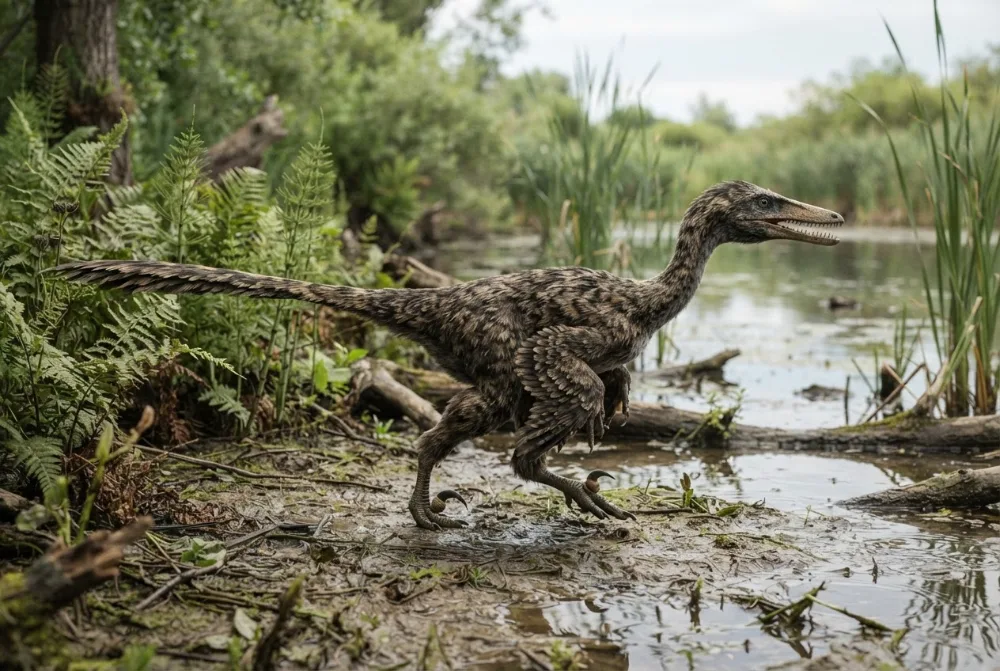
Halszkaraptor had a very long neck for a dinosaur, about 20 cm (7.9 in) long, which is almost half its total body length.1
Its front limbs were short and flipper-like, which scientists think it may have used to paddle in water.1
The snout had many tiny holes that might have held sensors to detect vibrations in water, like a crocodile.1
The only known fossil was smuggled out of Mongolia and later returned after scientists proved it was real using a powerful X-ray scanner.1
It lived about 75 million years ago, during the Late Cretaceous period.1
Some scientists think Halszkaraptor was an insectivore that hunted small bugs in murky water or at night, because its eyes were large.1
Most asked questions about Halszkaraptor
?Was Halszkaraptor a dinosaur?
Yes, Halszkaraptor was a small, duck-sized dromaeosaurid dinosaur from the Late Cretaceous.1
?How big was Halszkaraptor?
About the size of a mallard duck. Its head was 7 cm long and its neck was 20 cm long.1
?Could Halszkaraptor swim?
Some scientists think it could swim using flipper-like forelimbs and a long neck, but others disagree because its bones were not dense enough.12
?What did Halszkaraptor eat?
It likely ate small fish or insects. Its sharp, backward-curving teeth and snout sensors helped it catch prey in water.13
?Why did Halszkaraptor have a long neck?
Its long, swan-like neck helped it strike at prey in the water, similar to how herons hunt today.13
?When did Halszkaraptor live?
It lived about 75 million years ago, during the Late Cretaceous period.1

Ask Rex about Halszkaraptor
Rex only answers questions about this page. 3 questions a day.
Rex is an AI and can make mistakes. He runs on servers in the EU and questions are never saved. Never type your name or other personal things.
Myth buster
Myth: Halszkaraptor was a fully aquatic dinosaur like a dolphin.
Truth: Scientists debate whether it was semi-aquatic. It had some adaptations for water, like a long neck and flipper-like arms, but also strong legs for running on land. It likely spent time both in water and on land.1
For dino experts
- Scientific name
- Halszkaraptor
- Named by
- Cau et al. 20174
- Group
- Raptors
- Family / clade
- Dromaeosauridae4
- Classification
- Theropoda > Dromaeosauridae4
- Age of the rocks
- 84 to 72 million years (Campanian)4
- Rock formations
- Djadokhta4
- Countries
- Mongolia4
- Fossil records
- 1 in the Paleobiology Database4
- Discovery
- The fossil was found by poachers in Mongolia before 2011, then bought by a dealer who showed it to scientists in 2015. It was named Halszkaraptor escuilliei in 2017 by Andrea Cau and colleagues.1
- Still debated
- Scientists are still debating whether Halszkaraptor was truly semi-aquatic or mainly lived on land and ate insects.1
Where the facts come from
- Halszkaraptor (en.wikipedia.org)
- Synchrotron scanning reveals amphibious ecomorphology in a new clade of bird-like dinosaurs | Nature (nature.com)
- Duck-Like Dinosaur Is Among Oddest Fossils Yet Found | National Geographic (nationalgeographic.com)
- Halszkaraptor in The Paleobiology Database (CC BY 4.0): age, places, rock formations, classification.
Every fact on this page has a number that points to its source. If we got something wrong, sorry, we are dino fans, not a science journal. Tell us at [email protected] and we will fix it.
Rex is hungry! Dino Wiki is a dad's project for his dino-loving son, free with no ads. Grown-ups can feed Rex a snack to help keep it online.Feed Rex Velociraptor
 Microraptor
 Deinonychus
 Asiamericana
 Richardoestesia
 Saurornitholestes
 Triceratops
 Spinosaurus
 Ankylosaurus
 Parasaurolophus
 Pteranodon